Trouble every day

Even NPR is running ’em out the door now. John McChesney and Ketzel Levine are among the 7 percent of staff to be unplugged, along with the shows “Day to Day” and “News and Notes,” as the public broadcaster tries to erase a projected budget shortfall of $23 million for this fiscal year.

“Companywide, NPR is laying off 64 people and eliminating 21 other positions that are currently vacant,” writes David Folkenflik.

The culprit, says NPR? Same sumbitch that nailed the rest of us in the wallet pocket — the Wall Street meltdown, which croaked interest payments from an endowment created from the bequest of the late Joan Kroc, which has typically paid NPR about $10 million a year.

Like the man said, a million here, a million there, and pretty soon you’re talking about real money.

Late update: That would be a billion here, etc., as Bruce has reminded me. Everett Dirksen. They told me that stuff would damage my brain, but did I listen? Nooooo.

Later update: Almost forgot to wish a happy birthday to one of my favorite authors, poet and novelist Jim Harrison. I was reminded by Garrison Keillor’s “Writer’s Almanac” on NPR. Harrison mentions NPR now and again in his latest novel, “The English Major,” which the critics love more than I do. But then what the hell do I know? I met Harrison once, briefly, following a reading at The Colorado College, and asked him to sign a copy of “Warlock.” He complied, somewhat grouchily, I thought; later I discovered he hated that novel, which he apparently whipped out at speed for money. I loved it. It seems unlikely that I will be invited to visit Montana for a week of fly-fishing with Harrison and Thomas McGuane anytime soon.
Write on!

In The New Republic, Mark Pinsky calls for the resurrection of the Federal Writers Project as a bailout for laid-off journalists, a less-than-exclusive club to which he belongs:

Gifted FWP alumni who went on to distinguished literary careers in literature include John Steinbeck, John Cheever, Nelson Algren, Saul Bellow, and African-Americans Zora Neale Hurston, Ralph Ellison, and Richard Wright. The recent death of Studs Terkel — a FWP veteran who went on to use the skills he developed in the program to chronicle the working- and middle-classes on his long-running radio show and in his Pulitzer Prize-winning books — is a reminder of how valuable this kind of experience can be. Ellison used his FWP research in “Invisible Man,” and Steinbeck and John Gunther relied on the FWP state guides for “Travels With Charley: In Search of America” and “Inside U.S.A.,” respectively.

Count me in. I haven’t been laid off — yet — but I feel that should worse come to worst, I’m ready, willing and able to contribute to some compilation of cheap jokes at other people’s expense. It’s either that or move to Montana to become a dental-floss tycoon.

Memoirs of a Zappatista (cont.)

Funny, yeah? Not to Frank Zappa it wasn't.

Another encounter with FZ, this time as a Sears-poncho faux hippie slouching down Tejon Street in scenic downtown Bibleburg. Head shops were everywhere in the Seventies, even here. Tejon also served as home to an office of the John Birch Society, two or three dirty bookstores and a clean one, Dick and Judy Noyes’ Chinook, felled some years back by Amazon.com. One dirty bookstore survives, which tells you much of what you need to know about this place.

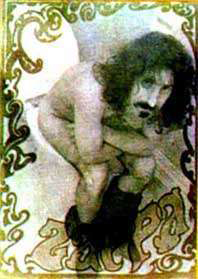
But as I said, I was slouching down Tejon and in the window of this head shop I saw a poster that stopped me in my tracks — the now-legendary Phi Zappa Krappa poster, depicting FZ squatting on a toilet. I was eagerly doing my lame-o best to offend as many people as possible through cartoons like “For Sure God Gets High” and “The Adventures of Loadedman,” and so found it delightful.

But FZ apparently found it less so, according to Kill Ugly Radio. The picture was originally intended to illustrate a British magazine article and promote The Mothers’ first concert in 1967, but took on a life of its own as a widely bootlegged poster from which FZ derived no royalties, though he did authorize at least one version, according to a 1975 story written by Steve Weitzman:

“Well, I don’t see anything wrong about sitting on a toilet and having your picture taken, but when somebody takes that picture and uses it to make money on your name. … Then you compound that with the public’s attitude toward excretory processes pictured in a poster like that … more people knew me for that poster than for my music. I said, ‘Well, that’s not fair.’ So I said, ‘I’m either going to do something drastic about it or just let it go’ and I figured, ‘Well, kiss it off.’ You can’t really change the public’s attitude about that.”

Ironic that FZ himself was probably the person most offended by that poster, no?

Watch out where the huskies go

And don't you eat that yellow snow.

Dreamed I was an Eskimo

Frozen wind began to blow

Under my boots ‘n’ around my toe

Frost had bit the ground below

Was a hundred degrees below zero

And my momma cried: Boo-a-hoo hoo-ooo.

Well, OK, it’s not a hundred below. I’m not an Eskimo. And my momma’s dead. But it is chilly, and the white stuff is coming down, and by morning I’ll bet you a pancake breakfast at St. Alphonzo’s that the deadly yellow snow will be lying about the joint in abundance come morning.

What kind of a guru are you, anyway?

http://www.youtube.com/v/Mm9RqatOby0

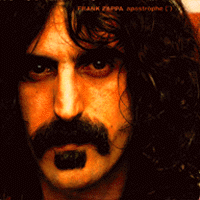
Back to college, 1974, and this time it was “Apostrophe” on the turntable (“Now is that a real poncho or is that a Sears poncho?”). We were the Sears-poncho type, I fear. But it was fun, anyway, even without the crystal ball and the oil of Aphrodite, because we had more than enough of the dust of the Grand Wazoo.

Meanwhile, if you want to know who’s wearing the Real Poncho, check out these folks, a bunch of Chicago workers who got laid off, but refused to fade away. Too bad The Newspaper Guild never had the stones these folks do. A couple thousand Gannett folks might still be on the job.