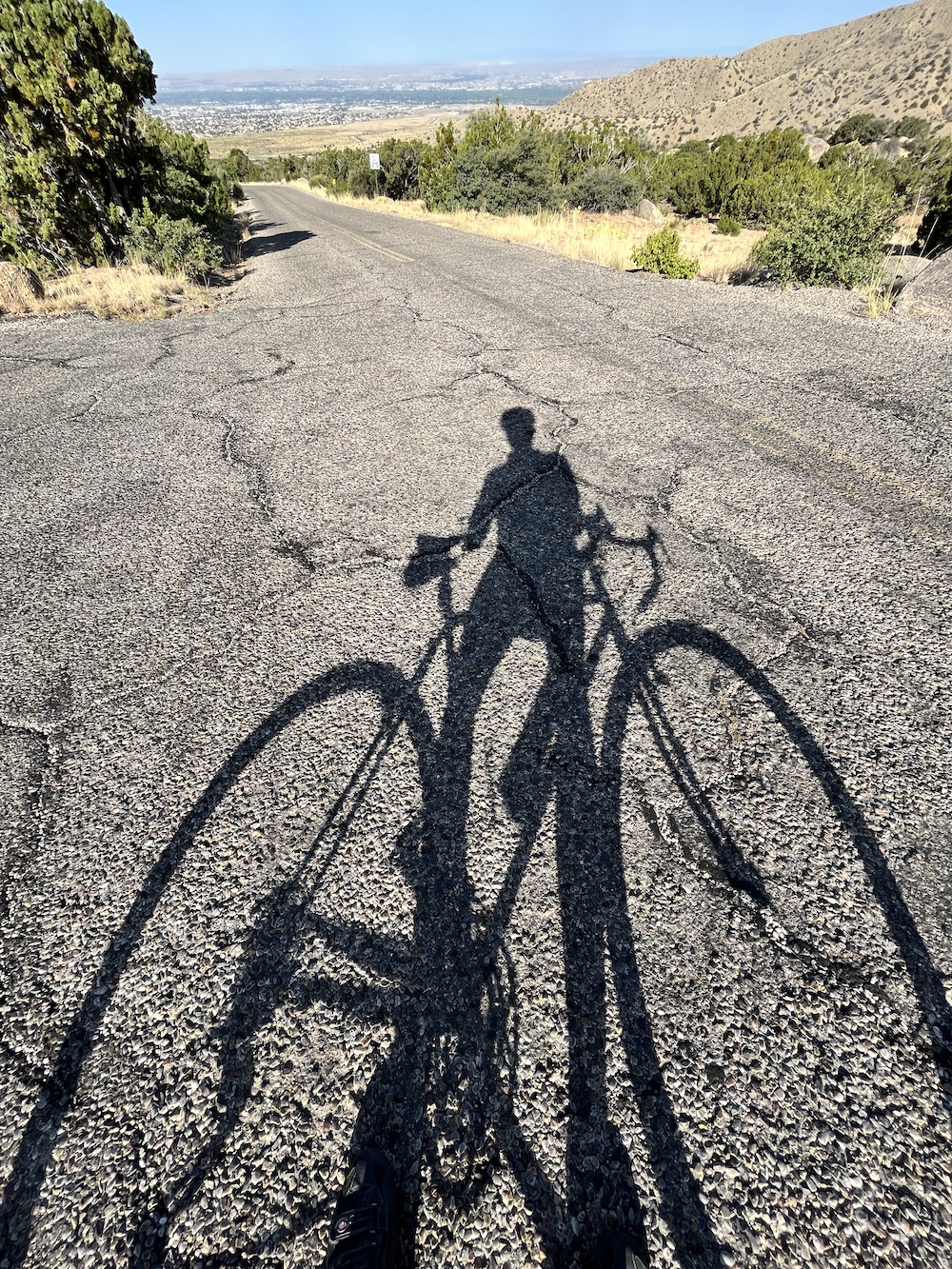
Herself and I were enjoying the usual weekly quail-spotting ride through High Desert and Sandia Heights yesterday when another cyclist caught up to us and we began chatting, as cyclists do.
It being The Duck! City, we found ourselves collecting one of those odd tales that seem to be included in every random encounter with a stranger.
After discussing the beautiful almost-fall weather, other places we had lived, and the critters we had seen, our new riding buddy told us about a neighbor who objected strenuously to hikers tramping along the arroyo that snakes along behind their houses.
So much so, he said, that one day she hid in the scrub with a Louisville Slugger and took a little vigorous batting practice on one of them.
Now, I’ve ridden this arroyo a time or two, or one very much like it in the general vicinity, and I’ve never seen any signs, placards, fencing, or other indication that it was private property. Which I don’t believe it is.
Nonetheless, I told him I’d keep my eyes peeled henceforth.
“Watch out for an old bat with a bat,” he advised.
You won’t know the name, unless you worked with him or read him at the Los Angeles Times, the Colorado Springs Sun, the Gazette Telegraph, The Denver Post, or the Jackson Hole News, or studied under him at the University of Wyoming in Laramie.
But George stands tall in my personal history. He was one of the people who showed me by word and deed that there was a place in the newspaper game even for those of us who were a bubble or two off plumb.
When I got hired as a copy boy at the Colorado Springs Sun I was at loose ends following a brief tour of the dead-end gigs available to a dropout from a third-rate college. George was the police reporter, as I recall, and came to the Sun from the L.A. paper.
Back in 1974 the newsroom was stiff with talent, the best possible haven for a wannabe cartoonist shambling out of his teens into nowhere special if he didn’t pull his hairy head out of his hippie arse.
Bill Woestendiek and his wife, Kay, ran the outfit, sister paper to the Las Vegas Sun in Sin City. Carl Miller, who would move on to helm The Denver Post, was city editor. Bill Buzenberg, who would rise to veep of news at National Public Radio, was his assistant and an investigative reporter.
Bill McBean, another reporter, would abandon his typewriter for a paper route, claiming afterward that he made more money from delivering the Sun than he ever did writing for it. That didn’t last; he eventually got back on the scribbler’s horse in Denver, at the Post.
I was an actual scribbler; a cartoonist, or so I thought. But an adviser at Adams State College had told me just how few full-time, paid editorial cartoonists there were in the country and suggested that I cast a wider loop, maybe consider taking a reporter’s job as my entrée, a foot in the door.
Well, there I was, with both feet in and my dumb ass for company. Not a reporter; just a copy boy. And I didn’t even have the chops for that. When Carl handed me a stack of press releases to rewrite I told him I didn’t know how to type.
“Better learn,” he replied. And I did, whenever I wasn’t stripping and sorting copy from the wire-service teletypes, running copy and art to and from composing and engraving, and doing other scutwork so real journalists didn’t have to.
I learned something from all these people, starting with typing, thanks to Carl, who also passed on some firm hints about how to write for newspapers. Bill Buzenberg let me tag along and watch him interview hookers for a piece on the massage parlors infesting Bibleburg. The Woestendieks let me sit in on the copy desk on slow nights, learning how to fit copy, size art, and write heds.
George and Bill McBean took me out for drinks, told me war stories, had me over to their houses for dinner, introduced me to their wives; I soaked up their experience like a bar rag and felt as though I had become part of a family.
When I left the Sun to go back to school, this time at the University of Northern Colorado, George told me he hoped I’d come back as a reporter. And I did. But not to the Sun — to the Gazette, the bigger of the two papers in town. Because George was there, this time on the city desk.
He helped me sneak in the back door as a contractor — a little glimpse of the future there, yeah? I compiled the annual industrial edition, drew a few cartoons, and even wrote a couple of stories before getting hired in early 1978 as a for-reals general-assignment reporter at $155 a week.
And that’s where the rubber met the road. As George’s obit notes, he was “a meticulous editor and dedicated teacher.” He was not above crumpling up your copy and tossing it back to you. (We were still working on typewriters in 1978, and other people in the newsroom could actually see it when an editor threw your copy back at you.)
After a few rounds of journalism badminton George would call me over and explain in detail, citing irrefutable examples, precisely why I was a toothless cog in the Gazette‘s well-oiled machinery. Sometimes he and his opposite number Joe Barber would tag-team me. This could be like getting tossed around the ring by Mad Dog and Butcher Vachon.
It was the school of hard knocks, for sure. But man, if you don’t get kayoed, you learn how to roll with the punches and throw a few of your own. As Carl had told me once at the Sun, “We can teach you more about newspapering in a year than you’ll learn in four at college.”
But Carl also insisted I go back to college. Once again, good advice at the precise moment it was needed. Because without that journalism degree I would not have been able to stay and learn at the Sun, or follow George to the Gazette, where I learned even more, in the company of comrades from other schools, other papers.
Sadly, I suspect Carl’s advice is no longer relevant. Back in the early Seventies, at the minor-metro papers that hired me, editors like Carl and George could spend some time breaking in the noobs. An assistant city editor would call you over to demand an act of contrition for some sin of commission or omission. A copy editor might have some thoughts about condensation and clarification. A typesetter could catch an error that had eluded everyone else and that observation would find its way back to you like a bad check.
If the error slipped past the typesetter, the page proofer, and the press check, and actually made it into print, the managing editor might want a word. This would be truly educational. Envision a very angry principal, swinging a larger “board of education.”
Even George made a few mistakes, and like good students we did too. (Actually, we did not require coaching in making these kinds of mistakes, but we were finally getting paid, and could afford to make bigger and better ones.)
This was why the list of phone numbers taped to a drawer at the city desk listed as many taverns, titty bars, alehouses, grog shops, gin mills, cantinas, and buckets o’ blood as it did home numbers. In extreme cases some expenditure of shoe leather was required, but by then we were seasoned reporters, kinda, sorta, and dogged in the pursuit of The Story, or whoever was supposed to write or edit it.
After a few years we all moved on to other opportunities, because in the newspaper game this is how you get a raise or a better job, or at least a different one. If you’re inclined to keep making some of the old mistakes or maybe acquire a few new ones, it’s also how you get a fresh nest to shit in.
George suggested I start keeping a journal, and Lord, have I ever kept ’em.
George eventually left the newsroom entirely and settled down in academia, where he could continue gently and relentlessly squeezing the dumbass out of young eejits afflicted with delusions of grandeur.
One of his students recalls: “I learned so much from that man that I still find myself quoting him and referring to him as someone who influenced my life in important and meaningful ways.”
Me too. And you as well. You probably never read George Gladney, or worked with him, or studied under him. But if you’re reading this, you are under his influence.
Because it was George who told me back in 1974 that I should start keeping a journal. And that’s just another word for “blog.”
We just got that much rain between coffee and oatmeal. It sounded like the Bad Old Days, when I lived next to the railroad tracks in a series of shacks. That train just kept on thundering along.
We’d gotten just under 3 inches all year long until this morning.
I’ma go out on a very soggy limb and speculate that this may be a poor morning for the ol’ bikey ridey.
Probably be a good day to swim laps around the house, though.
The 2021 iPhone 13 Mini. Cute little kitty-cat not included.
Anyone queuing up for the new Apple gadgets this morning?
Me neither.
I have this fine 2021 iPhone 13 Mini here, which I had to snap with the 2016 iPad Pro, since I no longer have any actual cameras in the vicinity.
The iPad is practically useless — I was pinching pennies when I bought it and went for the 32GB of storage, which is of course full to overflowing despite my ruthless purging of apps, data, pix, music, etc.
It still works, but to no particular purpose, like the U.S. House of Reprehensibles, and I don’t expect to ever buy another.
Remember, kids: You can never be too rich or too thin, or have too much storage and memory.
Speaking of things that don’t work as they should, no further intel from WordPress. WP was good enough to send me a note proposing that I upgrade to their Business plan to “unlock a set of amazing features,” among them “live chat support for on-demand help from our global team of Happiness Engineers.”
This, like a new iPad — and commenting on the blog without having to buy a postcard, slap a stamp on it, and hand it over to the U.S. Mail — is another non-starter.


 Mad Blog Media