R.I.P., Laurence Malone

The details remain elusive, but it seems that five-time U.S. national cyclocross champ Laurence Malone died Monday in an automobile crash near Lancaster, Calif.

Laurence was the real deal. When he turned up in New Mexico back in 1990 or thereabouts he’d pin on a number and go round and round with the little people. But he never went Hollywood on us. He would race in the most outdated, anonymous gear you ever saw, and beat your ass with it, too. Sold lentil burritos, which he delivered by bike.

I knew him to say hi to, but that’s about it. Herself and I gave him a lift to a race once. Another time I saw him ride a sketchy, sandy descent to the pit with his spare bike slung across one shoulder like a messenger bag, and I thought: “Man. I want to learn how to do that.”

And I had the privilege of finishing second to him in the 1991 state road championships outside Albuquerque.

Laurence was good. I was lucky. I was actually riding OK for a change, and Laurence and I had both made it into the break coming into the finish of the masters-35 race. Everybody in there was better than me, so I thought I’d launch one of my patented, doomed, last-kilo’ attacks on Sedillo Hill, go down in a blaze of glory.

But it was everyone else who went down. Well, almost everyone. Cliff Loucks and Rick Quant got tangled up somehow, taking out Tim Schoeny, Neil Davie, and Louis Abruzzo, as the contenders jockeyed for position in what should have been quite a sprint.

I heard the clatter, looked around, and the only dude still with me was … Laurence Malone.

“Shit,” sez I.

And that, as they say, was that.

I should’ve been seventh at best, but instead I got to finish on the podium with Laurence fuckin’ Malone. I’ll remember it until the day we meet again on the Other Side. If I can catch him, that is.

Peace to Laurence, his family, friends, and fans. He left us way too soon.

Adios, Larry McMurtry

My Larry McMurtry collection falls far short of his actual output.

Larry McMurtry has loaded up his last rented Lincoln Continental and rolled west, into the sunset.

I didn’t come close to reading his entire output, but I managed more than a few of his novels; it’s a habit I have, working my way steadily through an author’s collected works.

Got started with “The Last Picture Show,” as I recall, after seeing the movie of the same name. Finished with “Duane’s Depressed.”

And is there anyone who didn’t read “Lonesome Dove?” As Skip Hollandsworth writes in his remembrance of McMurtry at Texas Monthly:

McMurtry had spent years railing against writers who produced clichéd novels about the Old West. He swore he would never stoop to writing a western. But he did, and the novel he produced gripped the public’s imagination. “Lonesome Dove” won the Pulitzer Prize and sold nearly 300,000 copies in hardcover and more than a million copies in paperback. It spawned a sequel as well as prequels, and became one of the most popular miniseries of all time, starring Tommy Lee Jones and Robert Duvall. To Texans, went one joke, “Lonesome Dove” was the third-most-important book in publishing history, right behind the Bible and the Warren Commission Report.

Like Stephen King, McMurtry was too preposterously prolific for some critics. Also like King, he wasn’t always winning Pulitzers for his work.

But he buckled down and got to ’er anyway. As his writing partner Diana Ossana told Hollandsworth: “Larry is like an old cowboy who has to get up in the morning and do some chores. He has to get up and write.”

Not anymore, he doesn’t. He can pull off the boots, put up his feet, and enjoy a well-deserved rest.

R.I.P., Tony Hendra

“It is the job of a satirist to make people in power uncomfortable. Really uncomfortable.”

That was Tony Hendra, and he knew whereof he spoke. Hendra, who died of Lou Gehrig’s disease on Thursday, helped make a lot of people very uncomfortable indeed with his work for National Lampoon and Spy magazine, among others.

Had it not been for the trailblazing Lampoon some of us would have laughed a great deal less over the past half century. The magazine had a nut-crushing stable of funnymen, among them Hendra himself. And its “Radio Dinner,” “The National Lampoon Radio Hour,” and “Lemmings” led directly to “Saturday Night Live,” “Animal House,” “This Is Spinal Tap,” and the “Vacation” movie franchise.

Hendra’s “Magical Misery Tour” was a brutal takedown of John Lennon using Lennon’s own words from an interview in Rolling Stone. I bet John wasn’t laughing when he heard that one.

Hendra may not be as familiar to you as Chevy Chase, John Belushi, P.J. O’Rourke, or Christopher Guest. But he was right in there among them, one of the ha-ha mechanics throwing shit, just to see what might stick, and to what, or whom. Making people in power uncomfortable. Really uncomfortable.

One of his last smiles before the disease took those from him came when he learned the results of the last presidential election, said his wife, Carla.

“He was an immigrant who sailed from London into N.Y. Harbor on the SS United States after being given free passage in exchange for performing stand-up,” she told The New York Times. “What was to be a two-week visit became 57 years, because he believed in the promise of America.”

R.I.P., Lawrence Ferlinghetti

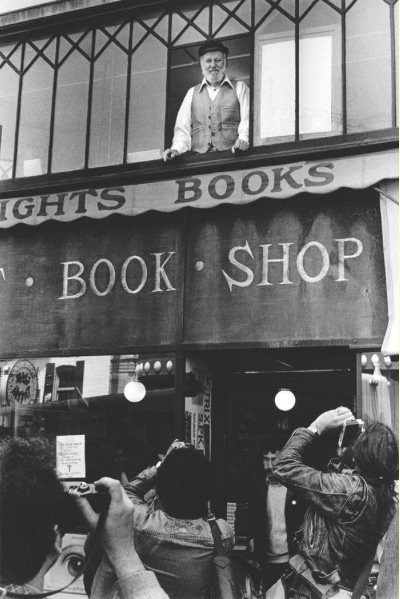
The poet and his public. | Photo: City Lights

Ah, man, they keep shoving off. Not the first Beat, but the last bohemian, Lawrence Ferlinghetti went west on Monday. He was 101.

A World War II vet and a graduate of the Sorbonne, Ferlinghetti was a writer, the proprietor of San Francisco’s City Lights bookstore, and a First Amendment champion who got arrested for publishing Allen Ginsburg’s “Howl” … and beat the rap.

Like many a voracious reader, I made a pilgrimage to City Lights when I visited the city for the first time. Didn’t have the opportunity to meet Himself, alas. He was probably busy writing, or just “minding the store,” which is what he said he was doing rather than founding and directing an artistic subculture.

“When I arrived in San Francisco in 1951 I was wearing a beret,” he once told the Guardian. “If anything I was the last of the bohemians rather than the first of the Beats.”

• From the City Lights website: “He continued to write and publish new work up until he was 100 years old, and his work has earned him a place in the American canon. We intend to build on Ferlinghetti’s vision and honor his memory by sustaining City Lights into the future as a center for open intellectual inquiry and commitment to literary culture and progressive politics.”

• The Poetry Foundation remembers Ferlinghetti. Here’s their bio and a collection of his works, which include the poem titled (wait for it) “Dog.”

R.I.P., S. Clay Wilson

A sampling of the works of S. Clay Wilson.

S. Clay Wilson made Robert Crumb look like Charles M. Schultz.

Captain Pissgums and his Pervert Pirates. The Checkered Demon and Star-Eyed Stella. Ruby the Dyke. Dude didn’t push the envelope, he lit it up and pissed it out.

I was a fiend for underground cartoons in their heyday, and still am, now that I think of it. My personal fave is Gilbert Shelton, probably because he paid at least as much attention to being funny as to being controversial.

There was R. Crumb, of course. And Bobby London, Vaughn Bodē, Spain Rodriguez, Rand Holmes, Dan O’Neill, Dave Sheridan, Skip Williamson, Jay Lynch, Greg Irons, Robert Williams … shit, the list goes on and on and on. Many were outrageous, and quite a few were funny, too.

But Wilson was out there, all by himself.  Even Crumb knew it, and he could punch the squares’ buttons as well as anyone.

Interviewed in the early 1990s for The Comics Journal by the underground-comics aficionado Bob Levin, Mr. Wilson called comics “a great visual art form,” adding, “Primarily, I’m trying to show that you can draw anything you want.”

I took a page from Wilson’s book once, drawing a vile caricature of myself doing something unspeakable and faxing it to a publisher who had wronged me, as publishers are wont to do. I don’t recall whether the act achieved my purpose, but at that particular moment I felt that I could draw anything I wanted.

S. Clay Wilson died Sunday in San Francisco. He was 79.