R.I.P., Tony Hendra

“It is the job of a satirist to make people in power uncomfortable. Really uncomfortable.”

That was Tony Hendra, and he knew whereof he spoke. Hendra, who died of Lou Gehrig’s disease on Thursday, helped make a lot of people very uncomfortable indeed with his work for National Lampoon and Spy magazine, among others.

Had it not been for the trailblazing Lampoon some of us would have laughed a great deal less over the past half century. The magazine had a nut-crushing stable of funnymen, among them Hendra himself. And its “Radio Dinner,” “The National Lampoon Radio Hour,” and “Lemmings” led directly to “Saturday Night Live,” “Animal House,” “This Is Spinal Tap,” and the “Vacation” movie franchise.

Hendra’s “Magical Misery Tour” was a brutal takedown of John Lennon using Lennon’s own words from an interview in Rolling Stone. I bet John wasn’t laughing when he heard that one.

Hendra may not be as familiar to you as Chevy Chase, John Belushi, P.J. O’Rourke, or Christopher Guest. But he was right in there among them, one of the ha-ha mechanics throwing shit, just to see what might stick, and to what, or whom. Making people in power uncomfortable. Really uncomfortable.

One of his last smiles before the disease took those from him came when he learned the results of the last presidential election, said his wife, Carla.

“He was an immigrant who sailed from London into N.Y. Harbor on the SS United States after being given free passage in exchange for performing stand-up,” she told The New York Times. “What was to be a two-week visit became 57 years, because he believed in the promise of America.”
It’s been a quiet week at El Rancho Pendejo. …

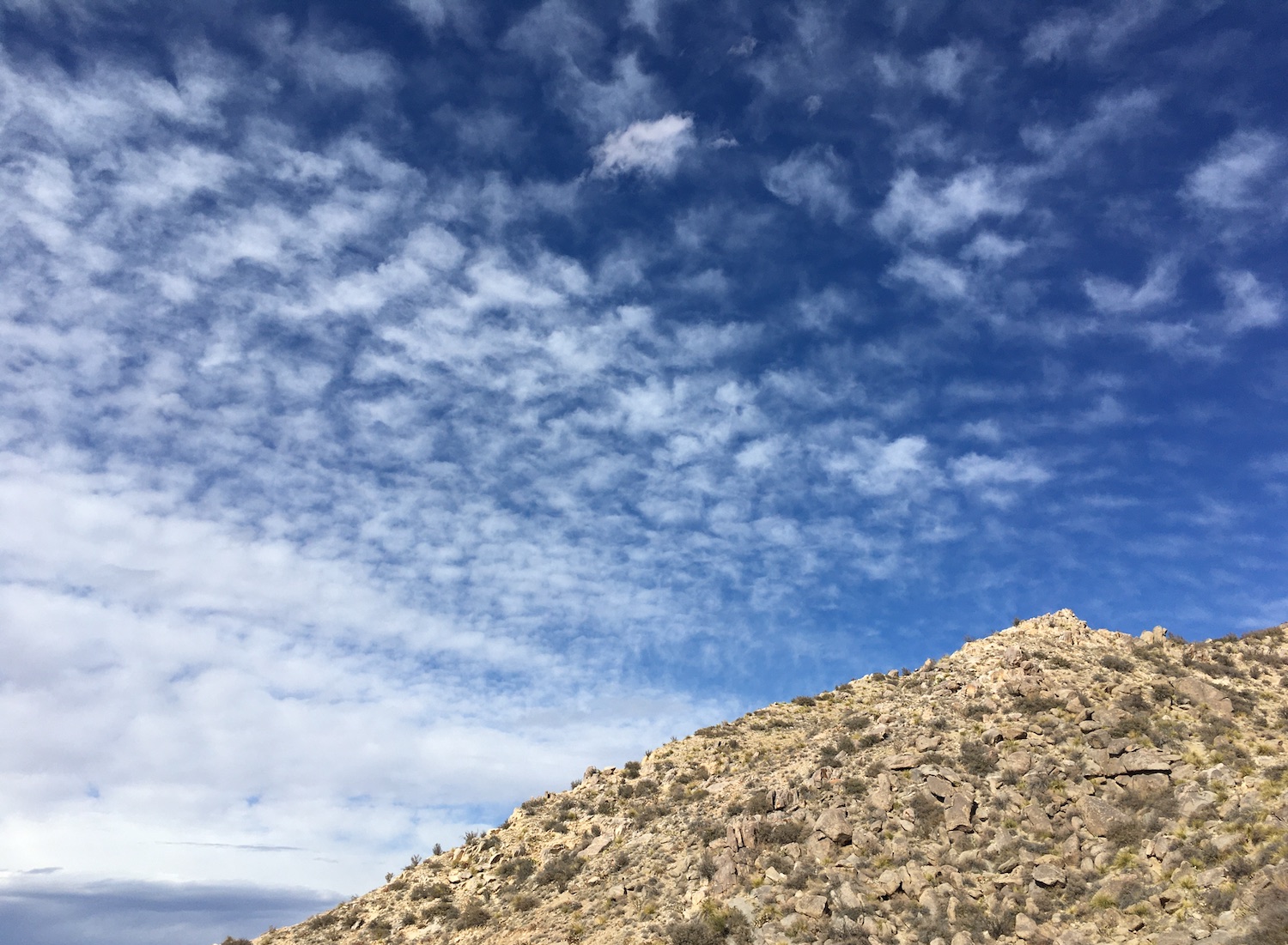
The wind sketches clouds across the skies west of the Sandias.

It’s been a quiet week, as Garrison Keillor used to say of Lake Woebegon, “where all the women are strong, all the men are good-looking, and all the children are above average.”

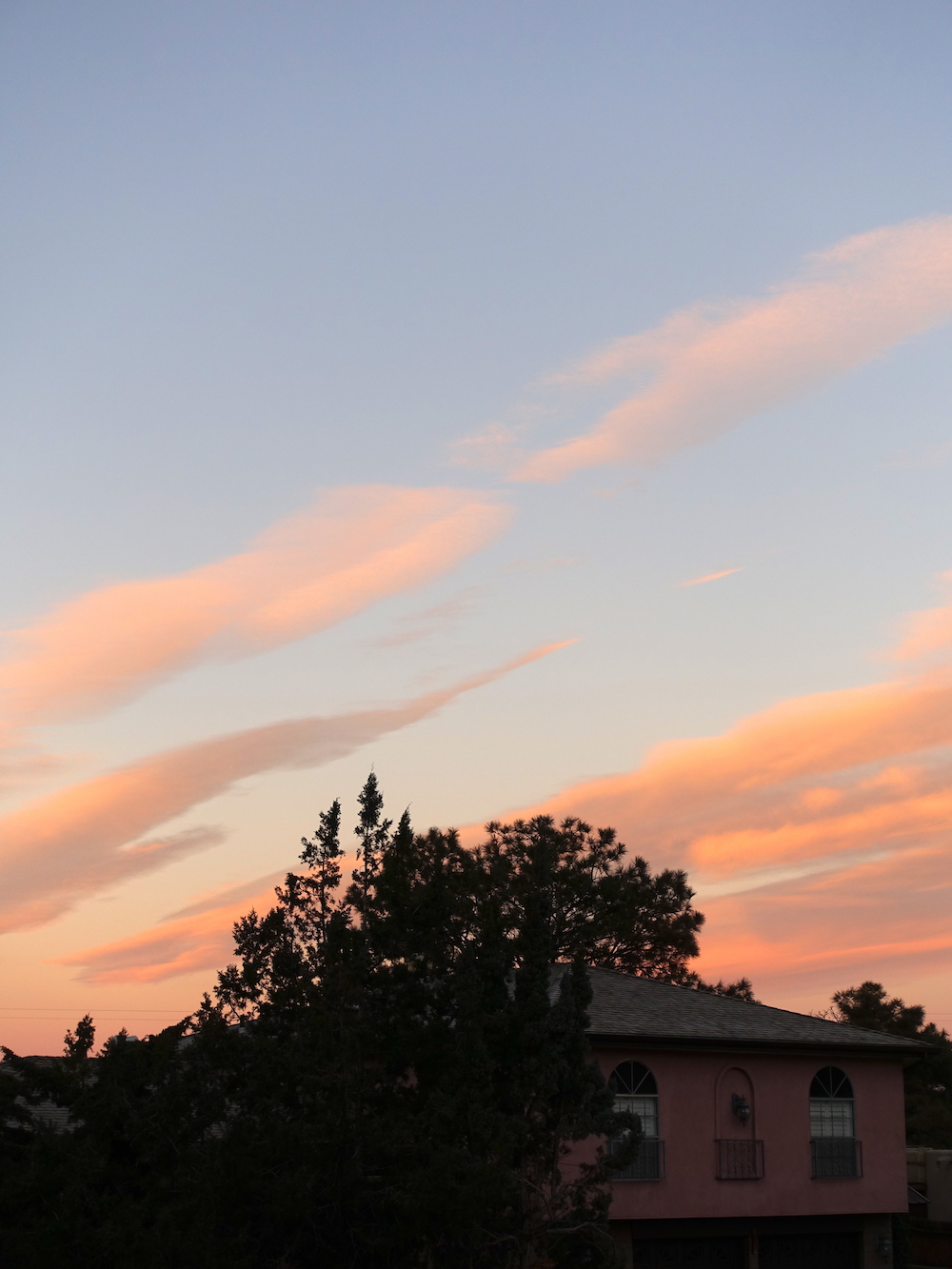
Pink skies to the west.

The weather has returned to something a little more favorable for hiking and biking, and the National Weather Service forecasts a spring that should be drier and warmer than normal.

In fact, we’re already into allergy season here. Junipers and elms. Honk, snurk, hawwwwk, ptui, etc.

Two of the four people we know who have been looking for work have found it, so, yay. The jobs may not be ideal, but neither are the times. So it goes.

I am not looking for work, but it seems to have been looking for me. Adventure Cyclist asked if I wanted to dash off a little sumpin’-sumpin’ that is not a bicycle review, and we’ll see how that goes. Having been without a column for a while now, I’m kind of out of practice as regards busking for bucks.

It’s much easier to do that here, where I’m both organ grinder and monkey, all at once. Out there in the workaday world they expect you to dance to their tune, when they’re hiring at all.

R.I.P., Lawrence Ferlinghetti

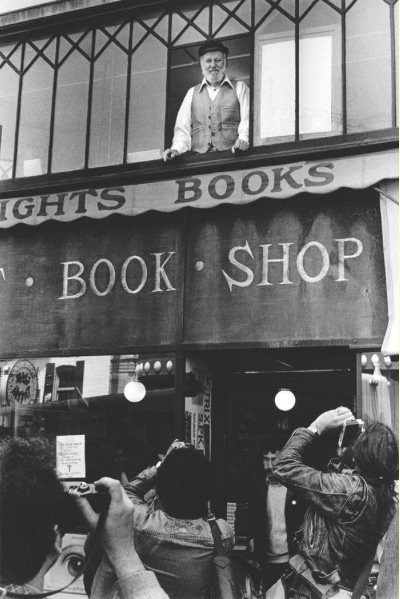
The poet and his public. | Photo: City Lights

Ah, man, they keep shoving off. Not the first Beat, but the last bohemian, Lawrence Ferlinghetti went west on Monday. He was 101.

A World War II vet and a graduate of the Sorbonne, Ferlinghetti was a writer, the proprietor of San Francisco’s City Lights bookstore, and a First Amendment champion who got arrested for publishing Allen Ginsburg’s “Howl” … and beat the rap.

Like many a voracious reader, I made a pilgrimage to City Lights when I visited the city for the first time. Didn’t have the opportunity to meet Himself, alas. He was probably busy writing, or just “minding the store,” which is what he said he was doing rather than founding and directing an artistic subculture.

“When I arrived in San Francisco in 1951 I was wearing a beret,” he once told the Guardian. “If anything I was the last of the bohemians rather than the first of the Beats.”

• From the City Lights website: “He continued to write and publish new work up until he was 100 years old, and his work has earned him a place in the American canon. We intend to build on Ferlinghetti’s vision and honor his memory by sustaining City Lights into the future as a center for open intellectual inquiry and commitment to literary culture and progressive politics.”

• The Poetry Foundation remembers Ferlinghetti. Here’s their bio and a collection of his works, which include the poem titled (wait for it) “Dog.”

Vox clamantis in deserto

If you’re feeling the strain of a year spent sheltering in place, occasionally pulling on the mask(s) and nitrile gloves before carrying your 10-foot pole into the grocery store like Little John facing off with Robin Hood over the last sack of whole-wheat flour in Sherwood Forest, you’ll appreciate this week’s episode of Desert Oracle Radio, “Out of Our Holes.”

Ken Layne talks about the urge to join the coyotes on the night shift, the struggle to write in an age when the word has faded, and the joy of finally coming out of our holes to once again tell strange stories around the fire.

‘Nomadland’ is a work of art (van, go)

“Nomadland”: Buy the ticket, take the ride.

We watched “Nomadland” last night via Hulu, and the verdict is two thumbs up.

It’s art, not journalism; for the latter, you’ll want to read Jessica Bruder’s book. But some real people from those pages get to participate in the telling of their story, and the pros are going to have to up their game after they see how well the amateurs hit their marks and delivered their lines.

Frances McDormand was excellent, as always. Swear to God, I’d watch her read from the Oklahoma City Yellow Pages. David Strathairn, who I’ve seen only in a few things (“Home for the Holidays,” “Good Night, and Good Luck,” and three episodes of “The Sopranos”), kept it dialed way down low as a kinda-sorta love interest with one foot in a van and the other in a house not his own.

The film is less about a new breed of migratory worker — older people who discovered too late that their nest eggs were actually stones, and then set about making stone soup — and more about a woman who thinks she maybe spent too much of her life “just remembering.”

It’s beautifully acted, shot and scored, neither glamorizes nor trivializes its subjects, and leaves you wondering just who is it that’s sleeping in that battered old Econoline in the big-box parking lot, where they’ve been and where they’re going, and what their dreams might be.