A few more days like this and the trails will look more like trails and less like muddy creeks.
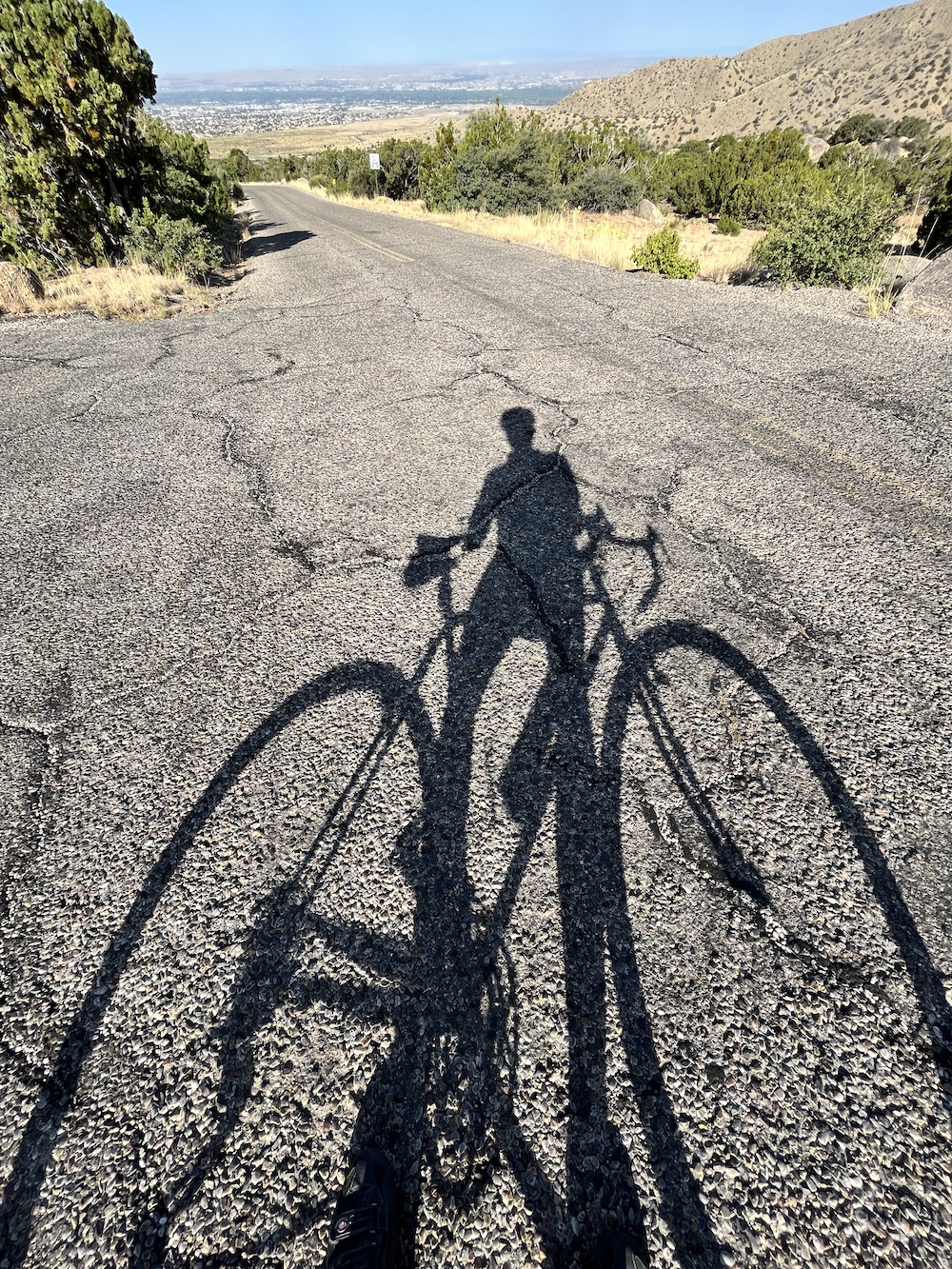
It’s hard to believe, but today’s outing was my first road ride of the new year.
Oh, sure, I’ve been riding the road, but on a cyclocross bike, or a gravel bike, and then only to get to the dirt, where the fun is.
But the trails have gotten pretty gooey lately, and with the sun peeking out and the temps inching up I’d just as soon not add my 33mm scrawl to the graffiti being carved into Mother Earth. Thus, today, the road.
In other news, my man Hal Walter is talking about pulling together another e-book with the tentative title of “American Flats,” a reference to a section of the World Championship Pack-Burro Race out of Fairplay. More as I hear it.
One of our family jokes is, “’Ee’s not the Messiah, ’ee’s a very naughty boy!”
That was only one of the innumerable killer lines delivered over the years by Terry Jones, who died at home Tuesday. He was 77, and had suffered from primary progressive aphasia, a cruel disease that stripped him of his marvelous powers of communication.
As a member of Monty Python’s Flying Circus, Jones generally wrote with Michael Palin, co-directed “Holy Grail” and “Meaning of Life” with Terry Gilliam, and flew solo as director for “Life of Brian,” which gave us that family gag we use so often.
Condolences, peace, and egg and spam; egg bacon and spam; egg bacon sausage and spam; spam bacon sausage and spam; spam egg spam spam bacon and spam; spam sausage spam spam bacon spam tomato and spam, or Lobster Thermidor au Crevette with a Mornay sauce served in a Provençale manner with shallots and aubergines garnished with truffle pâté, brandy and with a fried egg on top, and spam, to Jones, his family, the surviving Pythons (“Two down*, four to go,” notes John Cleese), and their friends and fans.
* Cleese forgot to count the Seventh Python, Neil Innes. No spam for him.
Susan Calvin was off when these two rolled off the line at U.S. Robots. From the September 2019 issue of BRAIN.
E-bikes present both opportunity and challenge for the IBD.
One more bike to sell to the base — the old white guy who already has 15 two-wheelers in the garage but may be slowing down a bit due to age or infirmity, and wants a little assist.
One more bike to lure new customers, who may have found old-fashioned cycling too difficult, or who have decided to replace a car with something greener.
One more bike to service, because the future requires more maintenance than the past.
Our heroes at BRAIN’s bike shop acquired an e-assistant to work on e-bikes, which raises another issue, one familiar to anyone who ever read Harlan Ellison’s “I Have No Mouth, and I Must Scream.”
Artificial intelligence will not come to us from U.S. Robots, complete with a full installation of Isaac Asimov’s Three Laws of Robotics and overseen by Susan Calvin, Greg Powell and Mike Donovan. It will come from Allied Mastercomputer via Ellison Wonderland, it will have ideas all its own, and it will not be our friend.
“They’re a cleaner better breed than we are,” Calvin said in an interview with The Interplanetary Press. Maybe so. in Asimov’s novels, anyway. But in real life our e-assistants will be made by us, in our image. Frightening.
You’ll want to keep them locked up at night, and not for fear of thieves.
Stoned again: From the April 2019 edition of BRAIN.
The bike business sometimes reminds me of Henri the painter in John Steinbeck’s “Cannery Row.”
Regularly he revolted against outworn techniques and materials. One season he threw out perspective. Another year he abandoned red, even as the mother of purple. Finally he gave up paint entirely. It is not known whether Henri was a good painter or not for he threw himself so violently into movements that he had very little time left for painting of any kind.
Think about it. Movements, and violently. The road bike. The mountain bike. The suspension fork. Full suspension. Steel, aluminum, carbon, bamboo. The cyclocross bike. The cruiser. The fixie. The townie. The fat bike. 1x drivetrains. 8-, 9-, 10-, 11- and 12-cog cassettes. STI, ErgoPower and DoubleTap. Internally geared hubs. Belt drive. Disc brakes. Hydraulic disc brakes. Electronic shifting. Tubeless tires. The e-bike. The cargo bike. The gravel bike.
We can argue about whether all (or any) of these movements improve upon the basic bicycle. But I think I speak for a lot of people when I say that I just want to ride the damn things. And if I have to be a quantum mechanic to work on it, I don’t need it.
Told I could have just one bicycle, I would choose a chromoly frame and fork with rack and fender mounts plus clearance for 42mm tires, a nine-speed, 11-34T cassette with a 46/30T crank, a short-reach, shallow-drop handlebar, bar-end shifters, aero levers, rim brakes, external cable routing, and 32-spoke clincher wheels (pre-tubeless “standards”).
Of course, that’s just me. One old white guy does not an industry make. But still.
In the meantime, I make fun of fads. Keep making those superhero movies, fellas. I’ll be over here, reading a fucking book.
My old paperback copy of “Close Quarters” has taken a beating from reading and re-reading.
Goddamn, this is turning out to be an ugly day.
Larry Heinemann, who was the surprise winner of the National Book Award for fiction in 1987, died Dec. 11 in Texas. He was 75.
Heinemann won the award for “Paco’s Story,” but I read his 1977 novel “Close Quarters” first, and it is one of the best Vietnam War stories out there. Not a pretty story, but it was not a pretty war. None of them is. It was one of the books that made me glad I missed the party.
He did his year in an infantry battalion, then came home, went to school, and started writing.
“I was not one of those guys who got home and went to their room and shut up,” he told The Los Angeles Times in 1988. “I know guys who the war’s been eating up for 20 years. Anybody who asked me about it, I told them. I shot my mouth off about everything — the whorehouses, the endless hatred, the ugliness, the real work of the war. It took two to three years of talking to get the story out.”
Heinemann got more of the story out later, in a memoir, “Black Virgin Mountain: A Return to Vietnam.” His hometown paper wrote about it, and him, even including an excerpt.
Upon his return from Vietnam, he wrote:
I felt joyless and old, physically and spiritually exhausted, mean and grateful and uncommonly sad; relieved as if a stone had been lifted from my heart and radicalized beyond my own severely thinned patience: pissed off and ground down by a bottomless grief that I could not right then begin to express.
So, still sore and raw from the war I began writing.


 Mad Blog Media