When I come in cold and tired, it’s good to warm my bones by the fire.
“Dark Side of the Moon” would’ve been an excellent soundtrack for yesterday. Cold, gray, damp, gloomy, madness lurking just around the corner. You lock the door, and throw away the key; there’s someone in my head, but it’s not me.
Happily, the sun returned today, though warmth remained AWOL. So I dragged Herself out for a short trail run and it was just the ticket. A bit squishy underfoot in spots, and windy, but loads better than hanging on in quiet desperation. It’s not the Irish way.
Speaking of the Irish, we finally finished watching Martin Scorsese’s “The Irishman,” which was so bloody long that we had to make a three-part miniseries out of it. The digital de-aging is a little distracting, until you quit looking for it, but the performances are top shelf. Joe Pesci was superb, Robert De Niro was restrained, and even Al Pacino took a break from chewing on the scenery, mostly. I’d have liked more screen time for Harvey Keitel, but hey, whaddaya gonna do? It is what it is.
There’s a whole gang of familiar faces in this one: comics Ray Romano, Sebastian Maniscalco and Jim Norton; straight men Jesse Piemons, Stephen Graham, and Dominick Lombardozzi; even Little Steven Van Zandt as crooner Jerry Vale.
And you may notice a theater marquee advertising “The Shootist” in the background of one scene. It was about an aging gunman hoping for a quiet death, and John Wayne’s final film. Not long after, De Niro’s character is seen shopping for his own coffin.
They lay a sweet, smooth coat of Sherwin-Williams over that weatherbeaten Waits structure, which Zanes describes with all due respect as a “trash-can aesthetic,” and it works beautifully in the cuts I’ve heard.
Roseanne Cash performs a gently reimagined “Time,” one of the Waits songs I like to play badly on guitar. Iris Dement, a frequent John Prine collaborator, takes a deep, Dolly Parton country dive into “The House Where Nobody Lives.” And Patty Griffin’s take on “Ruby’s Arms” strips the original of its instrumental fat and gets right down to the bone.
In an interview on NPR’s “Weekend Edition Saturday,” Scott Simon quotes Moorer describing Waits as “a fully integrated artist who seemingly sees the whole picture at once and knows how to present it so that we do too.”
“He does seem to draw up marginal characters a lot — people who are either stuck in life or we don’t consider them people that we see,” Moorer said. “He exposes the everyday.”
Zanes hopes the album will unearth the lyrical voice that for some may be inextricable from the “grit and the growl” that characterizes Waits’s delivery.
“I think over the years he went deeper into the back of the cave, and sometimes I think people fail to see the very classic nature of the songs because of that ‘trash can’ aesthetic,” he told Simon.
“We viewed it as, ‘His 70th birthday is coming, and it’s a feast day, and we’re gonna take these songs and we’re gonna give them all the sweetness that we can.’ There’s something about the female voice that’s associated with a kind of vulnerability and a kind of emotion that we really wanted to breathe in these songs.”
Meanwhile, here’s the original “Ruby’s Arms,” the closer to 1980’s “Heartattack and Vine.” I was alone and miserable in Tucson when I trudged down Orange Grove Road to some anonymous Oracle Road music shop to buy this one. Still have it, too.
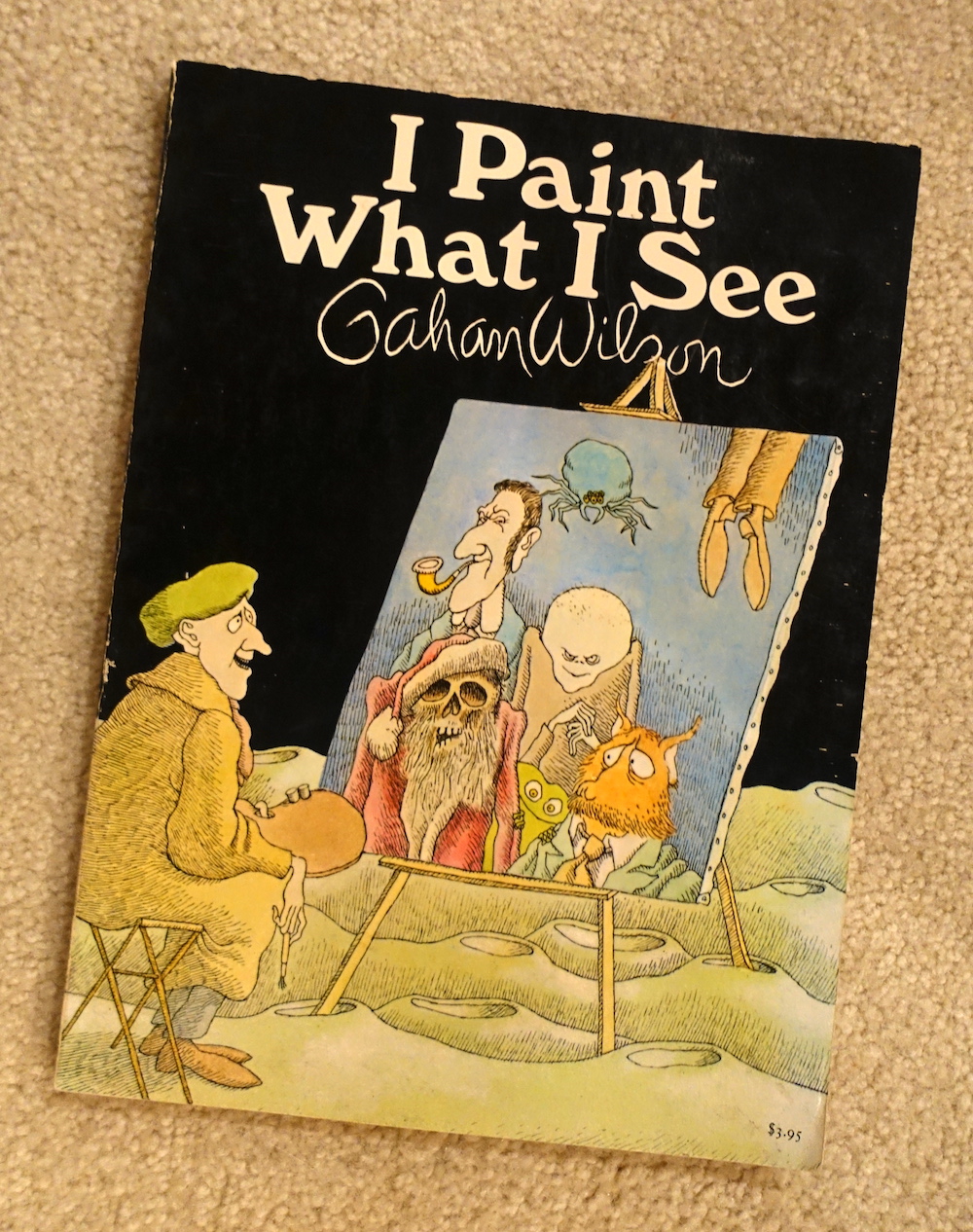
Gahan Wilson, whose surreal cartoons regularly appeared in National Lampoon, Playboy, and other top-shelf mags, has stepped away from the drawing board.
He died Thursday in Scottsdale, Ariz. Complications of dementia, they say. He was 89.
This guy was funny. Bleak, weird, the owner and operator of left field, he kept you off balance like some psychotic judo master. There was nobody else like him working Back in the Day®, and if he has a successor, I’ve not seen him or her yet.
One of my faves? An overstuffed chair absorbing a reader. Eyeglasses and book lie on the floor. All you can see as the reader vanishes is a pair of hands, protruding from the seat.
Another depicts a gardener who has unearthed a skeleton. His employer, a stately, dessicated husk of a woman, says, “I think you would be advised to locate the new delphinium bed elsewhere, Hobbs.”
Yet another shows a soldier covered in gore, muck and God knows what all, knife in one hand and assault rifle in the other. He stands alone in a smoking hellscape that makes the “Terminator” future look like Disneyland. His eyes pop out of the murk like cue balls. And he smiles. “I think I won!” he says.
Dracula with a vampire hand puppet. Dracula with a salt shaker. (Dude liked Dracula, what can I tell you?) A woman who has stuffed her husband into the trash can outside her apartment door (“You don’t get rid of him that easy, Mrs. Jacowsky,” says a man who may be the building superintendent). A writer for “The National Confidential Weekly” who, stuck for a lively bit of the old Fake News®, finally leaves his typewriter for a while and returns to tap out, “It isn’t easy cutting the heart out of a woman with a dull knife. And it takes time. It takes a good fifteen minutes.”
Oh, Gahan Wilson was one of the greats. I hope he and Charles Addams are hoisting a tall cold one in the Beyond.
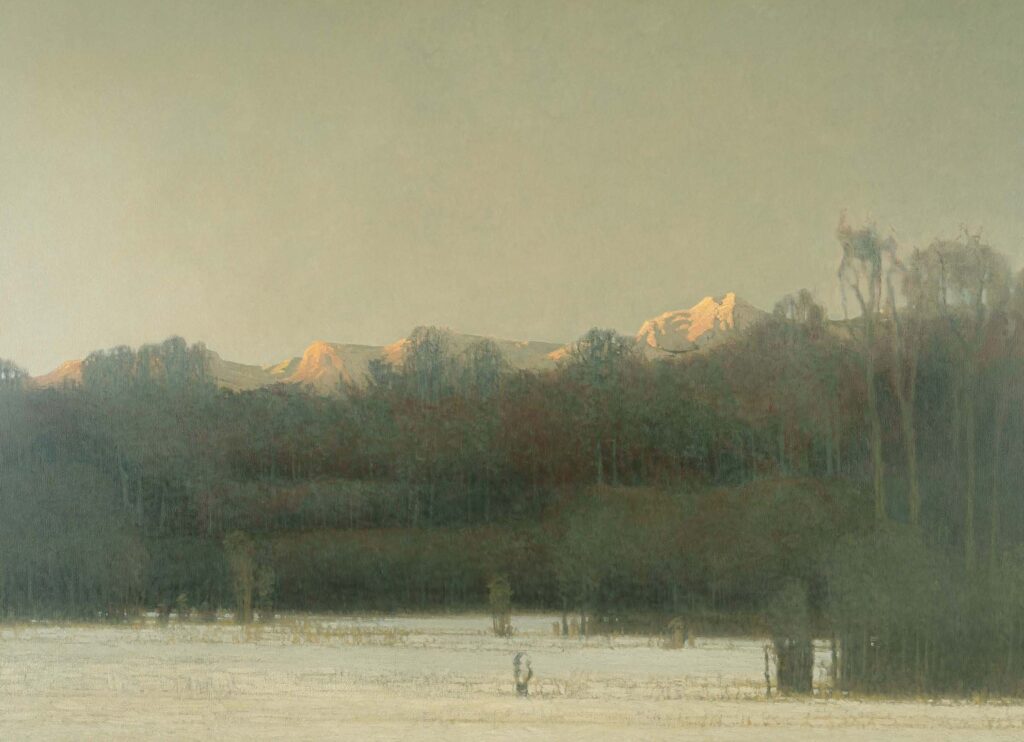
“Crazy Mountains in March” by Russell Chatham, 1991.
The IRS can’t get Russell Chatham now. He’s skedaddled with his paints and brushes, vamoosed to a secret place where his creditors will never find him.
His flight west hasn’t interested the big boys yet. The New York Times, once Johnny-on-the-spot when it came to obits, hasn’t uttered a peep.
It was apparently the dementia that got him, among other things. Once a Montanan and rounder, an artist and writer whose running mates included the likes of Jim Harrison, Thomas McGuane, and Rick Bass, Chatham died Nov. 10 in a memory-care facility in Marin County, Calif. He was 80.
Chatham’s landscapes adorn many a book cover, when they aren’t busy elsewhere, selling for tens of thousands of dollars. Indeed, it’s hard to find a Harrison book without one, and he dedicated “Sundog” to Chatham.
The artist also makes frequent guest appearances in Harrison’s essays. While fly-fishing for billfish off Costa Rica both men contracted bad cases of turista, but Chatham’s was by far the champeen, if you believe Harrison. In “The Tugboats of Costa Rica,” he wrote:
“I shall never forget his pathetic yelp in the night as he pooped his bed during a feverish dream about trying to eat a giant Mindanao clam that wouldn’t stop moving,” Harrison wrote. “This artist is a walking field day for a psychotherapists’ convention.”
In his essay “Seasons Through the Net” McGuane described Chatham as “a man who has ruined his life with sport,” a relentless angler and shootist “who “skulks from his home at all hours with gun or rod.”
“Russ never thought of painting as a career. It was just something he did,” said McGuane.
Bass called him “the greatest living landscape painter in America, famous for his outlandish appetites for food, wine, travel, art, music, literature, and the sporting life.”
And Chatham? He was busy doing the somethings he did, sport and art. Working without a net. Everything else would have to take care of itself.
“I’m not a businessman,” he told Charles Schultz for the Point Reyes Light. “If any money crosses my path, it is gone faster than butter in an oven. I have no savings, no retirement. I have whatever’s in my wallet. To a lot of people that would be frightening.”
He added: “The artist has absolutely no safety net.”
This didn’t mean that he was unaware of the ground down there waiting for him. In a chat with Todd Wilkinson for the Mountain Journal, Chatham said:
“Early on, I was never concerned about having a career, so I didn’t have one. And now nothing could interest me less. But I think we all have a programmed tape running inside us, and most of mine is now stored on the right hand side of the cassette. I finally feel I know enough to paint what I could only dream about in my twenties. People say it’s time to slow down, relax, go fishing. Well, I took the first forty years of my life off and went fishing, and now my tape is telling me to finish what I was put on earth to do. Before, time didn’t matter. Now it does.”


 Mad Blog Media