By the blather of St. Phil, with all the revoltin’ developments on this side of the Big Ditch I nearly forgot that Le Tour was to kick off today.
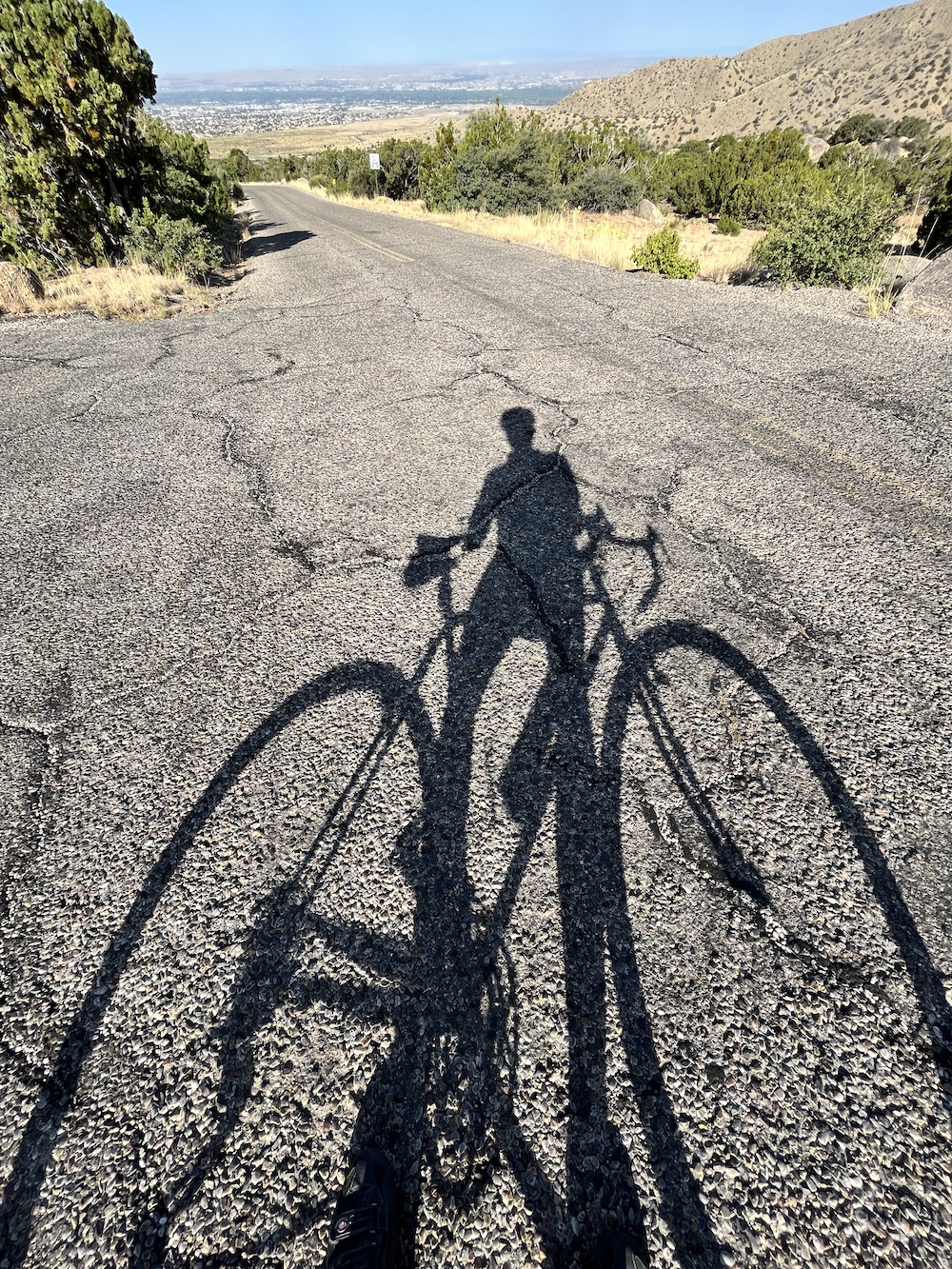
I caught a little of The Guardian‘s live update of the Grand Départ — all due respect, but I preferred the Non-Race Related Blah Blah Blah of them other fellers at Live Update Guy — and then decided to go out and ride one of my own damn’ bicycles before it got too hot.
Any of yis following Le Shew Bigge this year? As you can tell, if Charles, Fatso and I aren’t acting the fool for fun and profit, I’m just not that interested.
Wind and other things that blow kept my bike mileage in the double digits last week, which would not be such a bad thing if it weren’t for my addiction to the news.
After spending too much time in front of the monitor and not enough behind the handlebar I came this close (finger and thumb so close together that you couldn’t slip the homepage of the Albuquerque Journal between them) to canceling all my subscriptions. Bad news, badly written, barely edited, and poorly presented.
The motto of The New York Times used to be “All the News That’s Fit to Print.” At lesser journals wiseguys often revised it to “All the News That Fits, We Print.” In the Age of the Bottomless Internet it might be “All the News We Print Gives You Fits.”
Practically nobody needs to know most of this stuff, much less write about it.
“The rise of executive butlers.”
“At-home IV drips are the latest luxury building amenity.”
“We tried to pet all 200 dogs at the [Westminster Dog Show]. Here’s what it all felt like.”
Newspapers have always provided a spoonful of sugar to help the medicine go down, of course. But once the sheer volume of treacle was limited by the traditional 60/40 ratio of ads to news, which constrained page count; editors’ desire to focus on what was actually important, like, uh, the fucking news; and publishers’ insistence that the final package turn a profit.
There is no bottom to the Internet, no satisfying its endless appetite. Ever fed a baby bird? Imagine one the size of NASA’s Vehicle Assembly Building, but with a basement that extends all the way to Hell.
Whew. Now. All this being said, I have stumbled across two items you might enjoy reading over your morning coffee, shot of whiskey, or morning coffee with a shot of whiskey in it. And surprise, surprise: They both come from the godsend that rescued me from pulling an oar in the sinking longboat of daily newspapering, the wonderful world of bicycling.
First: The Washington Post presents a fabulous report by Peter W. Stevenson on Indiana University’s annual Little 500 bicycle race, made famous by the only cycling movie worth the price of a frame pump to put it into the ditch, “Breaking Away.”
It’s not clear who shot all the video and photos — Stevenson, a video producer, is credited on some, but not all — but they really help tell the story. And I love the still of the Kappa Alpha Theta rider hovering in midair over her saddle during a remount.
Second, The Cycling Independentgives us an essay by Laura Killingbeck, “A Good Time at the Dollar Store.” Killingbeck, free to explore after three months of housesitting, sings a soggy hosanna to the joys of the open road, a song I’m always eager to hear.
I’m supposed to do a short ride in the foothills with my fellow geezers this morning, but Killingbeck makes me want to strap some camping gear to a Soma and wobble off on a skull-flushing tour of wherever. Shucks, it’s not even sleeting here.
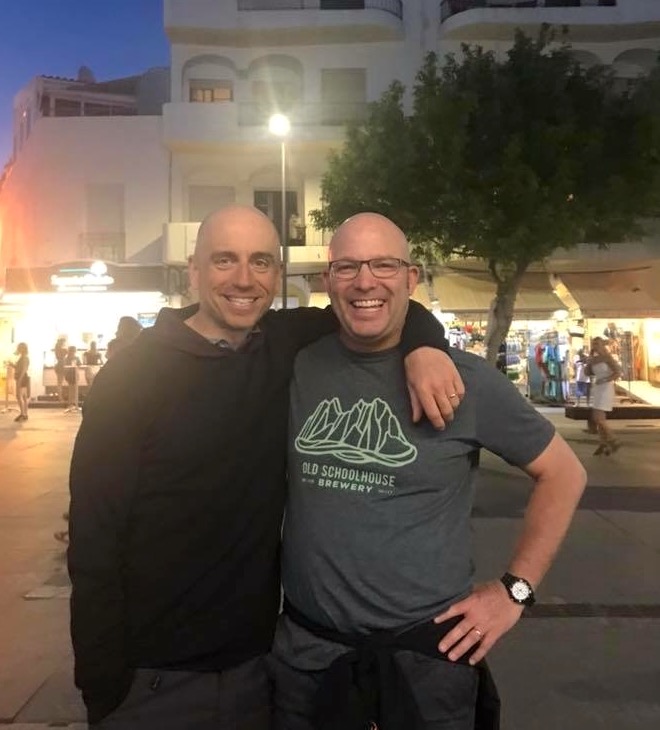
Rob Coppolillo (left) and longtime Friend of the Blog Michael Porter, who supplied the pic.
The great outdoors is a little less great this morning because Rob Coppolillo is no longer here to show it to us.
Rob was one of the people who made VeloNews worth reading Back in the Day®. But he was more than just another velo-scribe; much, much, more.
He was into cycling, sure. And he wrote about it, too, with skill and style. But he also skied and climbed; guided expeditions (certified by the American Mountain Guides Association and International Federation of Mountain Guides Associations); wrote stories and books; spoke French and Italian; owned and operated Vetta Mountain Guides; and with his wife, Rebecca, fathered twin boys, Luca and Dominic. Rob was a twin himself.
The details remain thin, but something went horribly wrong during a Canadian trip Rob was guiding this past week and he was taken from us. Our old friend Charles Pelkey, who worked more closely with Rob than I did, mourns his passing at his Facebook page. Here’s a brief outtake:
We’d known each other for nearly 30 years, since we met during our times at VeloNews. We traveled in the same circles, be they here in the U.S. or in Europe. He had a remarkable wit and was always there when a friend needed him. He came and sat with me at the Medical Center of the Rockies on days when I was stuck in a chair getting filled with noxious chemo’ chemicals for cancer 13 years ago. Believe it or not, he even made that seem fun. We hadn’t talked in years, but I called him just a couple of weeks ago. We didn’t miss a beat. Within minutes we were regaling each other with stories about cycling, mountaineering, old friends and, above all, our kids.
Stories about cycling. I’m something of a pack rat, and though I recently found the strength to discard all my back issues of VeloNews, I plumbed the depths of a couple old hard drives and unearthed a few pieces Rob wrote for the mag back when he, Charles and I were still members of the club in good standing.
My favorite was about the 2001 Eroica. It showcases Rob’s love for the sport; his admiration of the legendary hardmen, the bare-bones bicycles they rode, and the courses that challenged them; and his storytelling skill.
It even provides a glimpse of where bicycle racing would be headed a couple decades later, which was back to where it began, albeit with more sophisticated machinery.
The story follows below. Peace to Rob, his family, and his many friends.
Campioni del passato: Racing’s heroic past lives once more in Italy’s Eroica
By Rob Coppolillo
Each September, the heroes of the road gather in the little town of Gaiole for the Eroica. This old-school bike race covers 125km of winding gravel and paved roads in one of Italy’s most famous regions, the wine-growing land of Chianti, in the heart of Tuscany. On September 30 last year, a Sunday, the heroes departed Gaiole through sheets of rain and streaked toward the muddy vineyards to prove their worth astride bicycles from another era, costumed in clothing from times past. The greatest of them soon fell behind the leaders during this arduous edition of the Eroica. …
Fifty-five kilometers into the day, Luciano Berruti stood and summoned the considerable force necessary to propel himself and his 35.2-pound single-speed 190 Peugeot at the base of another climb. The course fell precipitously in switchbacks from the hill town of Radda, then launched riders at the valley’s opposite wall, toward the ancient fortified castle of Volpaia. Berruti led his competition into another of the countless hills on a road of pulverized white stone. His woolen shorts sagged from suspenders, waterlogged from two-and-one-half hours of cascading rain. Foggy, mud-splattered goggles on his helmetless head and a thickly woven Cicli Gerbi jersey framed the grimace of exhaustion and ferocity on the 58-year-old’s face.
David Maddalena followed, having ceded five seconds at the initiation of the 15-percent grade. Maddalena — an Italian with an anglicized first name — had twisted his shifting rod to find the easier of his two gears, and the maneuver required two hops of his rear wheel to reseat the chain. He glanced down to confirm the change, then raised his face towards the few spectators hardy enough to endure the weather. Ashen and soaked, Maddalena parted his lips in a smile, belying the effort required to keep Berruti in check on the hill.
Nearly a minute later the world champion’s jersey arrived, aglow under dark skies and against the lush chestnut- and oak-forested hills. Luigi Luzzana, 62 years strong, defiantly churned the pedals of his celeste Bianchi as water channeled down grooves in the broken road. He heaved mightily as he climbed, passing the vineyards of the some of the world’s greatest red wines — Pergole Torte, Querciagrande and the Antinori family’s Chiantis. The bearded Luzzana gave nothing away in his expression, save for the eyes. They followed the curve in the road just ahead that led to Berruti and the finish, more than 70km away.
Though the starter’s whistle had unleashed more than 60 riders at the line that morning, the race had truly been reduced to four heroes by this point, and the last of these trailed some minutes behind Luzzana — Ermes Leonardi, another champion in his 60s. As the three others began the grade up Volpaia, Leonardi stood on the shoulder of the narrow ribbon of asphalt leading into Radda. He had suffered his fourth flat of the day, and after stripping his last tubular from his shoulders and mounting it, he threw a leg over the top tube and began pursuit. His wool jersey hung heavily on his body. The Italian national champion’s shirt, printed with the familiar logo of Legnano and sporting world champion’s piping on the sleeves — presented itself in a darker shade of blue, with streaks of road grime running vertically.
The race would last another four hours. Countless young competitors would retire, asking with eyes diverted toward the slick road surface, “What’s the quickest way back to Gaiole?” Their synthetic clothing and modern bicycles, most nearly 20 pounds lighter than Luciano Berruti’s Peugeot, were no help in the most unique road cycling race in Europe.
• • •
The Eroica challenges and honors cycling’s heroes, past and present. At most races, the youthful, fit and fast riders command the spotlight; and true, at this year’s Eroica, a young rider arrived first, wearing Lycra shorts, sporting 10 speeds on his rig and even a fashionable sprout of facial hair. A few spectators offered him polite applause, but the real champions of the day were the men who were hours behind at that point. Men like Luzzana, Berruti, Leonardi and Maddalena.
There are no hard-and-fast rules for the Eroica. The style with which one competes, the ethos of one’s approach to the bike; these count more at the finish than does time. The race asks only that one pedal in honor of the increasingly scarce spirit that inhabited the hearts of the greats, Merckx, Van Looy, Binda and Bottechia. Show up and ride, offer up your sweat on the altar of these gods. Perform your genuflection in wool shorts and a jersey, astride a 30-pounds-plus bicycle with just a few gears, and chances are your prayers will carry you further, even if your deliverance comes that much more slowly. The Eroica has everything to do with the ride and cares little for dramatic finales.
This year marked the fourth edition of the Eroica. I arrived in Gaiole the night before the race with Enrico Caracciolo, a journalist and photographer specializing in cycle-tourism in exotic destinations such as Madagascar, Alaska, Iceland, New Zealand … and the dirt roads in and around Tuscany.
At the local gymnasium in Gaiole was an exhibit to make any cyclophile weep in ecstasy. More than 50 vintage bicycles, including an 1890 Clement with a single gear and wooden rims (ridden the year prior by Luciano Berruti!) led visitors through the evolution of the machine. Antique jerseys and even a few restored Vespas and Lambrettas whetted everyone’s appetite for Sunday’s race.
Don’t think of it as just a bike race, though. The Eroica is the crown jewel in a righteous conservation movement. Due to increasing pressure from automobile-based tourism and modernization, the remaining bianche strade — or white roads — in Chianti are in peril of being paved under, just like the pavé of northern France. Furthermore, desirable cycling destinations like Tuscany, Provence, and even Napa Valley and Sonoma County, run the risk of selling their souls to four-lane highways and motor lodges.
The race’s founder and director, Giancarlo Brocci, a medical doctor by education who has since left the practice to pursue his passion of promoting cycling, is in the process of organizing what he calls the Chianti Cycling Park to help include the bicycle in Chianti’s future, as well as that of Italy and the rest of the world.
The evening before the Eroica, Brocci explained his strategy. “We hope to build a cycling park here in the Chianti, with the help of the Siena tourism office, local businesses and the towns in the area,” he said. The park would feature itineraries catering to all abilities, from 10km-a-day tourists, to the seasoned cyclist looking for rides of up to 100 miles in a single outing. Carraciolo has been instrumental in developing many of these routes.
After launching the program in Chianti, Brocci plans to export the model to other cycling areas in Italy, such as Umbria and Piemonte. Indeed, the Eroica may in fact grow over the coming years into a mammoth, 200km-plus course which cycle tourists could ride throughout the year, or in stages. The goal is to make it a yearly classic, with a formidable course and established route to be ridden all year, but raced one day in the fall. Signs at each of the course’s many intersections would lead followers along the quiet back roads, through some of Italy’s most beautiful cycling territory.
• • •
The Eroica may be a cornerstone in Brocci’s movement to protect and preserve one of the world’s great cycling landscapes. But it also acts as a moving monument to a paradise lost in cycling, that once-upon-a-time world inhabited by an endangered species: the complete rider, impervious to fatigue, inmune to pain, unflappable no matter the circumstance, those who’ve passed to the pantheon of gods alongside Kelly, Hinault and Janssen.
“When I’m riding, I don’t feel pain, I only think of pedaling,” Berruti said at the start of this year’s race. During the 2000 edition, when Berruti rode the 1890 Clement, his costume included leather cycling shoes from the period. The cleat and pedal pressure eventually sliced both his feet across the ball, an injury he only discovered at the finish, which counts two-thirds of its course on bianche strade.
“It’s a different mentality,” Berruti says with a smile, describing his ride. The diminutive gentleman from Liguria exemplifies the courage in cycling, the great sacrifices, the unassailable endurance, bulletproof perseverance and blue-collar tenacity. In short, he overflows with the qualities so rarified in today’s world of pretty-boy superstars who quit as many races as they finish, who highlight their hair, who speak of themselves in the third person.
Another telling anecdote: The 35-pound Peugeot upon which Berruti performed in this year’s Eroica has been to the summit of L’Alpe d’Huez. The bike, a black beast complete with wooden rims, an uncushioned leather saddle and one gear — a 44×23 — should be a museum piece, but Berruti finesses it on the descents, wills it up the climbs, drives it along the flat sections.
“On L’Alpe d’Huez, after four kilometers I thought I wouldn’t be able to ride it, but I rode the whole way without stopping,” he says, smiling. “Some of it even sitting down.”
Again, that’s a 44×23 on a 35-pound bike…and he’s 58. His wife of 32 years, Sofia, shakes her head and smiles.
• • •
Berruti dove onto the descent from Volpaia, leading Maddalena down the rutted road. The route bisected the fortified town, squeezing between walls just wide enough for a Fiat. Berruti never once dragged a foot, despite the inch-deep channels of water on the road, the loose gravel and hairpin turns.
Maddalena, riding a five-speed yellow Legnano from the ’50s, followed with the world champion, Luzzana, just behind. He’d eventually join the pair at the bottom of the descent, while Leonardi refueled at the rest stop high on the hill. There, riders ate bunches of grapes plucked from the fields nearby and downed glasses of red wine and mineral water.
It was at one such rest stop that Berruti waved a small, aluminum bottle beneath my nose. “You think I’m joking, here, smell!” he roared. Grappa, the horrid, distilled, 120-proof Italian beverage made from the leftover skins, seeds and stems of grapes used for wine. He had been drinking grappa for the first 50km of the race.
By the time Berruti and his three companions neared the line, another 70km after the descent off Volpaia, more than six hours after departing, the “winners” had changed, showered and eaten a pasta meal prepared by the race organization. The town square in Gaiole in Chianti had morphed into a scene from 100 years ago, complete with artisans pounding out horseshoes, vintage automobiles sputtering through the piazza, and a marching band providing the soundtrack for the festival honoring cycling and its champions. The rain had stopped, and slanting, afternoon sunlight settled over the Chianti.
Several hundred spectators crowded around the traguardo, craning necks and readying cameras to catch a glimpse of the hard men who had braved the day’s rain and hills. Around a gradual left-hand bend came Berruti, and Sofia smiled next to me. His fourth Eroica, finished, safe and sound.
Horns, cheering and wild applause greeted Luzzana, Berruti and Maddalena. Leonardi, the oldest of the four, rolled through and quickly found a cigarette.
“Ah, I should quit, eh?” he laughed, and added magnanimously, “It was difficult today.”
During the closing festivities, it seems as though Enrico and I allowed the enthusiasm and emotion to overcome us, and we’ve committed to riding the Eroica in 2002. Andy Hampsten’s touring group, Cinghiale Cycling Tours, will end its SuperTuscan itinerary at the race next year on September 29, and word is the former Giro winner will ride as well. I’ll go through with it, if only in the hopes of absorbing a little of the spirit that makes the Eroica what it is.
See you in Gaiole in Chianti, next September. The gods willing.
Dude, we got to bed at midnight, after mildly terrifying descents of both the Eisenhower Tunnel and Fremont Pass in the giant bus sleigh, which . . . barely made it the last miles to the college due to a mechanical issue. Also, it only had one headlight. — Hal Walter, who joined son Harrison for a Colorado Mountain College team bus trip to the NJCAA Region IX Championships Oct. 28 in Beatrice, Neb., after their return to Leadville in the dreaded wintry mix
We may be short of water here in The Duck! City, but we are also light on what state departments of transportation call “winter driving conditions,” a state of transportation that I do not miss in the slightest.
I don’t drive much in any conditions these days. Duck! City motorists lean toward the Four I’s — Inept, Inattentive, Impaired, and Insane — and are reliably unpredictable under sunny skies on dry roads.
So, even in good weather, I tend to limit my happy motoring to the weekly grocery run. That way the odds are 50-50 that I’ll have something to snack on while waiting for the paramedics.
And winter driving? Cyclocross may have ruined that for me before I ever got to The Duck! City. I always loved racing in mud and snow, because I was a strong runner, but unless I was promoting the event I was at least an hour’s drive from whatever soupy and/or snowy mess awaited me.
If the forecast were particularly dire I might drive up the day before a race, treat myself to a motel room and a restaurant meal. My ass didn’t always get a whuppin’, but my wallet pocket did.
Once, when we were living in Crusty County, I nearly slid off the icy descent of State Highway 96 through Hardscrabble Canyon en route to a race in Pueblo with the Bicycle Racing Association of Colorado’s cyclocross race kit — and my own race kit, including two expensive bicycles — piled high in the bed of my 2WD Toyota truck.
“2WD Toyota truck?” you inquire? Why, yes, it was blindingly pig-ignorant, thickheaded, and just plain stick-ass dumb of me, especially since I also owned a 4WD Toyota truck, and thanks for asking.
But as I recall the BRAC kit was already stacked in the bed of the 2WD truck, moving it over to the 4WD would’ve been a hassle, and surely the extra weight of all those plank barriers, metal stakes, and Reynolds 853 Steelman Eurocrosses would help keep the rubber on the road?
Just barely, as it turned out. Somehow I managed to keep the truck out of Washout Creek and the front end pointed downhill and made it to Pueblo in plenty of time to see hardly anyone turn out for the race because … well, it was in Pueblo.
Most of the racing then, as now, was in the Boulder-Denver clusterplex. It’s where I had to go to fetch the race kit. And if you can race twice a weekend just one cup of bespoke java from home, well. …
This was one of the reasons our Bibleburg races drew about half the entrants of a Boulder ’cross. In The Steal City, yet another hour’s drive south in bad weather, the race organizers were lucky to draw flies. Why was I there? Because I was the schmuck with the race kit.
Eventually I wised up. My last race was in Bibleburg, after we gave up on Crusty County. I didn’t promote it. Didn’t fetch the race kit. Rode my bike to the race.
It should go without saying that since I didn’t think to bring a spare bike slung over one shoulder, I flatted about halfway through and chalked up a big fat DNF in my final cyclocross.
After I replaced the punctured tube, I hung around for a while to heckle the Boulder-Denver contingent — “Hey, that looks just like cyclocross, only slower!” — and then pedaled lazily home.
There wasn’t a cloud in the sky. But it was a beautiful day just the same.
 Mad Blog Media