Behind the curtain

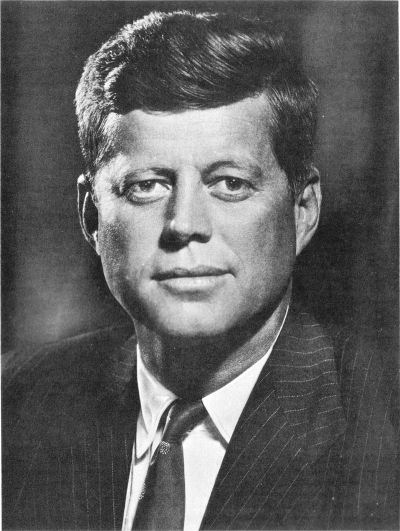
President John F. Kennedy.

Nov. 22, 1963, may have been the day when I first realized that all was not as it seemed.

I was sitting in front of my fifth-grade class at Randolph AFB outside San Antonio, reading aloud to the other kids (yes, even at age 9 I had the mellifluous speaking voice we have all come to know and love), when The Authorities announced via loudspeaker that President John Fitzgerald Kennedy had been shot in Dallas.

That was it for school. Stunned, confused, we trudged home and, with the rest of the world, watched on TV as the young president was buried and Vice President Lyndon Baines Johnson sworn in to replace him.

Yeah, right. Replace Jack Kennedy. Like that could ever happen.

Forget everything you’ve learned about him since. For a 9-year-old Irish-American, JFK was as good as it got. Like my old man, he’d been in the war; like me, JFK was a swimmer. “PT 109” sailed well ahead of “The Ten Commandments” in my personal mythology, and “Profiles in Courage” may have been the first work of non-fiction that I ever read.

JFK wasn’t some baldheaded old warhorse like President Eisenhower, or a sweaty, shifty-eyed rodent like Richard M. Nixon — he was young, and brash, and when he went eyeball to eyeball with the Commies,  guess who blinked first? Nikita Khrushchev and Fidel Castro, that’s who. Made it a little easier to crouch under the desk during duck-and-cover drills, knowing that Jack had our back.

Then, in a wink of an eye, he was dead. Gone. And some jug-eared Texican was calling himself the president. LBJ used Randolph as a landing strip whenever he had a hankerin’ to visit the ranch, and we went to see him a time or two, but it felt like bullshit to me. This guy was the president? Says fuckin’ who?

In the October-November issue of AARP The Magazine, Bob Schieffer recalls covering the assassination as night police reporter for the Fort Worth Star-Telegram. He likens the transition from Eisenhower to Kennedy to a key scene in “The Wizard of Oz.”

Remember how the movie started out in black-and-white, and then Dorothy opens her front door into this vibrant Technicolor? That’s how I think of the Kennedy administration. He brought style and grace, and inspired a generation to do something for their country.

I’ll carry that a step further. The assassination of John F. Kennedy revealed to some of us, for the first time, that there is a man behind the curtain, a shadowy, furtive figure that warrants our close and undivided attention, no matter what the Wizard says up front.

And while the Wizard loves to work his magic in rich, warm colors, the world often shows itself to us most truly in stark black and white.

• Editor’s note: As you might expect, Charles P. Pierce has some thoughts on this subject, too.
The summer grasses remain

I neglected to post something yesterday about Veterans Day, thinking I didn’t have anything fresh to say, and finding the outpouring of social-media thank-yous to the military slightly irksome. I never served, but if I had, I expect I might not enjoy being pandered to any better than I would being ignored.

Like Charles P. Pierce, when I was a squirt I didn’t know anyone whose father was not a veteran. Since the old man was career Air Force, we mostly knew the kids of Blue Zoomies, but in the course of affairs we would meet others; sons and daughters of soldiers, sailors, Marines.

dad2We’d hear the tales secondhand (none of the dads I knew bragged to kids about his service, so the kids bragged for them). This one was at Omaha Beach, that one at the Battle of the Bulge; this one got shot down in a B-29 after bombing Tokyo, that one flew unarmed Gooney Birds out of New Guinea.

It all sounded really cool, especially while consuming a steady diet of war movies at the base theater, like “The Longest Day,” “The Dirty Dozen,” or “PT 109.” And then we got a little older, and a little smarter, and we came to realize that going to war involved a strong probability of getting one’s arse shot off.

We realized that we never got to hear kids tell about their dads who didn’t make it back, because those kids died unborn with their would-be fathers, figments of an unrealized imagination. And we didn’t get to hear about the men who returned from war damaged in body, mind or spirit, or meet them; not until our own war, Vietnam, came along.

Books like “All Quiet on the Western Front” took on new meaning. And there were others, like “Dispatches,” by Michael Herr; “A Rumor of War,” by Philip Caputo; and “Everything We Had,” by Al Santoli.

In “Narrow Road to the Interior,” Japanese poet Matsuo Bashō (1644-94), following a visit to the ruins of Yasushira — and riffing off a line from the Chinese master Tu Fu about how war had left “the whole country devastated,” a place where “only mountains and rivers remain” — wrote:

Summer grasses:
all that remains of great soldiers’
imperial dreams

In “The Poetry of Zen,” co-author Sam Hamill calls this poem “a brilliant indictment of the stupidity and cruelty of war,” one that reminds us how little we have learned over the millennia. How does one say “Thank you for your service” to the grass?

By seeing to it that subsequent generations get to spend as much time as is humanly possible enjoying the sunny side of it, I suppose.

Peace to those to served, and especially to those who never came home.

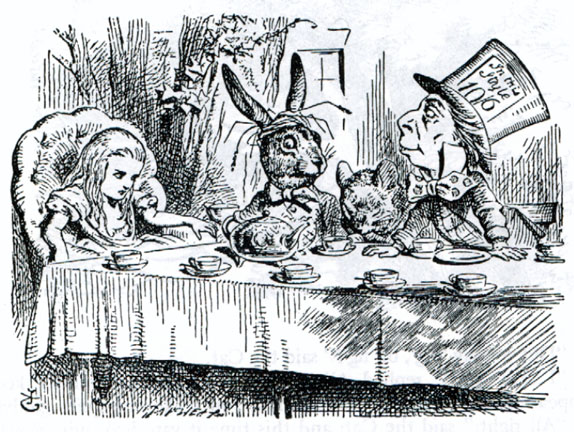
‘Take some more tea,’ the March Hare said

`I didn't know it was YOUR table,' said Alice; `it's laid for a great many more than three.'
`I didn’t know it was YOUR table,’ said Alice; `it’s laid for a great many more than three.’

Alas, The Beast is back in business in Washington, D.C. Lord, how the Constitutionalists’ comments must be a-flyin’ over at The Gazette‘s website. Repeat after me: Don’t read the comments; don’t read the comments; don’t read the comments.

The Teabillies’ tantrum cost the nation billions — there’s that Big Gummint hand in your pocket again, but this time it’s wearing a Louie Gohmert Decoder Ring — and based on the early returns, it taught them exactly fuck-all.

“There’s an old adage: There’s nothing to be learned from the second kick of a mule,” mused Sen. Bob Corker (R-Tenn.), shortly after voting in favor of the package. “Maybe there’s been a little bit of education—we’ll see.”

Oh, and for any Coloradans idled by the feddle-gummint shutdown, only Doug Lamborn (R-Lipton) voted to keep it going. Feel free to ask him why.

‘These rulers, so cruel’

"The Poetry of Zen," compiled by J.P. Seaton and Sam Hamill.
“The Poetry of Zen,” compiled by J.P. Seaton and Sam Hamill.

I’ve been reading a little poetry of an evening, much of it from the collection “The Poetry of Zen,” compiled by J.P. Seaton and Sam Hamill, and recently stumbled across a couple works that, alas, confirm my suspicions that the assholistic Reign of the Morons Charles P. Pierce has been following so assiduously is nothing new.

The first is “Bad Government,” from T’ang dynasty poet and painter Kuan Hsiu (832-912):

Sleet and rain, as if the pot were boiling.

Winds whack like the crack of an axe.

An old man, an old old man,

at sunset, crept into my hut.

He sighed. He sighed as if to himself,

“These rulers, so cruel. Why, tell me

why they must steal till we starve,

then slice the skin from our bones?

For a song from some beauty,

they’ll go back on sworn words;

for a song from some tart,

they’ll tear down our huts;

for a sweet song or two,

they’ll slaughter ten thousand like me,

like you. Weep as you will,

let your hair turn white,

let your whole clan go hungry . . .

no good wind will blow,

no gentle breeze

begin again.

Lord Locust Plague and Baron Bandit Bug,

one east, one west, one north, one south.

We’re surrounded.”

The second is an untitled piece from the mythical Han Shan, an eighth-century Chinese construct I first heard of via Jack Kerouac in “The Dharma Bums”:

I stand here and watch the people of this world:

all against one and one against all,

angry, arguing, plotting and scheming.

Then one day, suddenly, they die.

And each gets one plot of ground:

four feet wide, six feet long.

If you can scheme your way out of that plot,

I’ll set the stone that immortalizes your name.

The Baboon Caucus displays its hindquarters

The Baboon Caucus: They always have a case of the red ass.

Good God, these Tea Bagger twats in the Baboon Caucus are a shameless cluster of fucks.

One minute the feddle gummint is Gigantor, Terror of Civilization, the next it’s a bunny hutch full of fluffy cottontails.

Quoth The New York Times, discussing the House Repugs’ sudden change of heart as they scramble to find a hole through which to scamper in the Shutdown Shithouse they’ve constructed:

Programs that conservatives had tolerated at best were suddenly lavished with praise: nutrition assistance for women and children, federal medical research, national parks, the Smithsonian Institution, even the government of the District of Columbia, which was authorized to spend money to pick up Washington’s trash, maintain its needle exchange program for intravenous drug users and even implement the health care law.

Said Rep. Gerald E. Connolly (D-Va.): “This has been an Orwellian week in which white is black and black is white.”

As long as you don’t look at the Baboon Caucus’s hindquarters, that is. Still flaming red, and that will never change, no matter what they say.