It’s not the infamous “writer’s block.” The problem is that the only thing I want to write about is all the you-know-what coming from you-know-where.
And isn’t there enough of that sort of thing available pretty much everywhere? Every day? Every second?
I find myself belatedly having some sympathy for the mouth-breathers who squealed like maladjusted brakes whenever my columns would veer off the course laid out in the race bible and careen into the real world. Which, if we’re being brutally honest here, was pretty much all the time.
“Stick to cycling!” they’d wail.
“Everything is political!” I’d bark.
Now I’m just a blogger and don’t have to meet a regular deadline or wrestle with nervous editors, penny-pinching publishers, and illiterate critics.
Too harsh? Hey, I read the letters.
“Go back to waxing your chain, Spanky,” I’d grumble. “Leave writing to the pros.”
These days I write for free, because I like it. Anyone who doesn’t like it is likewise free, to fuck off.
Still, I’m not entirely sociopathic. I have you hardcores, my small, deeply disturbed audience, to consider. And I don’t want every single brain-dump here to be of the rancid, greasy, orange variety. There are only so many different ways to say ‘BOHICA!'”
Thing is, to write about anything else feels vaguely criminal. Borderline treasonous. Anyone with a voice, however small, should be sounding off like they have a pair.
What’s a poor mad dog to do?
Well, you may imagine my delight when I stumbled across another scribbler in similar straits. Chuck Wendig is a published author — like, of actual books, an’ shit — and he has a new one due out April 29, “The Staircase in the Woods.”
I first noticed him when The New York Times included “Staircase” in a roundup of 24 new works of fiction to read. Then his name came up again over at Daring Fireball, the free-ranging blog by John Gruber, who promoted this “crackerjack essay” Wendig had written while trying to write about other stuff and promote the new book and basically just live his fucking life.
It’s titled “What It Feels Like, Right Now.” Here’s a sample:
Writing is hard right now. Releasing a book is hard. Promoting that book is, say it with me, hard. It’s not trivial but it feels trivial. Like performing a puppet show in the town square as the town burns down. It feels good to do it and you want others to feel good while reading it but you also know feeling good right now also feels somehow bad, and maybe that’s one of the most fucked up things of all. They didn’t take joy but they took the joy of feeling joy away, made it feel wrong and strange. Turned happiness into a hot stove.
Top-shelf stuff here, folks. Rage and comedy, despair and hope, the whole ball of wax. Writing as an escape and an act of resistance. Inspirational.
In fact, I liked it so much that I immediately ordered up his new book from my favorite local bookstore, Page 1 Books.
Shit, I’d have given him the $32.29 just for the essay.
• Editor’s note: It’s a gray, gloomy day here at El Rancho Pendejo, and Hal Walter’s road-trip tale has put me in mind of my own meditation from the spring of 2000, when the vile Crusty County weather had me thinking about snorting that long white line to wherever.
“I have been buggered to near death by the clock.”— Jim Harrison in “The Beige Dolorosa,” from the novella collection “Julip”
“How do I shut this alarm off?” my wife asked some years back. Her sports watch was cheeping incessantly, like a baby bird in a sack of crack.
“Like this,” I replied, snatching the watch from her, placing it on the kitchen floor and pounding it into a flattened silence with a claw hammer. We both laughed, but warily; killing time just isn’t that easy.
Still, when you see time limping along like it does in a snowbound April in the Colorado mountains, scraping the slush off its boots on the welcome mat of spring, there arises a murderous desire to put it out of its misery. So Shannon has begun hiding the hammers as I glare at the clock, as if I could will its crawling hands into picking up the pace, spinning me up some sunshine.
• • •
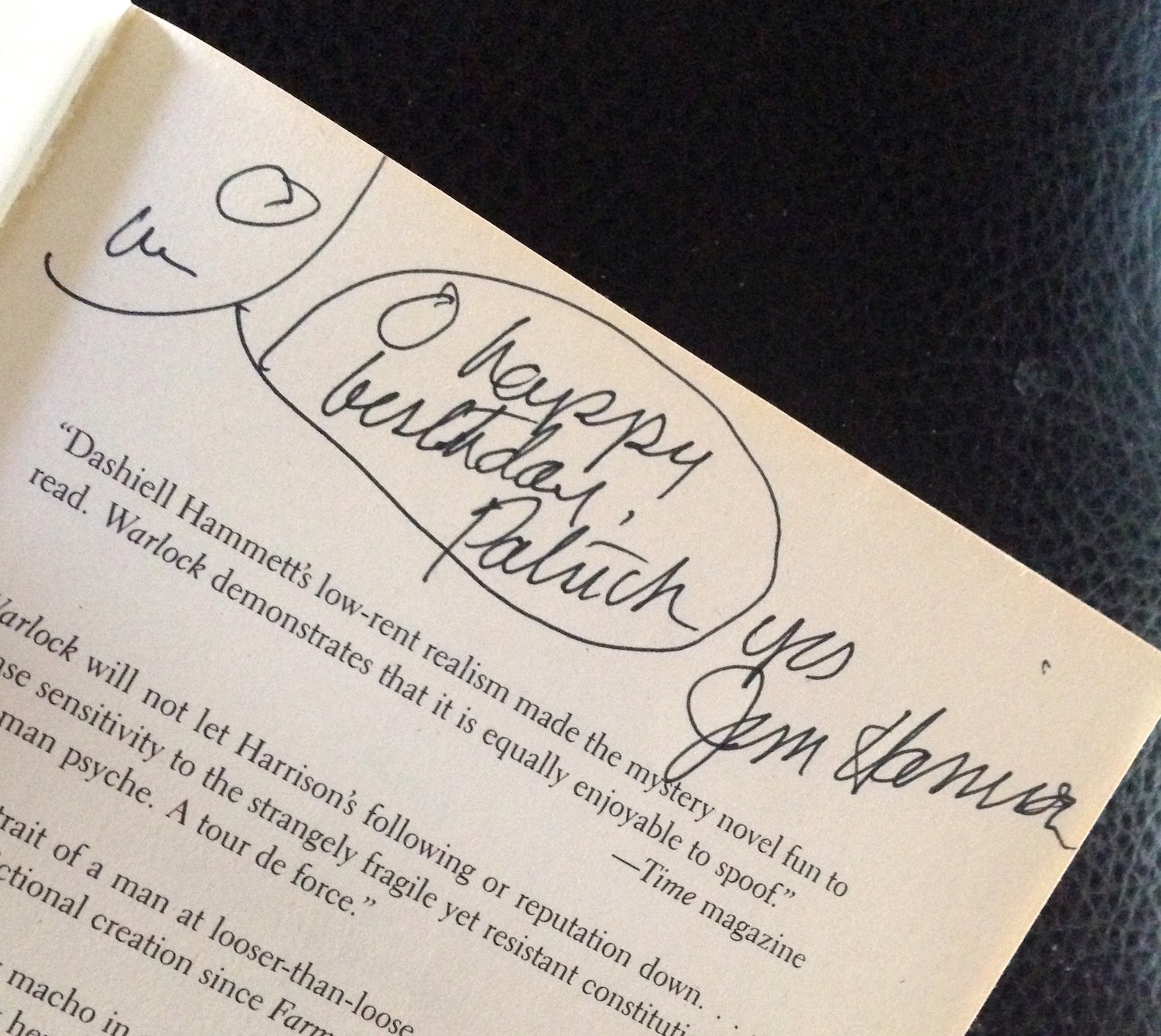
“We’re going to be late,” I warned my friends Hal and Mary as we dawdled first over stout, then over coffee, in a succession of Bibleburg bistros. It was my 46th birthday, and we were headed to Colorado College for a poetry reading by one of my favorite authors, Jim Harrison. Harrison seems the sort to bark at nitwits who interrupt his work, and I wanted his autograph, not his antipathy.
Jim Harrison laid his Jim Hancock on my copy of “Warlock,” though it was not among his favorite works.
As it turned out, we were right on time, and Harrison was late. A student of Zen Buddhism with his own temporal compulsions, Harrison announced: “I’m not a long reader. This will be exactly 52 minutes.” A koan for a birthday present.
Frankly, I’d have settled for a little less light and a little more warmth. Spring brings Colorado the heavy snows that we used to get in winter like everybody else, and the way my mental batteries were running down under the gray-flannel skies had me convinced that I was solar-powered.
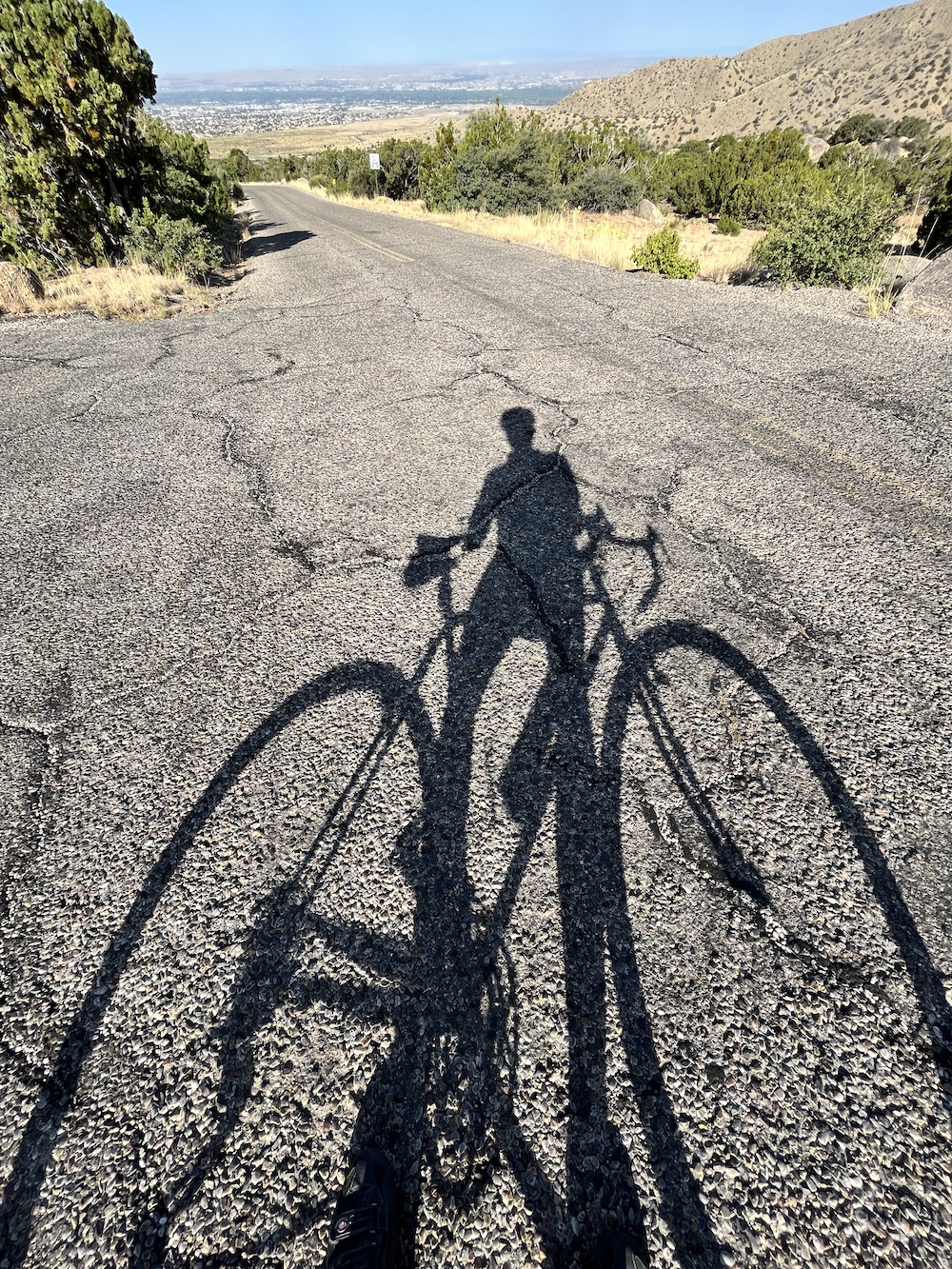
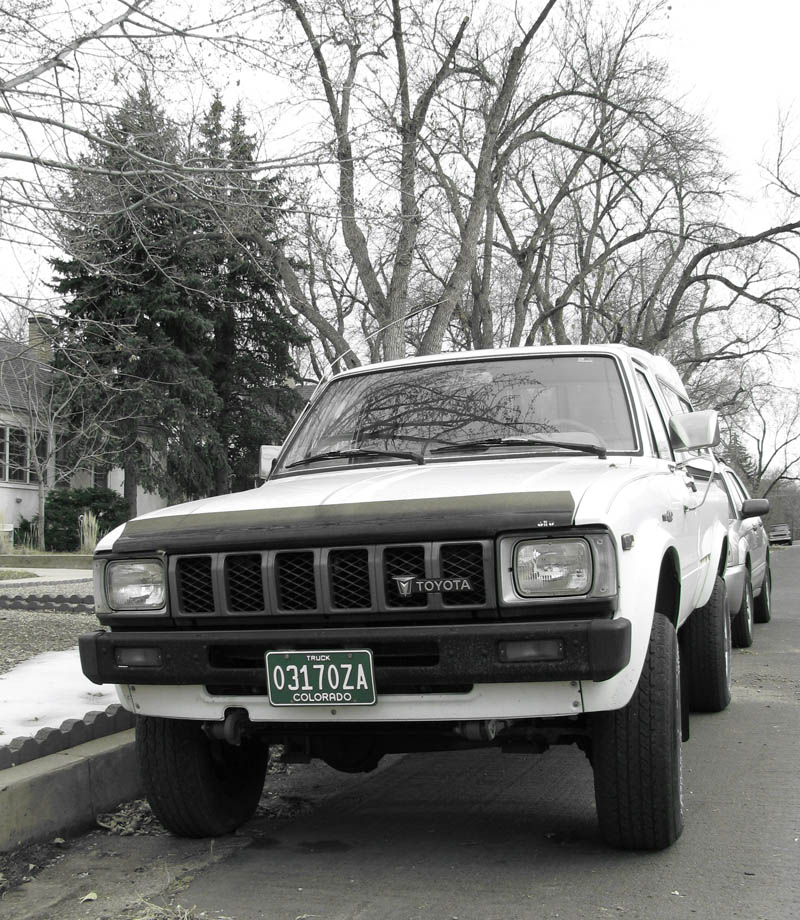
My last escape attempt, a mid-March road trip to a cycling festival in California, was too short and not nearly sweet enough. I’ve been contemplating another to someplace where the locals’ knowledge of snow is limited to what they’ve been able to glean from the Encyclopedia Britannica, but you can’t pilot a Toyota truck to the Virgin Islands, not even in four-wheel drive.
And then there’s the expense. The rising price of gasoline aside, it’s not always possible or desirable to sleep in a pickup, which lacks certain amenities — like a toilet, shower, sink, stove, furnace and elbow room, especially when the camper shell is stuffed fore to aft with a bicycle, a cooler full of beer and a day pack crammed with computer gear and drawing tools.
Even if you pack camping gear and spend your nights outside the truck, you’re doomed to an occasional Motel 666 if for no other reason than hygiene, an impulse that will cost you anywhere from $30 to $60 a pop, depending upon your ZIP code at the time.
So lately I’ve been eyeballing used RVs and wondering whether I’m old enough to own one. This is not unlike like cigar-smoking; you have to be of a certain age to pull it off without looking ridiculous.
Too, as a cyclist who has played mirror-tag with many a blue-haired land-yacht captain over the years, the notion leaves me feeling a little like a Lakota warrior applying to join Custer’s 7th Cavalry.
And the entry fee for the RV lifestyle is a high curb to hop — even an elderly, smallish Toyota RV can run from five to ten large, while free-lance cycling journalism pays on the small side.
• • •
In the essay “Going Places,” from his collection “Just Before Dark,” Harrison advises: “Do not scorn day trips. You can use them to avoid nervous collapse.” So with a light snow falling and the promise of more on the way, I jumped into my ’83 Toyota 4WD and headed north to talk to a guy who had a used, slide-in, pop-up camper for sale.
As I bounced crazily down our steep, corrugated goat path to the county road — this truck, which under a previous owner carried a camper, has springs apparently salvaged from a buckboard — I realized I’d forgotten my watch. A moment of dismay, then satori; I had more than enough time to make the noon appointment, and there was nothing of pressing urgency requiring a timepiece, so screw it.
So, after checking out the camper — affordable and nicely minimalist, with a cabover bed, a small sink and stove, a pedestal table and bench, and a furnace — I spent the afternoon idling around downtown Bibleburg, where it was not snowing, the roads were paved, and distractions were available in variety.
Drank a pint of Guinness and ate a burger in Jack Quinn’s; looked for Harrison books in the cavernous used-book store Gateways; sipped a tall Americano in a Starbucks staffed by two pleasant young women chattering away like magpies. Then I took my sweet time getting home, and not just because I was following a snowplow and an 18-wheeler up a slushy Hardscrabble Cañon.
Again, Harrison, in “The Beige Dolorosa” from “Julip”: “The clock is the weapon with which we butcher our lives.”
The character who writes this line on an index card — an academic rebelling against the tyranny of the clock as he comes to terms with a vastly altered life — then wraps his watch around the cord of his Big Ben electric clock and dangles both in the toilet, flushing and laughing.
He continues: “The damnable watch still worked. I put it on the floor, stepped up on the toilet seat and jumped, smashing the watch to bits. It occurred to me that I was getting a little excitable, so I took the remnants of the two timepieces outside and peed on them to complete the scene appropriately. I reached back in the cabin and turned off the light, the better to see the stars. They were so dense they made the sky look flossy, almost a fog of stars which had drawn infinitely closer to me than ever before, as if my destruction of time had made me a friendlier object for their indeterminate powers.”
Smash your watches. Pee on your clocks. Go look at the stars.
She took what they were giving ’cause she was working for a living.
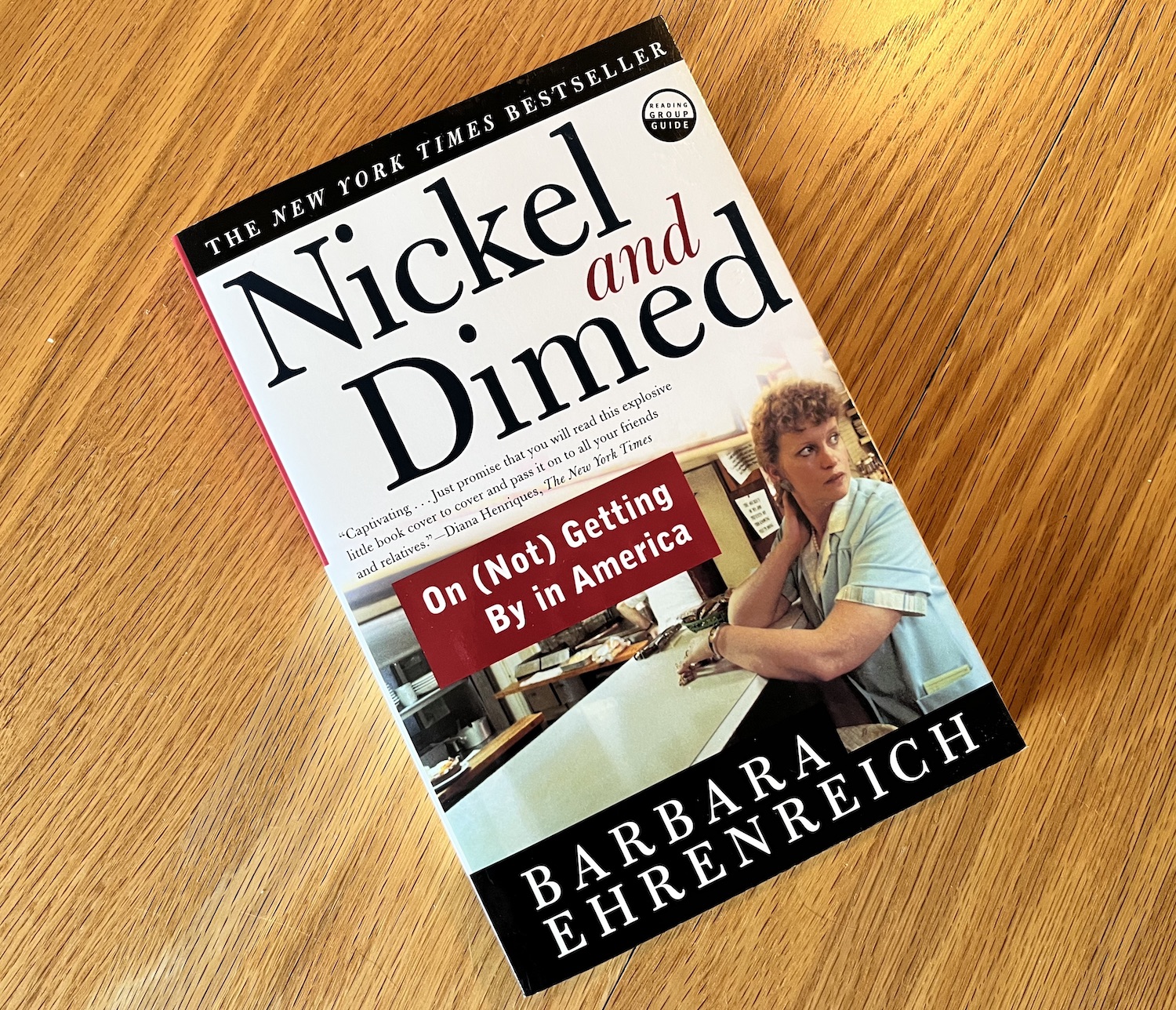
Barbara Ehrenreich, the journalist, activist, and author who never lost touch with her working-class roots, has clocked out. She was 81.
Her New York Times obit draws from the introduction to “Nickel and Dimed: On (Not) Getting By in America,” in which she recounts wondering with a magazine editor how the unskilled survive on the wages paid them and then blurting out something that she “had many opportunities to regret: ‘Someone ought to do the old-fashioned kind of journalism — you know, go out there and try it for themselves.'”
Which is exactly what Ehrenreich did, of course, working and living as a waitress, hotel maid, nursing-home aide, and Walmart “associate,” among other things. Then she came back and told us all about it.
And though she would be writing it up, she wasn’t phoning it in:
People knew me as a waitress, a cleaning person, a nursing home aide, or a retail clerk not because I acted like one but because that’s what I was, at least for the time I was with them. In every job, in every place I lived, the work absorbed all my energy and much of my intellect. I wasn’t kidding around. Even though I suspected from the start that the mathematics of wages and rents were working against me, I made a mighty effort to succeed.
She was not, and is not, alone. And in her Evaluation at the end of the book, Ehrenreich proposed that those of us who live in comfort while others barely scrape by should feel not just guilt, but shame.
When someone works for less pay than she can live on — when, for example, she goes hungry so that you can eat more cheaply and conveniently — then she has made a great sacrifice for you, she has made you a gift of some part of her abilities, her health, and her life.
What a gift was Ehrenreich’s life. Peace unto her, her family, friends, and readers.
Well, not exactly. There’s some gobblin’ at the corner of Tramway Road and Tramway Boulevard, all right, but it involves barbecue at The County Line.
The place smells wonderful when your snotlocker works, which mine mostly does not, thanks to seasonal allergies (oak, cottonwood, juniper, mulberry, grass, etc.).
Between being all boogered up and tweaking my lower back the other day I have been in something of a mood. Maybe watching part one of the Hemingway documentary on PBS last night helped a bit. Wasn’t anyone pulling a couple hundred bits of shrapnel out of my legs in an Italian hospital, and I’ve managed to hang on to my first wife, too. So, yeah, winning, an’ shit.
True, global literary fame has proven elusive, but that’s not exactly a surprise. My agent warned me against titling my debut novel “A Farewell to Arfs.”
In the August 2019 issue of The Atlantic, Michael LaPointe muses at some length on “The Unbearable Smugness of Walking,” as performed by the literati.
Following his examination of two recent books arguing for “walking’s invigorating literary power” and capacity for resistance to “the desire of those in power that we should participate in growing the GDP … as well as the corporate desire that we should consume as much as possible and rest whenever we aren’t doing so,” LaPointe wonders whether, for the writer, walking to work is really nothing more than another day at the office, albeit a larger, airier one.
And he poses the question: “What would it mean, for once, simply to walk and say nothing about it?”
What it would mean, Michael old sock, is that you would not get paid.
“Ah, fill the Cup:—what boots it to repeat
How Time is slipping underneath our Feet. …


 Mad Blog Media