The question is “What will A.I. do to jobs?” And the answers come from right, left and center, from tech CEOs to academic economists to Steve Fucking Bannon — yes, that Steve Fucking Bannon.
It’s smartly reported and cleverly written and the accompanying graphics from Stephan Dybus are top notch.
You will probably not find the story comforting, as it considers the irksome human factor’s effects, if any, upon the Rise of the Machines. The long and the short of it is that where job security in Meatworld is considered, A.I. will either be just ducky or something like a pickleball dustup in Florida.
But hey, if we’re going to be dumb enough to elect a venomous orange man-baby as the Pestilence of the Benighted Snakes — twice! — I guess we deserve to be pig-ign’ant of what he’s doing, too.
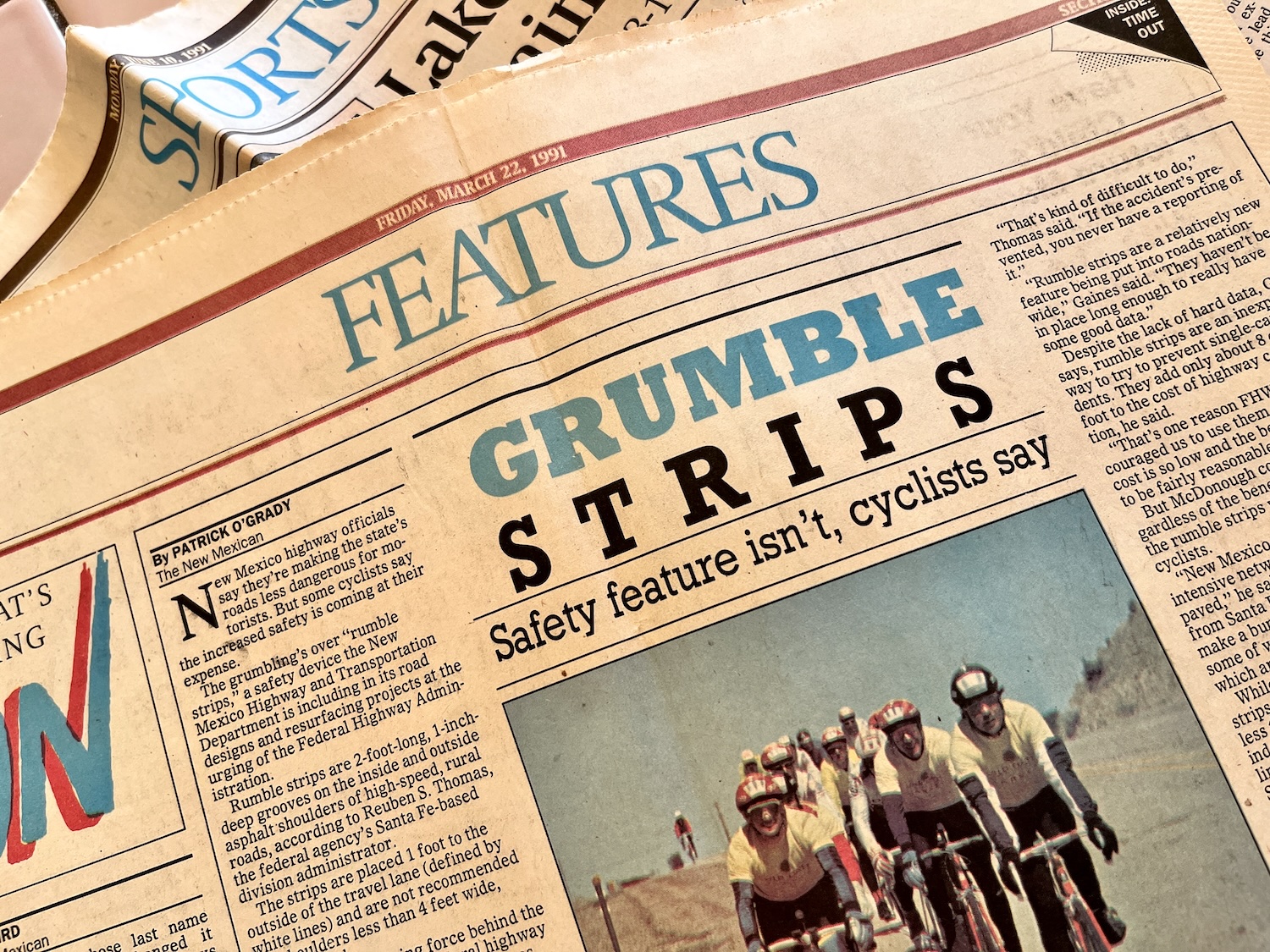
Anyway, the only thing raving about shitty newspapers ever got me was an invitation — more than one, actually — to leave the one I was raving about and drag my surly ass off to some other shitty newspaper, posthaste, s’il vous plaît, don’t let the door hit ya where the good Lord split ya, etc. I managed my final escape from The New Mexican in 1991, one step ahead of the publisher’s spike heel, and that was that.
You regulars know the story. I had joined that paper in 1988 as a copy editor, then cycled (har de har har) through a number of gigs — assistant sports editor, assistant features editor, and finally features editor, doing a little cartooning and cycling reportage on the side — before taking it on the Jesse Owens in ‘91 to do as a freelancer what pretty much every Damon Runyon character did on Broadway, to wit: “the best he can, which is an occupation that is greatly overcrowded at all times. …”
Boy howdy.
Still, 15 years of newspapering set me up pretty well for freelancing, because while I wasn’t exactly great at anything, I had learned to be OK at a number of things: writing hard news, soft features, and commentary (and fast, too); editing other people’s work and proofing pages; drawing cartoons and taking photos. I would try just about any old thing for any old crook who could spell my name right on a check and remember to mail it while I could still remember what I did to earn it.
So there I was, just doing the best I could and plenty of it, because freelancing paid less than newspaper work, and the kind of newspapers that would hire a hairy pain in the ass like Your Humble Narrator didn’t pay shit. If you wanted to get a raise, you had to move to another newspaper, and without being kicked, too.
Or maybe that was just me.
Happily, freelancers basically pioneered the concept of “remote work,” which kept my pain from manifesting itself daily in various editors’ asses. For a while, anyway. I developed a long reach. Nevertheless, I managed to log 30 years as a freelancer, twice the time I spent raving my way through a half-dozen Western dailies and one weekly outfit, and only had to move four times.
And newspapers taught me how.
I liked newspaper work, when I wasn’t hating it. The people were smart, except for the ones who weren’t, and you could try your hand at damn near anything unless you wanted to get paid more for it, in which case nix. The shift was basically hours of fuck-all peppered with seconds of cardiac arrest and/or stroke and we had to remake the entire fucking product every fucking day.
And no do-overs. Once your mistakes were off the press and soiling the readers’ greedy little paws they were yours forever, like misspelled tattoos.
God, it was fun. Except when it wasn’t. But sometimes even then, too. Plus it fed and housed me for 15 years, and set me up for the next three decades.
“Holy hell, hon’, better start filling the sandbags.”
Winter finally came a-calling yesterday.
More of a “ring the doorbell and run” deal, actually. Left 0.06 inch of rain on our doorstep instead of a flaming sack of dog shit.
We’ll take it. Don’t gotta stomp it out or nothin’.
Today dawned clear and cold, and the furnace and humidifier were harmonizing on what sounded like some sort of mariachi tune as I awakened just before 4 to “shake hands with the governor.”
“Are you getting up or going back to bed?” Herself asked as she set about her day.
“Back to bed,” I mumbled, and made it so. The next two hours of sleep were top shelf, curled up like an old dog under blanket and comforter. The news cycle can’t get me in there, with the phone locked and in silent mode. No wonder Miss Mia Sopaipilla loves the bed-cave I make for her every morning after coffee. And she doesn’t even read The New York Times.
The press is deep into “The Year in Review” mode now, which reminds me of the last time I went to a Broncos game at the old Mile High stadium, back in the days when the Donkeys would have had their hands full going up against a Pop Warner squad from Saguache.
Anyway, the Donks were getting their asses handed to them, by whom I can’t recall, and though there was plenty of time remaining on the clock, the stands were emptying faster than bladders overloaded by the industrial lager the fans were slamming to drown their sorrows.
In mid-exodus the PA gives out with a cheery, “And don’t forget to watch ‘Bronco Replay'” on whatever local TV channel was playing the piano in that whorehouse. After which some tosspot a few tiers downhill from us lurches to his unsteady feet, bellows, “Wasn’t it bad enough the first time?” and then tumbles down the stairs.
All these years later three hundred and sixty-five steps seems like quite a tumble, especially since I’m not wearing any protective gear — like, say, sinuses lined with cocaine, a beer-swollen liver, and a couple dozen extra elbees of adipose tissue.
So please excuse me if I skip the replay. It was bad enough the first time.
“What’s in a name? that which we call a hose / By any other name would smell as sour.” Apologies to The Bard.
Man, did I ever have to take the scenic route to this post.
This morning as I scanned the news, I noticed a headline at The New Mexican‘s website:
“Delays, bankruptcy let nursing-home chain avoid paying settlements for injuries, deaths.”
This sort of revelation is always of interest to me, as I am of a certain age, Herself’s patience is not without limits, and I have seen my mother, her mother, and an old friend renting rooms in such places.
But I don’t subscribe to The New Mex, and didn’t bother trying to hurdle their paywall.
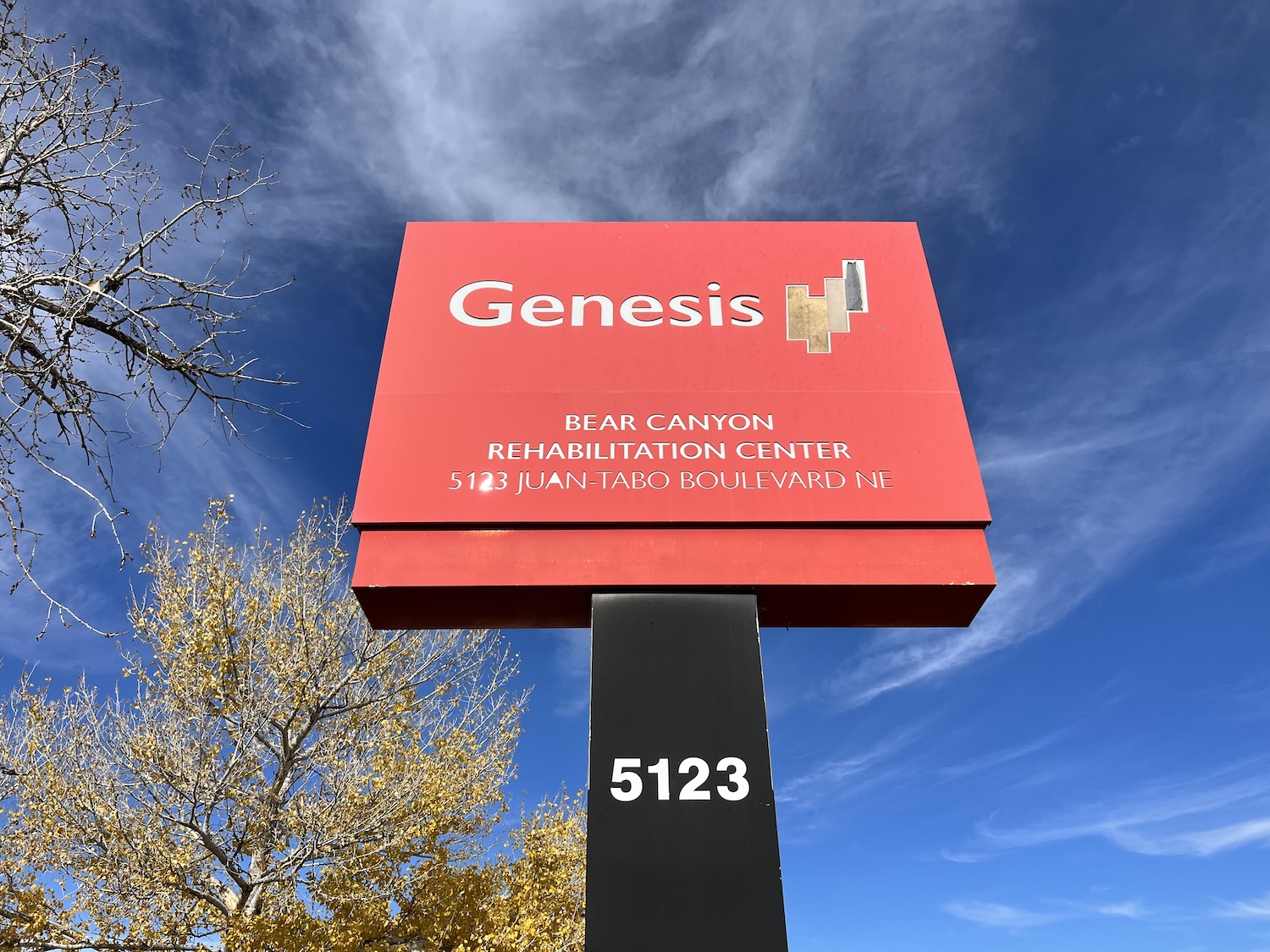
And then, in a sidebar beneath the main story, I saw the name of the nursing-home chain: Genesis.
Aha! As it happens we know someone who had a family member installed in one of their Duck! City facilities. This person failed to thrive, and the tales told did not recommend the joint as a comfy bench upon which to await the Greydog to the Hereafter, though it seemed a stint there might have made good training for a triathlon featuring Cormac McCarthy’s Road and Dante’s Sea of Excrement.
Our source called the outfit “Genocide.”
So I launched a quick search and hey presto: Turns out the piece by Jordan Rau was not by a New Mex scribe. It came from KFF Health News, the news arm of KFF, an endowed national nonprofit that calls itself “the leading health policy organization in the U.S.” (You may remember it as the Kaiser Family Foundation.) They have a very liberal reprint policy, but I’m just gonna give you the links and a free taste:
Once the nation’s largest nursing home chain, Genesis says it was spending $8 million a month defending and settling lawsuits over resident injuries and deaths in recent years. But the company is now poised to wipe the liability slate clean by seeking refuge in the most protective corner of the legal system for the nursing home industry: bankruptcy court. The Genesis case, one of 11 large senior care bankruptcies this year, illustrates how health care companies can dodge public and financial accountability for alleged negligence through delays, confidentiality clauses, and bankruptcy maneuvers, a KFF Health News investigation found.
It seems a bankruptcy judge has declined to sign off on one typical evasive maneuver (the sale of its nursing-home business, reportedly to an insider). Everything I was able to find on that was paywalled.
In other news, though the story mentioned three incidents in Duck!Burg facilities (Genesis has 10 of them here), and despite the ease of reprinting or citing KFF’s heavy lifting in this matter, I’ve seen nothing about this in the Albuquerque Journal, which has been otherwise occupied trying to make its grotesque website easier to look at and navigate.
A “Local” drop-down under “News” would be a plus. Recaps of gruesome murders in California and Australia I can get elsewhere.
And if I were a working editor instead of just another doddering old ink-stained wretch in queue for the Soylent Green treatment I might bookmark KFF Health News, too. The Genesis locations I visited today had full parking lots. Surely the visitors can’t all be personal-injury attorneys. Some might be subscribers visiting loved ones.
The ever-readable Mike Ferrentino has a meditation on “garbage miles” in his “Beggars Would Ride” column over at NSMB.com.
No spoilers. Pop over and have a squint. I will say only that his thoughts on the topic have evolved over the decades, because he is mos def one of the higher primates.
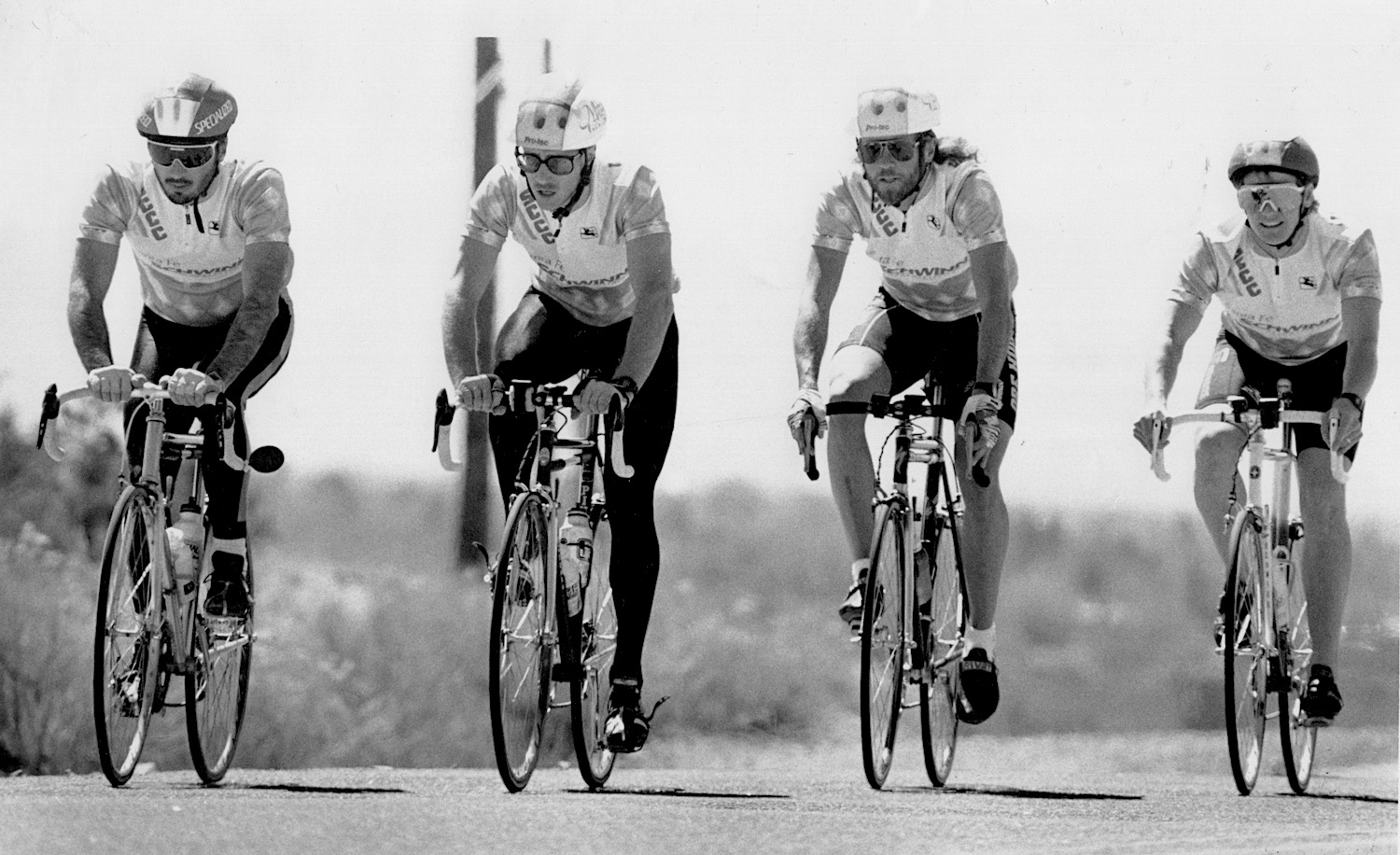
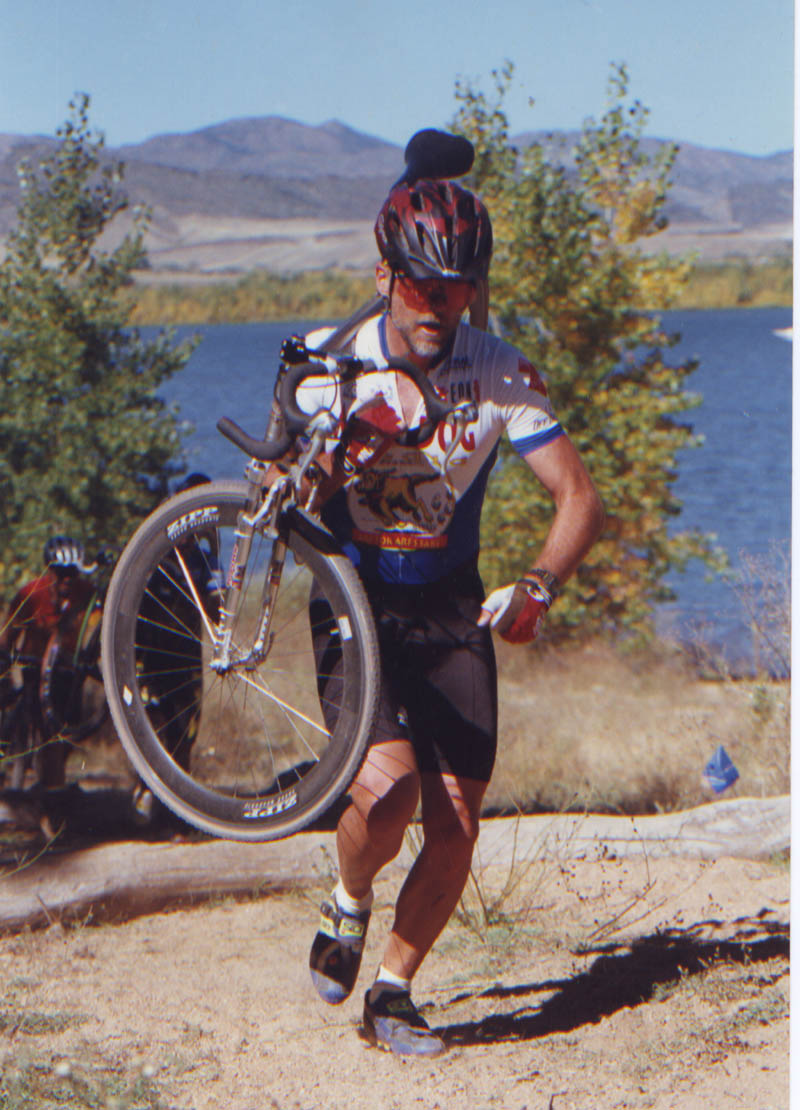
This photo was taken three days before my 36th birthday. I was single, I had a job, and yes, that is a ponytail you see peeking out of the back of my helmet. Photo by Larry Beckner | The New Mexican
I first encountered the concept of garbage miles back in the Eighties, while racing bikes out of Fanta Se. Logging a ton of miles I was, and getting ruthlessly flogged on race day by people doing half my weekly average, or less.
“The fuck?” I inquired.
“Too many junk miles,” they replied.
Junk miles, garbage miles, all samey same. Unfocused and thus unworthy. Or so they said, the rotten, podium-hogging sonsabitches.
But not me. Because whenever I was in the saddle spinning I was not parked at the The New Mexican‘s copy desk, where I had to log many junk miles indeed to underwrite my cycling habit. Many, many of them.
At least the bike miles, like crucifixion, got me out in the open air.
Once we moved to Bibleburg in fall 1991 I kept it up. The Sept. 15 entry in my training journal after a 157.5-mile week was: “A few respectable miles. Nice to not work — nothing like a job for fucking up your training.”
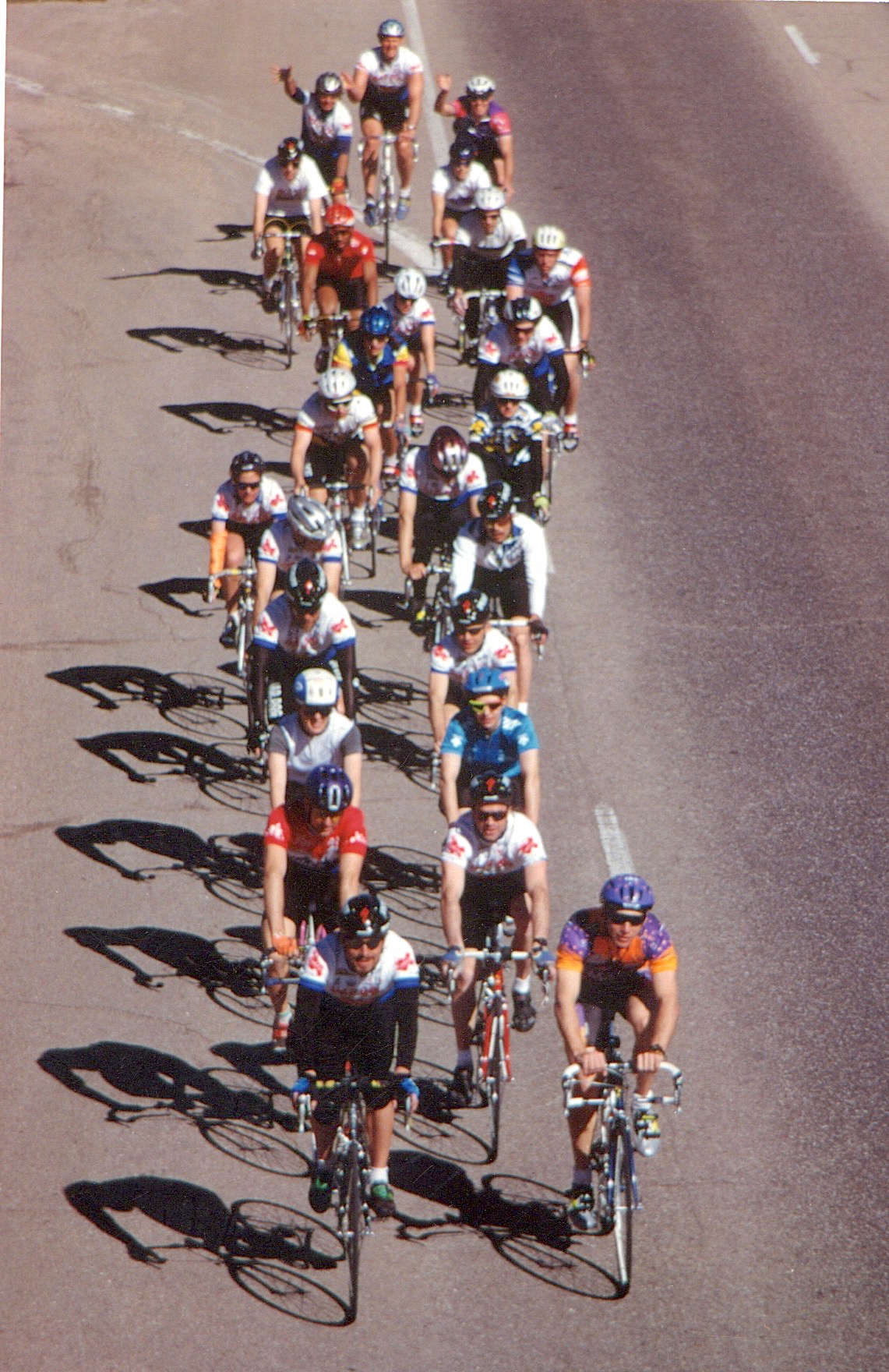
The fabled 115 ride from B-burg to Penrose and back, circa 1995 or thereabouts.
“Training,” he calls it. This is the hee, and also the haw. Oh, I was riding on road and off, first with Rainbow Racing, then later with the Mad Dogs. And I was running regularly, even doing a little inline skating and snowshoeing because I was freelancing pieces to a sports-and-fitness outfit in Boulder between my chores for VeloNews (see, I was actually trying to work and earn, kinda, sorta).
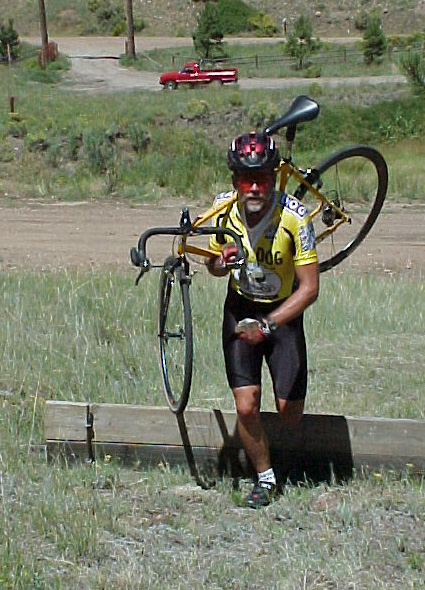
But at my first few Colorado cyclocrosses I was either OTB or DFL, eventually settling into a fairly reliable fourth-place kind of fella, out of the money yet very much in the way. Seventh of 11 finishers at the state championships at Chatfield State Park that year, after which I called it a season.
Too many junk miles. Garbage miles. Whatevs.
Oh, I got better. Or maybe they got worse, as one of the fast guys mused in my presence after I finally managed to finish a race in front of him. In any case, by the mid-Nineties I could podium at a ’cross every now and then, even win, rarely, if the weather got truly evil and the fast guys stayed home.
Solo on the home course.
This could’ve been because I actually trained for cyclocross, which by this time was the only cycling discipline I really cared about.
I worked on technique, ran a ton to counter my lack of snap in the saddle, and even built my own course at altitude (at the base of our 43-acre plot at 8,800 feet outside Weirdcliffe in CrustyTucky).
During the seven years we lived there I rode a ’cross bike just about everywhere, because pavement was miles away and when I finally got to it I didn’t want to be herding the old mountain bike with its 26-inch knobbies and boingy fork. Though I missed its 24-tooth granny ring while cursing my way up the long dirt mile back to the house, 430 feet up from the washboarded county road.
Dogging it at Chatfield.
Not a lot of junk miles in CrustyTucky.
In those years I logged my junk miles behind the wheel of a Toyota pickup, with my bikes in the bed. Our Mad Dog cyclocrosses were in B-burg, a 150-mile round trip from home base. The bulk of the state race series meant an even longer slog up the Front Strange, to Littleton, Denver, Franktown, Boulder, Mead, and Fort Collins. The weather was frequently wintry, masters were always first to race, and more than once to make the start I had to hit town the day before, overnighting in some low-rent motel.
Talk about your junk miles.
After a few years of that my training logs crumbled into random entries followed by none at all. It was starting to feel a whole lot like work — which was also suffering in part because the cycling community in CrustyTucky consisted of me, myself and I. It felt like being sentenced to Stationary Trainer Without Parole. I was taking all the pulls and yet going nowhere. In terms of fiscal and mental health it seemed prudent to seek out a few voices that weren’t coming from inside my head.
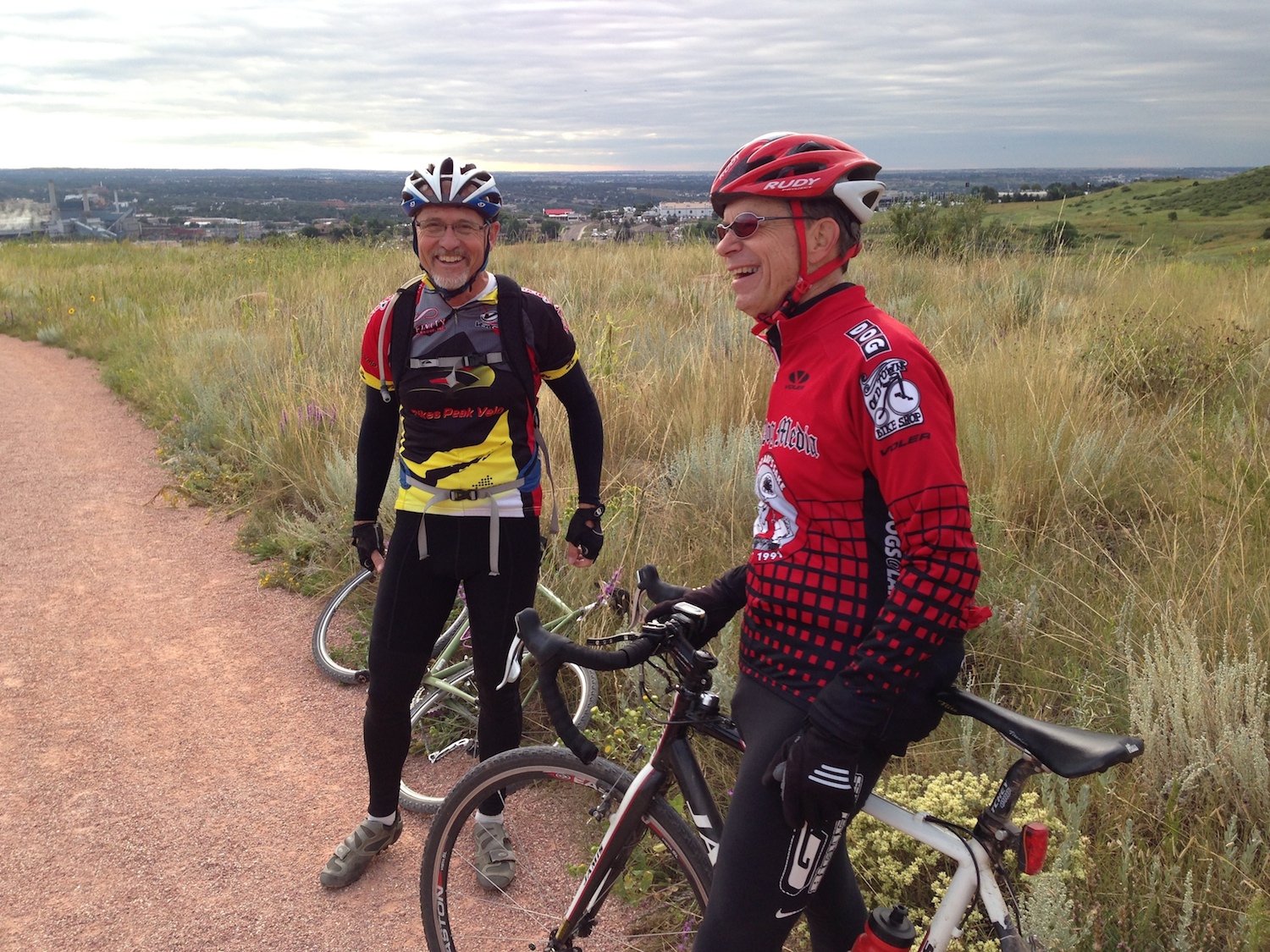
Dennis the Menace and Dr. Schenkenstein take the long view atop Bear Creek East, a once-active cyclo-cross venue.
In those first years back in Bibleburg I had a good crew. Quite a few of the Mad Dogs owned the clocks we punched and could rearrange at least one business day a week to log junk miles and devise solutions to the various crises facing the world (you’re welcome). Big Bill “Shut Up and Ride” McBeef and his bro Other Bill. Usuk and The Geek. Dr. Schenkstein and Dennis the Menace. The Old Town Bike Shop crew. And the rest of you lot; you know who you are. So in 2002 we went back there.
Took me right back to my riding roots it did. I no longer felt as though everything was uphill and into the wind in all directions. A couple years later I quit racing because I didn’t need it anymore. I had my junk miles. Garbage miles. Whatevs.
 Mad Blog Media