
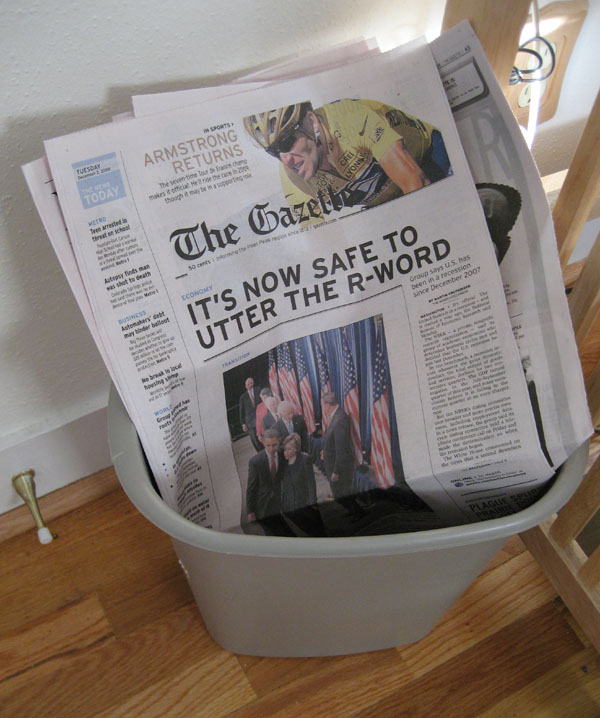
The headline is old newspaper lingo for “end of story,” and with this post I’ll end my discussion of the decline and fall of newspapering and move on to more important topics, like the Festival of Zappadan, which commences tomorrow.
In comments, James chides those of us who prefer taking our news online to paying hard cash for the daily fishwrap, noting that journalists deserve to be paid for their work, like anyone else providing a product and/or service.
But readers have never “paid” for their papers — the price of a newsstand copy or even a subscription doesn’t begin to cover the cost of ink, much less of newsprint, presses, computers, reporters, photographers, editors, wire services, delivery systems and so on. Newspapers and magazines depend upon ad sales for the bulk of their revenue, and these days ad dollars are going elsewhere, along with the readers. One of the magazines I work for is budgeting for a flat year on the print side and a boom year on the web, because that’s where the eyeballs are.
Why is this? In part, immediacy. When I got my first newspaper job, in 1974, it wasn’t uncommon for a paper to publish more than one edition per day. By the time I quit, in 1991, that sort of thing was limited to the occasional “special edition,” run off in response to some particular triumph or tragedy. And where TV once followed our lead, we had begun watching TV in the newsroom to see what The Big Eye deemed newsworthy.
Today, everyone’s hooked into the Intertubes, a 24/7 information source that makes TV seem quaint and newspapers prehistoric. Plus it’s free! All you need is, um, a computer, software, a wireless card, a wireless-ready DSL or cable modem, an ISP. . . .
Newspapers and magazines alike were late to respond to this most recent incursion onto “their” turf, particularly when it came to devising revenue models and deciding how to drive traffic from print to online and online to print. What goes where, and why? Is online merely a promotional device, intended to serve old-style journalism, or is it The Next Big Thing?
Well, we know how that turned out. Today’s reporter is as likely to pack a video camera as a pen and pad when he or she races off to cover a story, and the news item may appear first online, as a video clip, podcast or blog, and the next morning in print as a traditional newspaper story.
And that brings me to the second half of the equation: Quality, as determined by management’s myopic focus on the bottom line to the exclusion of all else in the face of a changing environment.
When I started in newspapering, Linotypes, manual typewriters, blue pencils and paste pots were the tools of the trade. Reporters reported and wrote. City editors and their assistants oversaw reporters’ work and ensured continuity in coverage. Copy editors edited copy and wrote headlines under the supervision of news editors, who laid out the pages, and slot men, who were the last gatekeepers before copy left the newsroom for the composing room. Wire editors compiled the wire-service offerings, some of which were localized to make them more relevant to the readership. A newsroom was full of specialists — the police reporter, the business editor, the photo chief.
With the advent of computerization, however, this began to change, and rapidly. The production side took the first hit — no more Linotype operators, printer’s devils or engraving rooms — but the newsroom was next. Copy editors began taking on typesetting functions in addition to editing and writing headlines, and by the time I left my seventh and final newspaper job it was not uncommon for a rim rat to be editing copy, writing headlines, designing pages, paginating them (this being the process of assembling a page — flowing text around ads, adding photos, cutlines, info boxes and what have you) and finally proofing them.
Something had to give, and in my experience it was the quality of editing that suffered most. Poorly conceived, badly reported, ill-written and casually edited copy slipped past us and into print while we were bogged down in the minutia of production, and there was no time for strategic thought about improving the ways we covered and presented the news. It’s worse now, with reporters, photographers and editors expected to blog about this and that in addition to their other chores, all while responding gently to e-mailed screeds from the tinfoil-beanie whackjobs who formerly annoyed only the editorial-page editor.
Too, chains were expanding and staffs were contracting. Good reporters and editors are expensive, more so than wire services, and a lot of Metro sections were (and are) getting filled up with regional Associated Press copy, which never takes vacations, sick leave or smoke breaks. Some chains repackage copy from this paper as copy at that paper, neglecting to tell the reader that his “local” fitness columnist is in fact writing some 1500 miles away. Others have formed story-swapping partnerships with out-of-town papers, as have the Gazette and the Rocky Mountain News. All are shedding staffers like a dead dog does fleas.
The upshot is that many newspapers have become defective products, failing to deliver the goods — timely, informed coverage of the news, especially local news. And I try very hard not to reward incompetence by paying hard-earned money for it.
Frankly, I suspect that most readers of newspapers stick by them out of habit. They’re probably older, like me, with longer attention spans and accustomed to the feel of a paper in the hand as they push their eggs around the plate. But we’re not gonna be around forever, and neither will newspapers, not in their present form. The outfits run by smart people will focus on local news and devise some synergy with online to feed both ends of the operation and keep the younger, hipper readers. The ones run by bottom-line dummies will go away.
Postscript: This isn’t entirely academic for me, as you may suspect. VeloNews croaked Winning through, among other things, increased frequency of publication. Winning was a monthly color slick with a long lead time; VeloNews was a mostly black-and-white newsprint rag that came out every other week. You’ll notice your local newsstand is short on copies of Winning these days. Now, of course, VeloNews faces its own timeliness crisis — the explosion of cycling news on the ‘net — and it is retooling to make the transition and survive in the digital age. Ironically, the feature-driven mag now looks not unlike Winning while the news-oriented website looks more like VeloNews. So it goes.
Postscript 2: It could be worse.
Postscript 3: It is worse: They’re laying off the cartoonists, including Brian Duffy at the Des Moines Register.
 Mad Blog Media