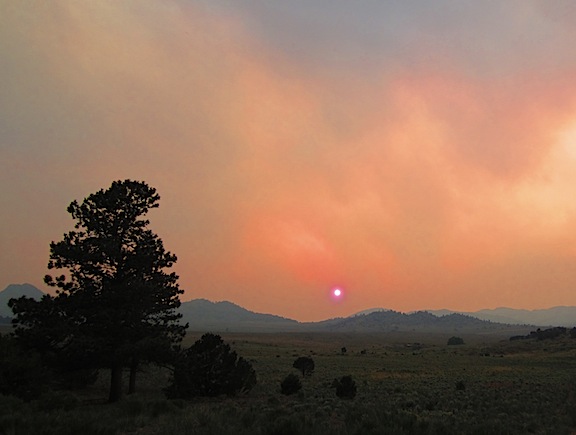
This sunset actually happened. It was not predictive of anything other than the sun setting.
I was wandering idly along the trashy shoulders of the Infobahn this morning, trying to not step in or trip over any particularly toxic bits of debris, when I noticed a newsletter from veteran scribe James Fallows that had gone overlooked in my in-box.
In it, Fallows proposes that cash-poor news organizations invest their limited resources in what’s actually happening now in politics instead of what might happen, “which the reporters can’t know when they’re writing the stories, and which readers will eventually find out anyway.”
For readers, he cites three types of stories that suggest you’ve been lured out of the newsroom and into the fortune-teller’s tent:
A story based on polls, which are manufactured “news” for those sponsoring them but only shakily connected to reality;
A story based on framing any development in terms of “how this will play” politically, which is the reporter’s guess about what voters will think, and;
A story on which candidate has “momentum” or traction” based on the vibe at events.
Predictive stories like these, Fallows says, “are like stock-market picks or the point spread on football games, but with less consequence for being wrong. And if news organizations had limitless time, space, and budgets, you could perhaps say, “What’s the harm?”
Alas, stories like these are also easy and cheap. Any half-bright wordslinger with Internet access and a comfortable chair can shower dubious wisdom upon you from a considerable height, like a buzzard with the runs. Be deeply suspicious of anything slugged “Commentary,” “Analysis,” or “Opinion.” Also, items headlined “Five takeaways from [insert actual news event here].”
However, sometimes the “takeaways” story can contain an actual glimmer of enlightenment. In one such at The New York Times this morning we have the concession — in this case, the fifth of five takeaways — that “Iowa doesn’t mean much for the fall.” This, after wall-to-wall coverage for Christ only knows how long of a non-event that saw 15 percent of registered Republicans (about 110,000 people) turn out to caucus. Thanks for sharing, Lisa, Maggie, and Jonathan.
For my part, I tip my fedora to Fallows and add a prescription of my own: Just because the Internet is endless doesn’t mean a story should be.
I read two things this morning that I knew would piss me off, mostly because I like being pissed off in the morning. That, and two cups of strong black coffee, are the jumper cables that get my heart started.
The first, from The New York Times Magazine, headlined “How Group Chats Rule the World,” was tagged “12 MIN READ.” I won’t link to it. Just because I enjoy spitting coffee into my keyboard and screaming “What the actual fuck?” doesn’t mean everyone does. We must consider the children. Also, cats, houseplants, and the homeowners’ association.
The second, from The Guardian, didn’t give me an ETA. But it was slugged, “The Long Read,” so I knew I was in for it. Headlined, “The tyranny of the algorithm: why every coffee shop looks the same,” this 4,200-word slog should’ve been headlined “I spend far too much time in coffee shops.”
I won’t link to that one, either. If that’s your idea of a good read you can chase it down yourself, or buy Kyle Chayka’s book, “Filterworld: How Algorithms Flattened Culture,” from which it was adapted.
But can you lift this mighty tome to read it? There may not be enough coffee in the shop. Or the world.
You won’t know the name, unless you worked with him or read him at the Los Angeles Times, the Colorado Springs Sun, the Gazette Telegraph, The Denver Post, or the Jackson Hole News, or studied under him at the University of Wyoming in Laramie.
But George stands tall in my personal history. He was one of the people who showed me by word and deed that there was a place in the newspaper game even for those of us who were a bubble or two off plumb.
When I got hired as a copy boy at the Colorado Springs Sun I was at loose ends following a brief tour of the dead-end gigs available to a dropout from a third-rate college. George was the police reporter, as I recall, and came to the Sun from the L.A. paper.
Back in 1974 the newsroom was stiff with talent, the best possible haven for a wannabe cartoonist shambling out of his teens into nowhere special if he didn’t pull his hairy head out of his hippie arse.
Bill Woestendiek and his wife, Kay, ran the outfit, sister paper to the Las Vegas Sun in Sin City. Carl Miller, who would move on to helm The Denver Post, was city editor. Bill Buzenberg, who would rise to veep of news at National Public Radio, was his assistant and an investigative reporter.
Bill McBean, another reporter, would abandon his typewriter for a paper route, claiming afterward that he made more money from delivering the Sun than he ever did writing for it. That didn’t last; he eventually got back on the scribbler’s horse in Denver, at the Post.
I was an actual scribbler; a cartoonist, or so I thought. But an adviser at Adams State College had told me just how few full-time, paid editorial cartoonists there were in the country and suggested that I cast a wider loop, maybe consider taking a reporter’s job as my entrée, a foot in the door.
Well, there I was, with both feet in and my dumb ass for company. Not a reporter; just a copy boy. And I didn’t even have the chops for that. When Carl handed me a stack of press releases to rewrite I told him I didn’t know how to type.
“Better learn,” he replied. And I did, whenever I wasn’t stripping and sorting copy from the wire-service teletypes, running copy and art to and from composing and engraving, and doing other scutwork so real journalists didn’t have to.
I learned something from all these people, starting with typing, thanks to Carl, who also passed on some firm hints about how to write for newspapers. Bill Buzenberg let me tag along and watch him interview hookers for a piece on the massage parlors infesting Bibleburg. The Woestendieks let me sit in on the copy desk on slow nights, learning how to fit copy, size art, and write heds.
George and Bill McBean took me out for drinks, told me war stories, had me over to their houses for dinner, introduced me to their wives; I soaked up their experience like a bar rag and felt as though I had become part of a family.
When I left the Sun to go back to school, this time at the University of Northern Colorado, George told me he hoped I’d come back as a reporter. And I did. But not to the Sun — to the Gazette, the bigger of the two papers in town. Because George was there, this time on the city desk.
He helped me sneak in the back door as a contractor — a little glimpse of the future there, yeah? I compiled the annual industrial edition, drew a few cartoons, and even wrote a couple of stories before getting hired in early 1978 as a for-reals general-assignment reporter at $155 a week.
And that’s where the rubber met the road. As George’s obit notes, he was “a meticulous editor and dedicated teacher.” He was not above crumpling up your copy and tossing it back to you. (We were still working on typewriters in 1978, and other people in the newsroom could actually see it when an editor threw your copy back at you.)
After a few rounds of journalism badminton George would call me over and explain in detail, citing irrefutable examples, precisely why I was a toothless cog in the Gazette‘s well-oiled machinery. Sometimes he and his opposite number Joe Barber would tag-team me. This could be like getting tossed around the ring by Mad Dog and Butcher Vachon.
It was the school of hard knocks, for sure. But man, if you don’t get kayoed, you learn how to roll with the punches and throw a few of your own. As Carl had told me once at the Sun, “We can teach you more about newspapering in a year than you’ll learn in four at college.”
But Carl also insisted I go back to college. Once again, good advice at the precise moment it was needed. Because without that journalism degree I would not have been able to stay and learn at the Sun, or follow George to the Gazette, where I learned even more, in the company of comrades from other schools, other papers.
Sadly, I suspect Carl’s advice is no longer relevant. Back in the early Seventies, at the minor-metro papers that hired me, editors like Carl and George could spend some time breaking in the noobs. An assistant city editor would call you over to demand an act of contrition for some sin of commission or omission. A copy editor might have some thoughts about condensation and clarification. A typesetter could catch an error that had eluded everyone else and that observation would find its way back to you like a bad check.
If the error slipped past the typesetter, the page proofer, and the press check, and actually made it into print, the managing editor might want a word. This would be truly educational. Envision a very angry principal, swinging a larger “board of education.”
Even George made a few mistakes, and like good students we did too. (Actually, we did not require coaching in making these kinds of mistakes, but we were finally getting paid, and could afford to make bigger and better ones.)
This was why the list of phone numbers taped to a drawer at the city desk listed as many taverns, titty bars, alehouses, grog shops, gin mills, cantinas, and buckets o’ blood as it did home numbers. In extreme cases some expenditure of shoe leather was required, but by then we were seasoned reporters, kinda, sorta, and dogged in the pursuit of The Story, or whoever was supposed to write or edit it.
After a few years we all moved on to other opportunities, because in the newspaper game this is how you get a raise or a better job, or at least a different one. If you’re inclined to keep making some of the old mistakes or maybe acquire a few new ones, it’s also how you get a fresh nest to shit in.
George suggested I start keeping a journal, and Lord, have I ever kept ’em.
George eventually left the newsroom entirely and settled down in academia, where he could continue gently and relentlessly squeezing the dumbass out of young eejits afflicted with delusions of grandeur.
One of his students recalls: “I learned so much from that man that I still find myself quoting him and referring to him as someone who influenced my life in important and meaningful ways.”
Me too. And you as well. You probably never read George Gladney, or worked with him, or studied under him. But if you’re reading this, you are under his influence.
Because it was George who told me back in 1974 that I should start keeping a journal. And that’s just another word for “blog.”
It’a rough ride for a Hal Walter bike. | Photo: Hal Walter
• Editor’s note: My old pal Hal Walter hasn’t been writing much lately. He’s a busy fellow, with a jackass ranch in Crusty County, a coaching gig in Weirdcliffe, and a kid at college in Shredville. But he dashed off this paean to the humble beater bike the other day and slipped it under my door.
By Hal Walter
Let me just start by saying that writing is just like riding a bike. If you haven’t done it in a while then you might as well embrace the squeaks, rust and scratched paint. Similarly, since I won’t likely be entering the Stone King Rally or even the Leadville Race Series MTB in my final 14 years of average life expectancy, I ride beater bikes.
Or not. My road bike, a 32-year-old Trek 1200, has been hanging in the garage for about 31 years. Because: I live four rugged miles from pavement and Colorado drivers are cray. Aside from the rotted rubber, it’s in mint condition.
My other bikes are off-road contraptions, what I call SUBs (Sport Utility Bikes). They are mostly bikes people have given to me over the years. A vintage Specialized Rockhopper was “gifted,” which certainly is not a verb, by friends when their guide service went belly-up. Also, I have an antique Trek Liquid 30 cross-country deathtrap with deadly brake-lever shifters. The third is a Trek Farley fat bike I actually bought as a demo for $500 — a massive sum for equipment that gets treated like a rock hammer on a college geology field trip.
My bikes ride tailgates on dusty roads (at least on the newer truck, which actually has one) or get tossed into the bed of the beater truck. They get left out in the rain and snow and cosmic rays. When they squeak I hose them down with WD-40. Well, sometimes, anyway. Usually they quit squeaking if you just keep on riding them.
Why do I even have bikes? I use them quite regularly — probably more than most cyclists — for cross-training and recovery exercise. I often ride a bike while coaching high-school cross country athletes or my son who runs college cross and track.
I also use them as transportation in my side hobby of training wild burros for pack-burro racing. I can trailer a burro away from the ranch, run it home. Then I hop on the bike, ride back to my rig, throw it in the bed and drive home. I don’t care how this looks and I often don’t wear a helmet.
A couple weeks ago the fat bike flew out of the bed of the gateless truck on a stretch of washboard. It glanced off the stock trailer I was towing, then cartwheeled into the borrow ditch. I saw this in the rearview mirror and stopped to find that, other than a scuffed handlebar grip, it seemed fine. I rode it at cross-country practice that evening.
I had planned to send that bike to college with my son, so I ended up taking it to a shop to have the frame assessed and for a tune-up: $106 total. Now the thing is like new and standing unlocked in a rack in front of the dorm. Basic transportation for a college kid. I understand they have security cameras in place, and it is at least under a roof.
During my recent travels I stopped at a high-end bike shop to see the wares. I was astounded that these things now cost thousands of dollars. I mean like $4,000 to $10,000. I got the hell out of there at high speed.
I could never own such a bike and it’s not only because I can’t afford the payments. I don’t even want one. Then I would have to take care of it, keep it indoors, worry about people stealing it, etc. This is one borrow ditch I’m steering clear of.
Besides, sooner or later someone will give me a new beater. Somebody has to ride these things.
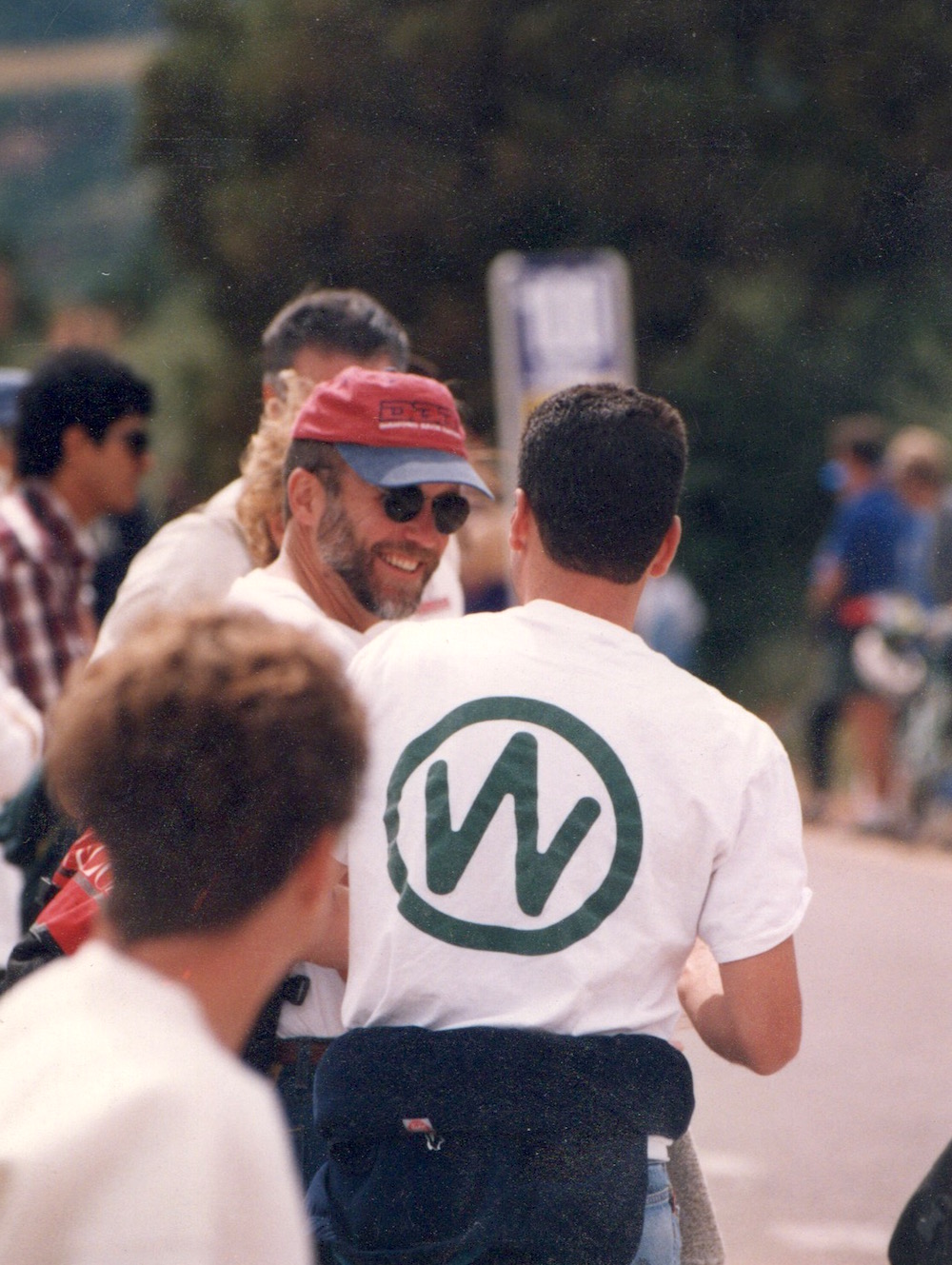
Your Humble Narrator in the salad days, covering a race in Bibleburg.
“Man is so made that he can only find relaxation from one kind of labor by taking up another.”— Anatole France, “The Crime of Sylvestre Bonnard.”
Whenever I think of myself as a “worker” I have to smile.
Oh, sure, I have worked, for short stretches, whenever there was no suitable alternative available. Drug dealer. Janitor. Installer of storm windows and patio covers. Appliance deliveryman. Dishwasher. Schlepper of pizzas and sandwiches.
But I spent the bulk of my worklife scribbling silly-ass pictures and/or arranging words in some particular order with malicious intent, to wit, attempting to convey an idea to an invisible audience.
This is right up there with tagging freeway overpasses and howling at the moon. But it pays slightly better, and mostly you can do it in the shade, sitting down.
There is a game-show quality to journalism. Your team has to collect, confirm, compose, and condense a mind-boggling overabundance of information, then stuff as much of it as possible into a sack that keeps changing size until the buzzer sounds, heralding the start of that night’s press run.
If you beat the clock, you “win” and get to come back tomorrow to play another round.
The word “play” is used deliberately. There were some long hours spent shoveling, to be sure, but they were easy on the lower back and the calluses formed mostly on the mind.
If journalism truly was a game, for me it was the only one in whichever town I was inhabiting at the moment. Composing the first draft of history day in and out in the company of (mostly) like-minded maniacs.
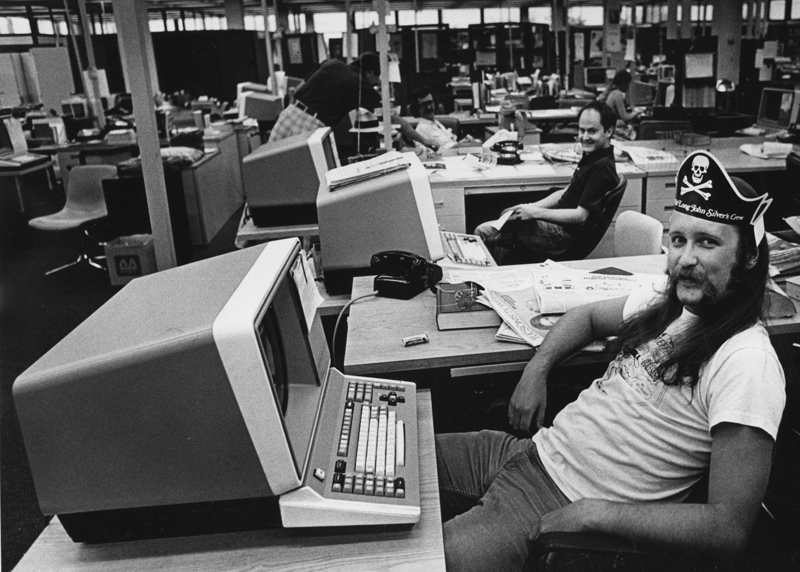
On my third daily and already thinking about jumping ship, arr.
The U.S. Navy used to sell itself by crooning, “It’s not just a job, it’s an adventure.” Journalism’s pitch was that it wasn’t just a job, or even a game, but a Calling — to preach the Gospel daily in the Church of What’s Happening Now (tip of the stingy-brim to Flip Wilson and the Rev. Leroy).
Now, if you think you are Called to preach, you are easy to exploit. And the gods could be unimpressed and indifferent.
“Fine sermon, Reverend. But that was yesterday. What have you done for Me lately?”
So, yeah. Long hours, and you frequently took the Work home with you. Sometimes it dragged you in early, or on a day off. Often it took you someplace you didn’t want to go, not even for money. Especially when you considered the paucity of coins in your collection plate.
But the Work found me when I was teetering along one of those ragged edges that beckon to oddballs like me. And it kept me in bacon, beans, and beer for nearly 15 years, though I backslid to the edge from time to time.
Living on the edge.
Finally I decided I liked the edge and set up shop nearby. A small chapel, nothing serious. My sermons were unorthodox, but so was the congregation. Same old gods, but hey, whaddaya gonna do? I dodged their lightning and kept that shtick up for 30 years.
Fortune eluded me, but I got all the low-rent fame I could handle, more than I deserved. God’s honest truth? I got lucky. In the right place at the right time, with friends in high places, and more than once, too.
Could a 20-year-old stoner with zero skills wander into the smaller of two daily papers in a medium-size city today and set his wandering feet upon a path that kept him out of jail for nearly a half-century?
Never fucking happen, to coin a phrase. There are no more two-newspaper towns, and damn few newspapers, period. Most are the journalistic equivalent of dollar stores, all owned by the same two or three outfits, all selling the same two-bit expired horseshit. And magazines are following them down the Highway to Hell, which is no longer paved with good intentions.
In 2023 the 20-year-old me couldn’t even go back to selling weed, because that’s just another job now. And you know how I feel about jobs.
I once was lost, but I was found. Can I get a hallelujah?
Smoke gets in your eyes. And your nose. And your hair, your clothes, and. … | File photo by Crusty County correspondent Hal Walter
Huh. The Elitist East Coast Big City Liberal Smartypants Media has finally discovered what us hardy Westerners have knowed for years — huffing a giant forest fire’s secondhand smoke sucks.
We’ve experienced a few lulus over the years in Bibleburg, Weirdcliffe, and The Duck! City. And yeah, they got a little ink despite being largely confined to Flyover Country.
But holy hell. When the Big Apple looks like the Devil’s been feeding his firebox a passel of green wood with a weak draft you gon’ git yoreself some wall-to-wall coverage, son! That’s Scripture!
And even a dyed-in-the-Carhartt mountain man and desert rat like Your Humble Narrator has to admit that a few hundred Canadian wildfires blowing smoke from Maine to Spokane might just be worth a few “Live” headers over to The New York Times.
My old hometown of Ottawa has been taking a hit (and not the kind made famous by Cheech and Chong).
And I expect our Great White North correspondent Ol’ Herb might have a few thoughts on the matter, if he can stop coughing long enough to file a report expanding on the Detroit News coverage. Anyone else out there wearing their N95s again?


 Mad Blog Media