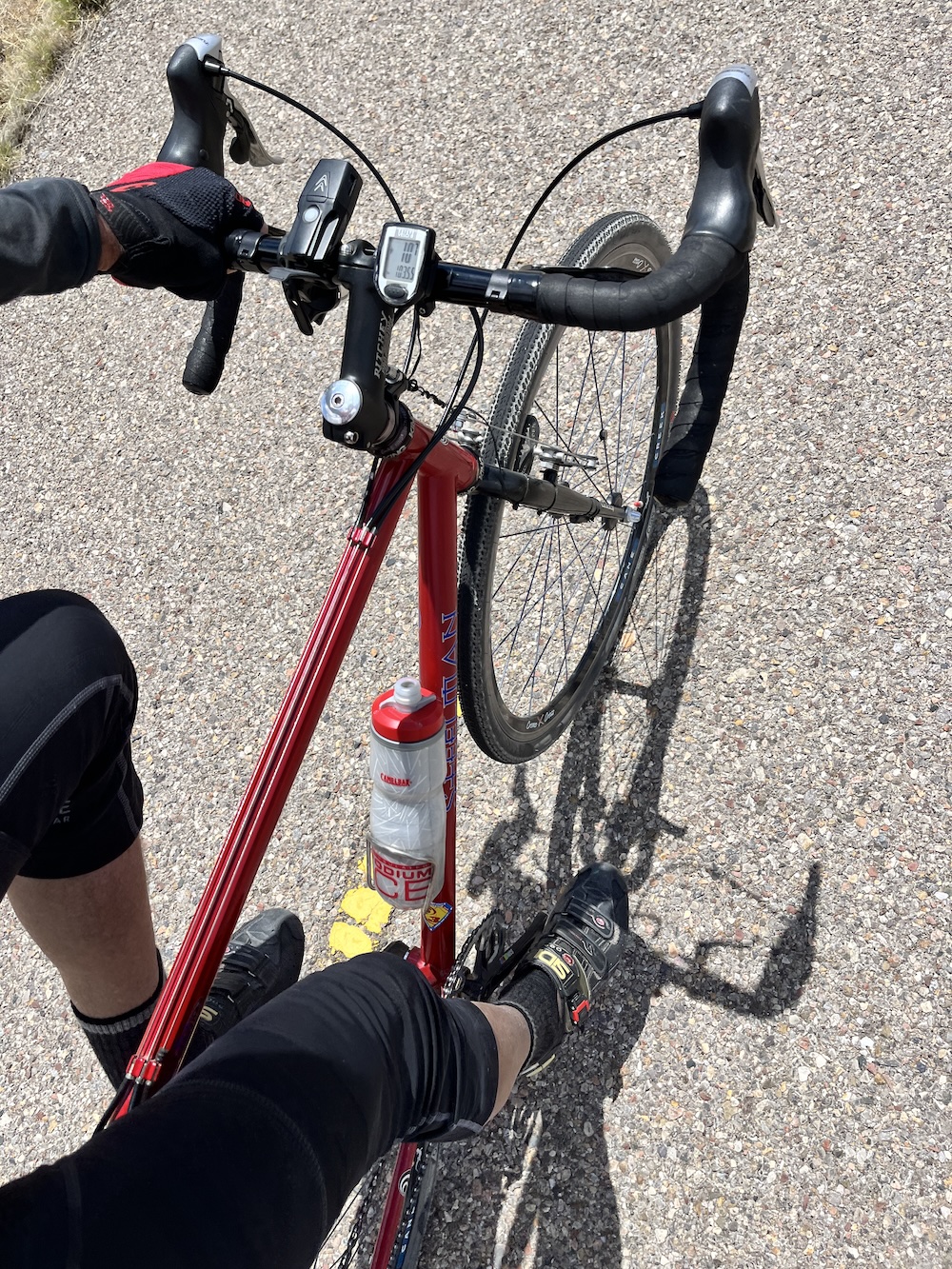
There was a May Day gathering at Civic Plaza yesterday but we gave it a miss. Instead I formed a rolling rally of one, equipped and clad to suit the occasion (in red) and the weather (brisk).
A quarter inch of rain is a whole lot better than none at all.
A quarter inch of rain fell overnight, and at high speed, too. The wind and water blew us out of a sound sleep shortly after 2 a.m., and while the rain stopped the wind was still with us at 11:30 when I took the red Steelman off its hook and rolled out to spend 90 minutes trying to find shelter from it.
We did honor the general strike. We bought nothing and did no paid work; I’ve gotten pretty good at that since retiring in 2022. To feed the starving masses I made three meals out of fridge and pantry: toast, tea, oatmeal, and fruit for breakfast; grilled cheese sandwiches for lunch; and pasta with a sauce of tomatoes, onions, jalapeño, garlic, black olives, red pepper flakes (there’s that red again) and chicken sausage for dinner.
This morning as I arose at 5 a.m. the furnace ticked on, which really lets you know it’s May. Forty-two, said the weather widget. We get summer in March and winter in May and if we’re lucky a little rain sneaks in there somewhere.
Today I will have to re-engage with capitalism in a fairly significant fashion. The pantry is bare, and the People’s Army, like any other, marches on its stomach.
Is the pen the writer? The brush the painter? The motor the cyclist?
Grumbling over coffee about the lack of interesting reading material online — just about any old thing that wasn’t about fascists, eejits, or fascist eejits— I stumbled first across a piece about artificial intelligence worming its way into the handmade world of ’zines, and then another about bearing your own burdens from the deep, deep well that is Mike Ferrentino.
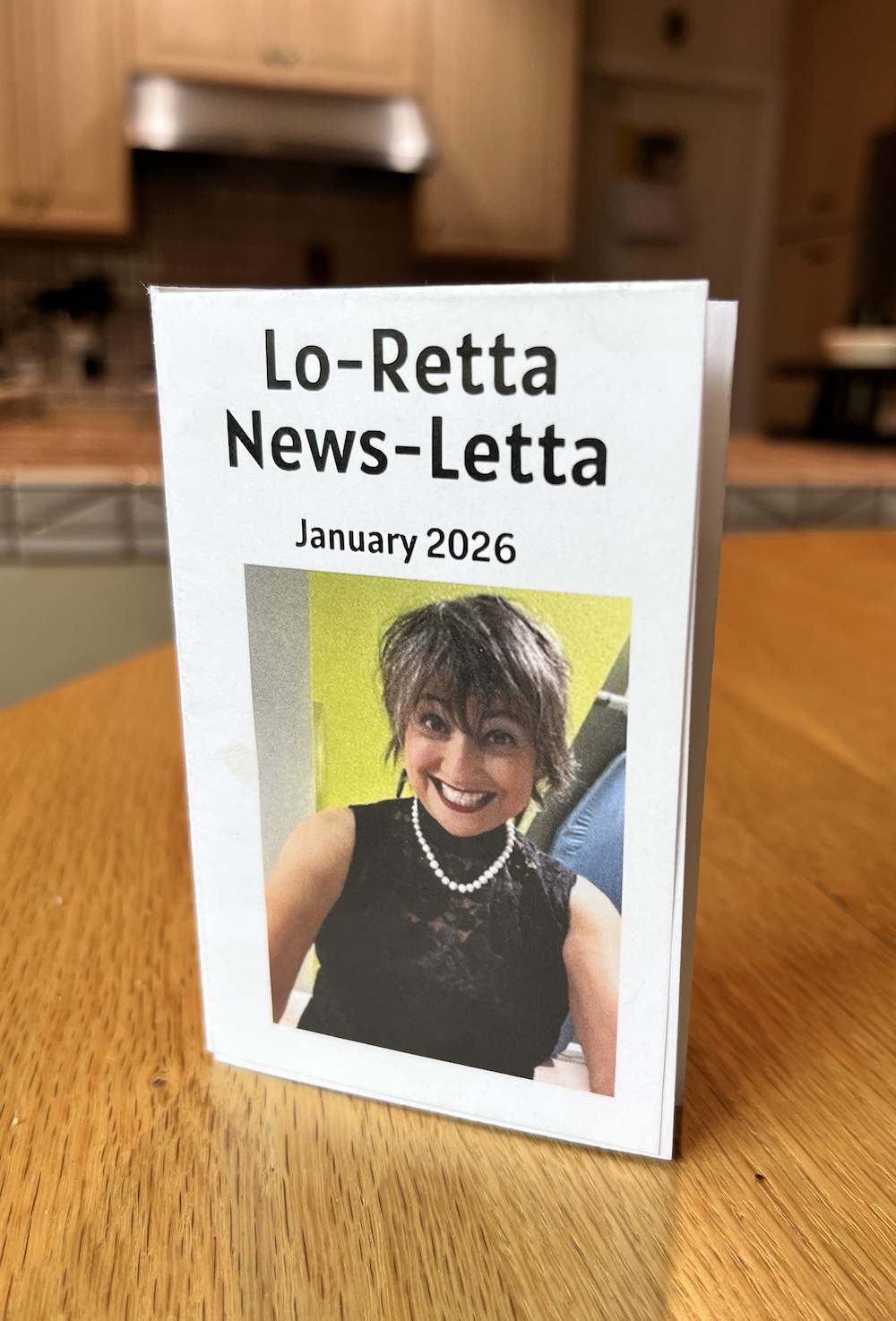
Lo’s letta.
I appreciate ’zines, with their homemade artsy feel. In January our friend Lo sent us a tiny one she’d made, about the size of a hang tag, that was miles above the tired old “What we’ve been up to” family newsletter.
The niche seems to share some DNA with the underground newspapers I enjoyed Back in the Day®. I did a little cartooning for a few of those, and even helped start a short-lived one while wrapping up that B.A. in journalism from the University of Northern Colorado in Greeley.
This may have followed my ouster as cartoonist for the college newspaper following a series of mildly vile attempts to bring Bay Area Rip Off Press-style hijinks to Weld County. My derivative bullshit failed to dollar up on the hoof in cattle country.
And the new venture somehow managed in short order to crawl right up the arse of some student-government numbnuts who threatened a lawsuit over a bit of unpleasantness we’d published.
“Good luck with that,” I said, referring him to our paper’s masthead, in which my dog Jojo was listed as editor. “Not only are you a public figure for the purposes of this story, but my dog is the editor. You’re the only person I can think of who is taking us seriously.”
Still, one longs to be taken seriously. Or at least laughed at for the right reasons. Also, paid. The Revolution was not only untelevised, it was underfunded.
So I left handmade hellraising for “straight” journalism, overstayed my welcome there, and now, here I am, a half century later, comfortably underground again and still waiting on the Revolution.
• • •
Blogging the way I do it has some ’zine-like qualities, I think. But what once was called a “weblog” actually has its roots in “journaling,” another handmade, offline sort of pasatiempo that’s enjoying a comeback of sorts. Though like everything else you can take it digital if you must — your iPhone has had a “Journal” app since 2023.
George suggested I start keeping a journal, and Lord, have I ever kept ’em.
I started keeping a journal in 1974, at the urging of George Gladney, then a reporter at the Colorado Springs Sun. In the Year of Our Lard 2026 I have 15 pounds of them, a cardboard box overflowing with old-school composition books defaced with ballpoint graffiti. And what a ’zine they would make, if anyone could decipher my scribbling (cursive early on, block lettering afterward).
The cops could clear many a cold case on the evidence therein.
“Honey, you’re making a scene!” Herself would exclaim as the John Laws burst through the door.
“No, I’m making a ’zine,” I would quip as the cuffs went on and the flashbulbs popped.
Those bracelets would come off again, and quickly, too, thanks to various statutes of limitations and a general unavailability of surviving/credible witnesses.
And then I could forget about ’zines and get back to the blogging, which I’ve been beavering away at since the Nineties, shortly after I abandoned newspapers for freelancing — basically trading one boss and regular paychecks for several bosses and “It’s in the mail. …” — and thought it might be fun to be my own underground, unpaid, hands-on publisher again, if only as a sideline.
Sadly, my editor Jojo was long gone, and his daughter Fuerte had no interest in journalism.
• • •
In the Nineties scribblers didn’t have to worry about A.I., unless they’d read a lot of science fiction. Some of us were short on intelligence of any sort, artificial or innate. My comp books and Bics got demoted from deep thought to training logs as I acquired a series of Macs, modems, and text editors. I taught myself some basic HTML, paid a rural hosting outfit to house my monstrosity in one of their cages from which it could screech and throw shit at passers-by, and hey presto! A blog.
The rest, as they say, is history, and quite a bit of it. My earliest efforts are lost in cyberspace, but the Archives contain about a quarter-century’s worth of bloggery in various states of decomposition.
What I brought to my little peepshow in the virtual carnival was decades of experience in newspapers and magazines as a reporter, editor, and cartoonist. I turned pro in the journalism racket just as newspapers were stumbling through the transition from hot type — for-reals hot, lines cast in lead by a clanking Linotype machine — to cold type, which meant computers. The times they were a-changin’.
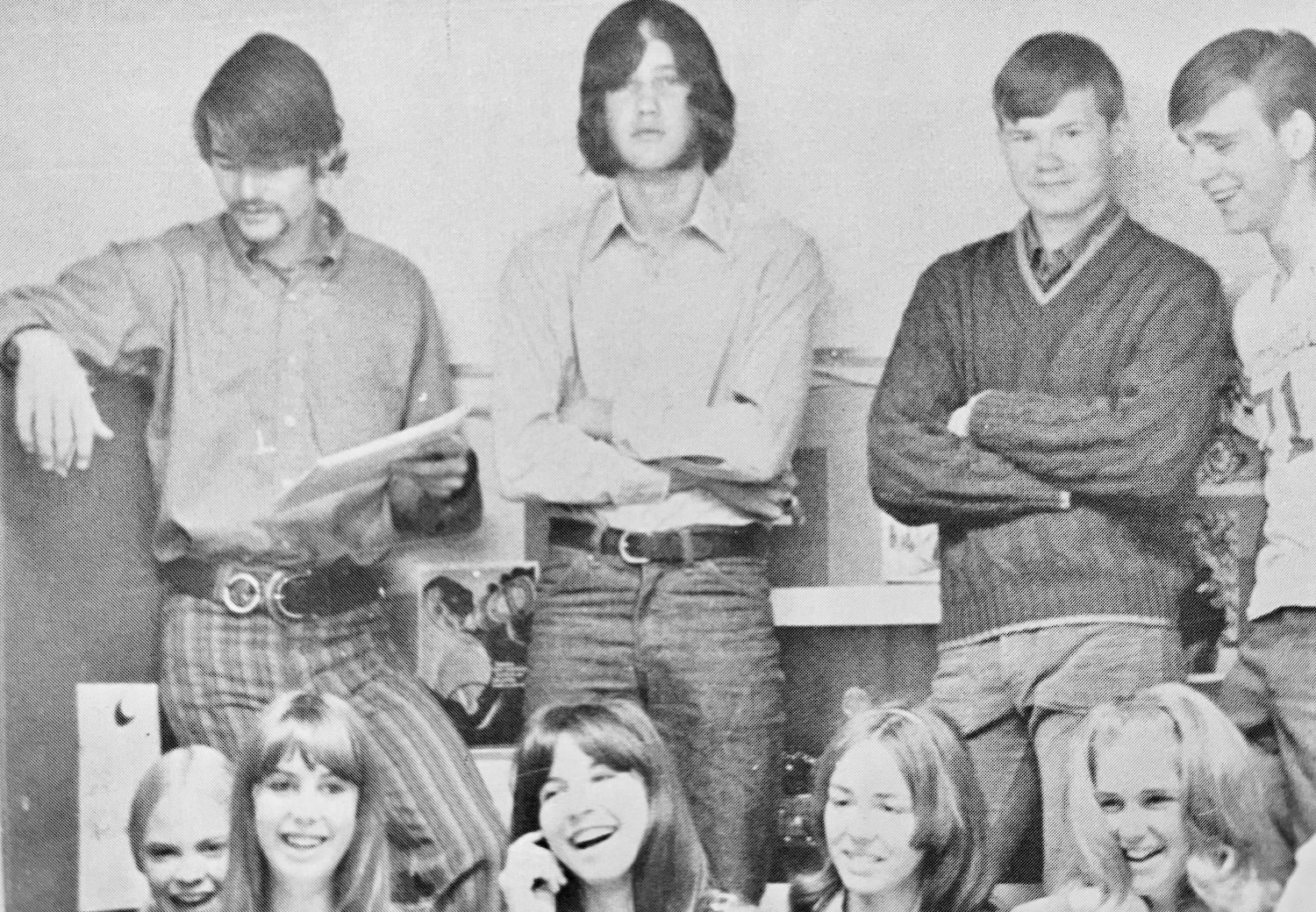
Your Humble Narrator in the Mitchell High School Echelon‘s newsroom, circa 1971.
And once the Internet became A Thing, and those computers evolved from rumbling gods behind locked doors to perky little desktop numbers that anyone could own for the price of a decent used car, they were a-changin’ again. If you wanted to keep your head above water you had to go with the flow.
Which brings us back to the process of creation, and how — for me, at least — it’s changed since I submitted that first cartoon to the Mitchell High School Echelon back in 1971.
• • •
I had only ever been a cartoonist.
Self-taught, of course. A comics junkie from jump. Superman and Batman, Mad magazine, Bill Mauldin, Herblock. I learned that you draw in pencil so you can erase your mistakes, and then try very very hard not to make more mistakes when you finally ink the penciled sketch because then you have to start over. Add ink washes or sticky halftone film to achieve shades of gray; use watercolors or colored pencils to go full Disney.
Luck of the draw.
But mostly I stuck to pencil, eraser, and black ink on paper because (a) I fucked up a ton, and (2) anything that got published was going to be in black and white anyway. Simple.
So I was I. Lord, was I ever.
And one day I found myself hired as a copy boy at the Sun, stripping wire-service copy from the teletypes, walking photos to engraving and page proofs to the copy desk, and waiting to be recognized as the next Pat Oliphant, who was then at The Denver Post.
Shortly after I’d proved competent at the basics the city editor handed me a press release to rewrite.
“But I don’t know how to type.” I said.
“Better learn,” he replied while walking away.
So I learned. My typing style remains unique, three fingers on the left hand and two on the right. Oddly fast, but a thing of beauty it is not; “touch typing” in the sense that each of those five fingers will eventually touch a key. The endless rewrites ordered by the city and/or copy desks were heavy lifting for a rookie scribe who couldn’t even fucking type, pounding away at the keys of a manual typewriter that was probably past retirement age when Damon Runyon was learning the newspaper racket down south at the Pueblo Star.
Nevertheless, I persisted. Learned. And adapted.
• • •
A few years and one B.A. in journalism later I was at the other newspaper in town — not as a cartoonist, but as a reporter — and I was delighted to see computerization finally rear its ugly head. Instead of going 10 rounds with that typewriter I could do a brain-dump into the terminal, then root through the pile and pick out a few shiny objects that might amuse an assistant city editor. If they didn’t, the rewrite would be a lot faster. And they couldn’t wad up my copy and throw it at me anymore.
Some of the veteranos in the Gazette Telegraph newsroom were less gung-ho. They would pound out their reports as per usual, on their ancient typewriters, and then with hard copy in hand retype them into their computer terminals as smoke billowed from ears at the city desk. Eventually the typewriters were removed. Some of the typists, too.
Forty-nine years, five newspapers, and countless magazines later I have written and/or drawn on just about everything using whatever was handy: pencils, pens, crayons, and keyboards; comp books, reporter’s notepads, bar napkins, and hotel stationery; manual and electric typewriters, dumb terminals hooked to mainframes, Macs connected to the Internet, and iPhones. Even shithouse walls.
Writing is never easy, because I have read so much of it, by more talented people. But it has become easier, with the advent of computers, and especially the laptop, which liberates you from the desk. Tip over the cranium wherever you are, let its contents spill out onto that solid-state floor, then root around in the pile until you find what you need.
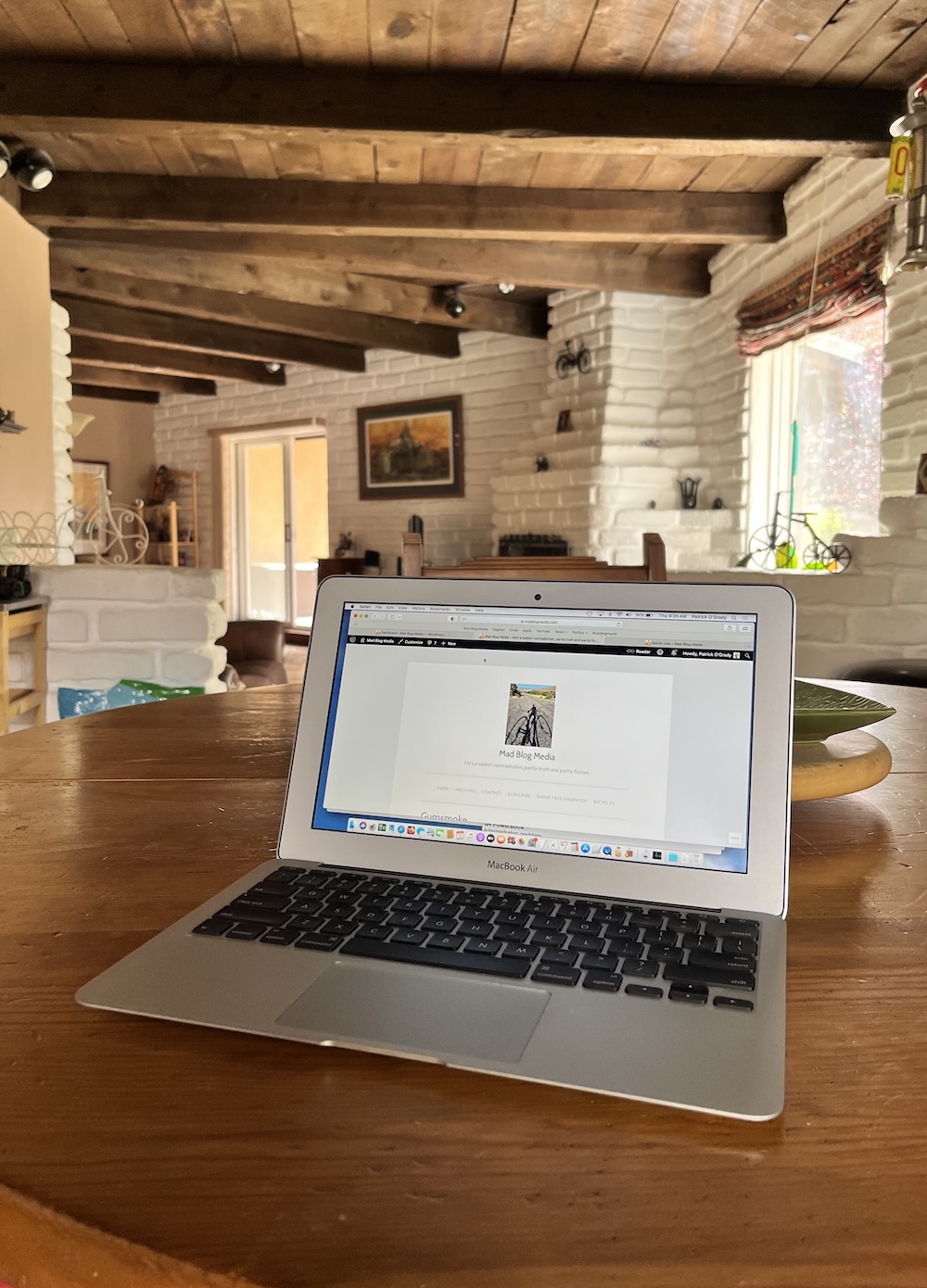
A 14-year-old hammer and chisel: My 2012 MacBook Air.
It should still feel a lot like work. Sweaty, irksome, a daylight-burning, down-the-rabbit-hole time-suck, just one goddamn thing after another. Michelangelo looked at a block of marble and saw David within. But he needed a hammer and chisel to get to him. Got his hands dirty.
I’m no Michelangelo. Just some fool with the brain farts in search of a few perverts who like the smell. Pull my finger! And I’ve tried to choose my tools wisely.
For instance, while I love me some laptop and text editor, I hate spellcheckers and grammar widgets. If I want something looking over my shoulder I’ll get a parrot. I do my own stunts, bub, and I work without a net. Now stand back and watch. Gimme room!
The cartooning got a little involved there for a while, once color became available. I needed a flatbed scanner and a lot of pig-ign’ant careening around in Adobe Photoshop to deliver 300-dpi CMYK images to the masses. But the ideas all came from the same old place (behind the increasingly powerful spectacles), and first sprang to hideous life using the same old tools (paper, pencil, pen, and ink).
My office in Bisbee, Ariz.
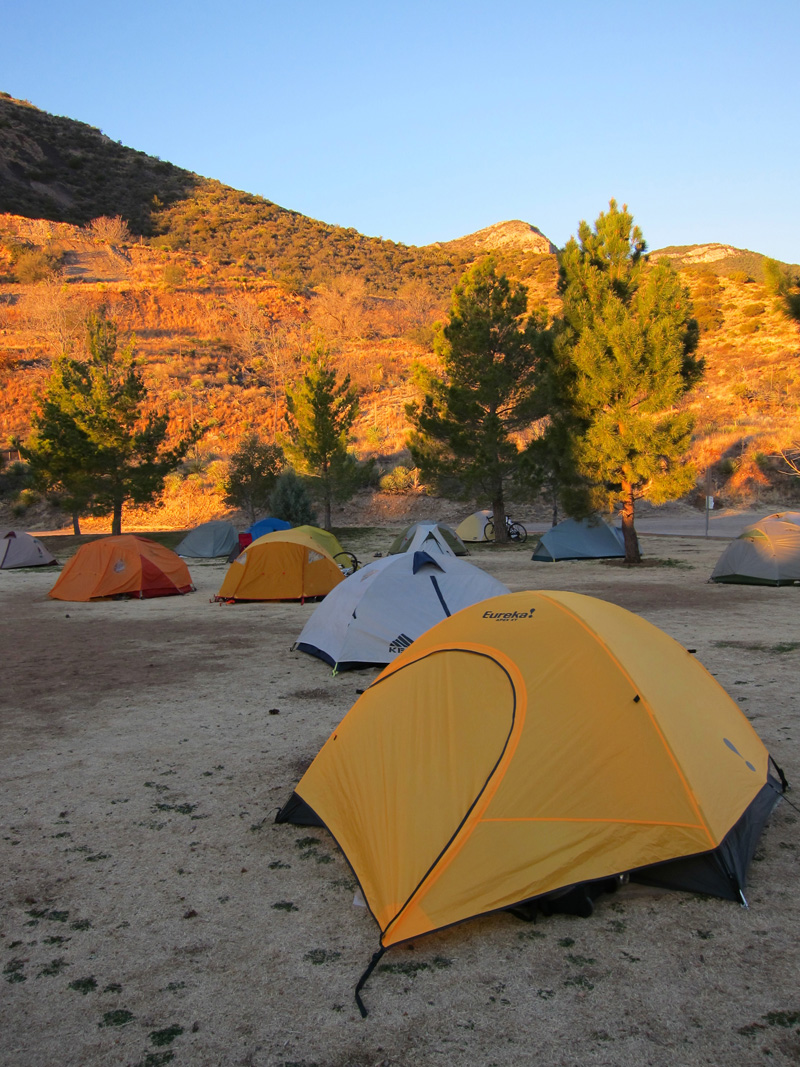
Between you and me, I think the march of progress developed a hitch in its gitalong a few years back. I work on a 14-inch 2024 M4 MacBook Pro now, but it’s no great improvement over my 11-inch MacBook Air, which dates to 2012. Better display, faster processor, yadda yadda yadda. I write a blog using a browser. I could do it with an iPhone from a tent. And I have.
So, if I ever run out of things worth saying, and interesting ways to say them, I won’t acquire some RoombaRite 9000® to hoover up all the words on the Internet and empty its bag into this blog. A.I.? N.O. It’d be like bolting a motor onto one of my Steelman Eurocrosses. Ferrentino and his father got it right: If you can’t lift it, don’t drive it.
No creative sort ever goes it completely alone, of course, unless they have a paper ranch, an ink well, a canvas farm, and a paint horse (har de har har). Find the lever and fulcrum that suit your needs and see if you can move the world. Without breaking it, if you please.
It doesn’t matter how you do the work as long as you do the work.
The question is “What will A.I. do to jobs?” And the answers come from right, left and center, from tech CEOs to academic economists to Steve Fucking Bannon — yes, that Steve Fucking Bannon.
It’s smartly reported and cleverly written and the accompanying graphics from Stephan Dybus are top notch.
You will probably not find the story comforting, as it considers the irksome human factor’s effects, if any, upon the Rise of the Machines. The long and the short of it is that where job security in Meatworld is considered, A.I. will either be just ducky or something like a pickleball dustup in Florida.
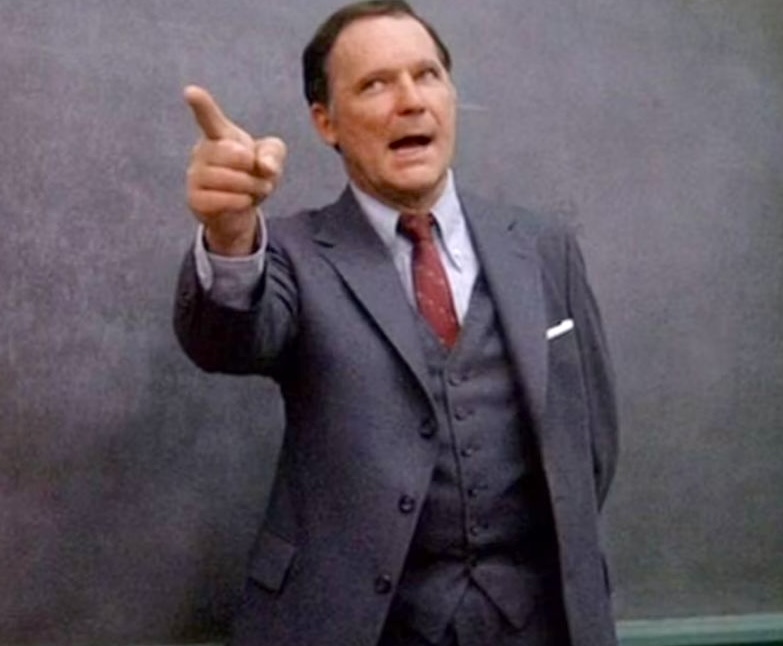
Disney CEO Vernon “Dean” Wormer pulls the plug on Jimmy Kimmel.
The Dean came for Jimmy Kimmel’s “Animal House” yesterday.
Nobody should be surprised, especially Kimmel, who has been attending the Hollywood School of Hard Knocks for the better part of quite some time and been sacked and/or compelled to apologize more than once over a long and checkered career.
Kimmel got his start in radio while still in high school, but didn’t land on America’s TV screens until 1977, when he provided the comic relief on “Win Ben Stein’s Money,” which aired on Comedy Central. “The Man Show” followed two years later.
And then in 2003 he got to hang out his own late-night shingle, “Jimmy Kimmel Live!” on ABC.
Maybe he felt safe there. Comedy Central would fall under the pinstriped shadow of Paramount, which earlier this year punked CBS News and Stephen Colbert to get its merger with Skydance approved.
But this year, ABC — a lesser rub-and-tug parlor in the Disney chain of cut-rate whorehouses — found itself caught between two rocks and a very hard place.
Two big owners of TV stations — Nexstar and Sinclair, the first seeking FCC approval to buy a rival, the second a right-wing white-noise machine — said they would suspend “Jimmy Kimmel Live!” after he addressed the killing of the recently canonized — or is that “cannonized?” — Charlie Kirk. Disney’s empty suits took notice and then gave same to Kimmel, reportedly as his audience was filing in for yesterday’s show.
If Kimmel didn’t see it coming, Calvin Coolidge certainly did. In an address to the American Society of Newspaper Editors on January 17, 1925, the president said: “After all, the chief business of the American people is business. They are profoundly concerned with producing, buying, selling, investing and prospering in the world.”
Some of them are, for sure. And you’re only funny until you get in their way.

 Mad Blog Media