Ozzy Osbourne turns 666 today (OK, so he’s only 66; sue me) and I expect that this surprises him nearly as much as it does the rest of us.
Now, you all know me as a discerning connoisseur of the arts, whether culinary, graphic or sonic, but there was a time in my misspent youth when I was something of a headbanger.
By laughing Satan’s spreading wings, ’tis a wonder my family was not chased from the ‘hood by angry villagers brandishing crucifixes, pitchforks and torches when I spun the volume knob all the way to the right for “War Pigs,” quite the anthem to hear thundering from the home of a WWII veteran.
You could actually see the picture window thrumming like the drums out of which Bill Ward was beating the shit, and Tony Iommi’s guitar licks killed all the flowers from Constitution to Maizeland. A neighbor’s canary almost chewed through the bars of its cage before exploding like a feathered M-80.
Today, of course, my tastes have become a good deal more refined. Either that or I’ve gone stone deaf. What?
It was 4:20 p.m. (smoke ’em if you got ’em) when I fired up the Forester for the latest six-hour drive from Bibleburg to Duke City.
Herself and I had been in the old hometown to prepare Chez Dog and The House Back East® for new tenants, a project I’d hoped would take only a couple of long, hard days, but I got there on Friday and didn’t get gone until Tuesday afternoon. Herself beat it on Monday, having one of them obnoxious “job” thingies that requires regular attendance.
So there I was, once again piloting a heavily laden Japanese automobile solo through the starry American night. It reminded me of the good old days, when all I needed for a cross-country jaunt was a bridge burned at one newspaper, a job offer at another, and a battered old rice-grinder that was nearly as full of shit as I was.
“What kind of sordid business are you on now? I mean, man, whither goest thou? Whither goest thou, America, in thy shiny car in the night?” — Jack Kerouac, “On the Road”
I used to love those long nights behind the wheel, in part because I generally enjoyed some sort of illicit chemical assist, having studied at the feet of Jack Kerouac, Ed Abbey and the redoubtable Dr. Hunter S. Thompson. Once a friend and I even took a page from the Good Doktor’s book — to be specific, a page from “Fear and Loathing In Las Vegas” — and ate some acid before stalking into the old MGM Grand to see what we could see, which proved to be much more than was actually there.
In short, it was a bad idea, like so many of the Good Doktor’s, and we quickly jumped back into our auto and drove straight through the inky darkness of the Intermountain West to Alamosa, Colorado, for a steaming plate of enchiladas and beans served up by my companion’s mom, who either didn’t notice or didn’t care that we were horribly twisted on LSD and Budweiser.
After a few hundred thousand miles of that sort of thing, coupled with deteriorating night vision, a bad back and a considerably diminished drug intake (I’m pretty much down to a cup and a half of coffee in the morning these days), I lost interest in snorting that long white line through the windshield and sleeping it off under the camper shell in some rest area or unpatrolled parking lot. When the sunlight started fading, so did I. A motel bed sounded a lot better than drumming on the steering wheel with ZZ Top, Bob Seger or the Allman Brothers cranked up to 11.
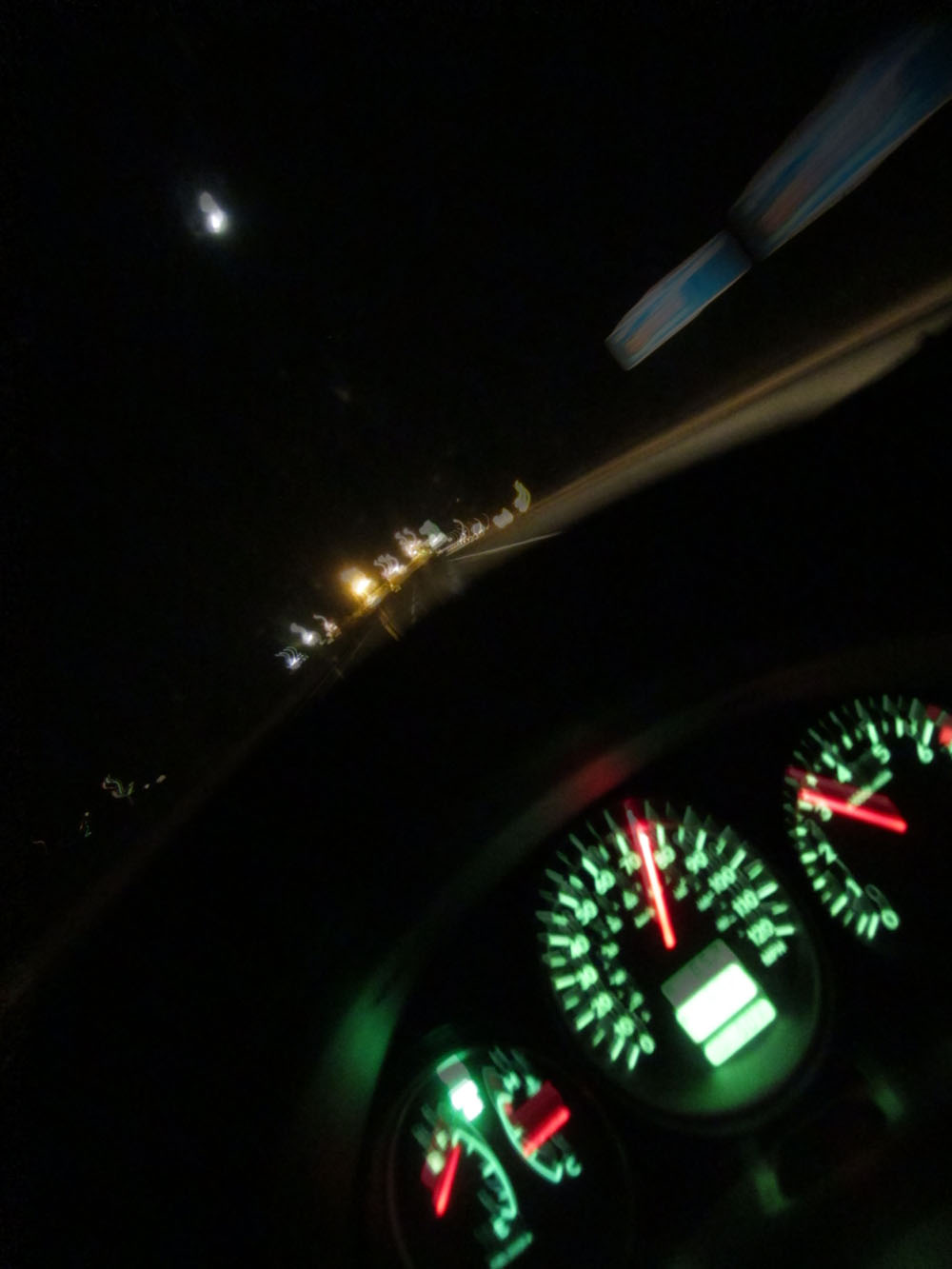
But I got a little of the old love back Tuesday night. As I motored southwest with the cruise control set at a safe and sane 75 mph a banana moon hung brightly in the sky dead ahead, the highway stripes rising up as if to meet it on the hills. Where to go? Mexico? San Francisco? Albuquerque, as it turned out. I left the stereo off and listened to the music in my head.
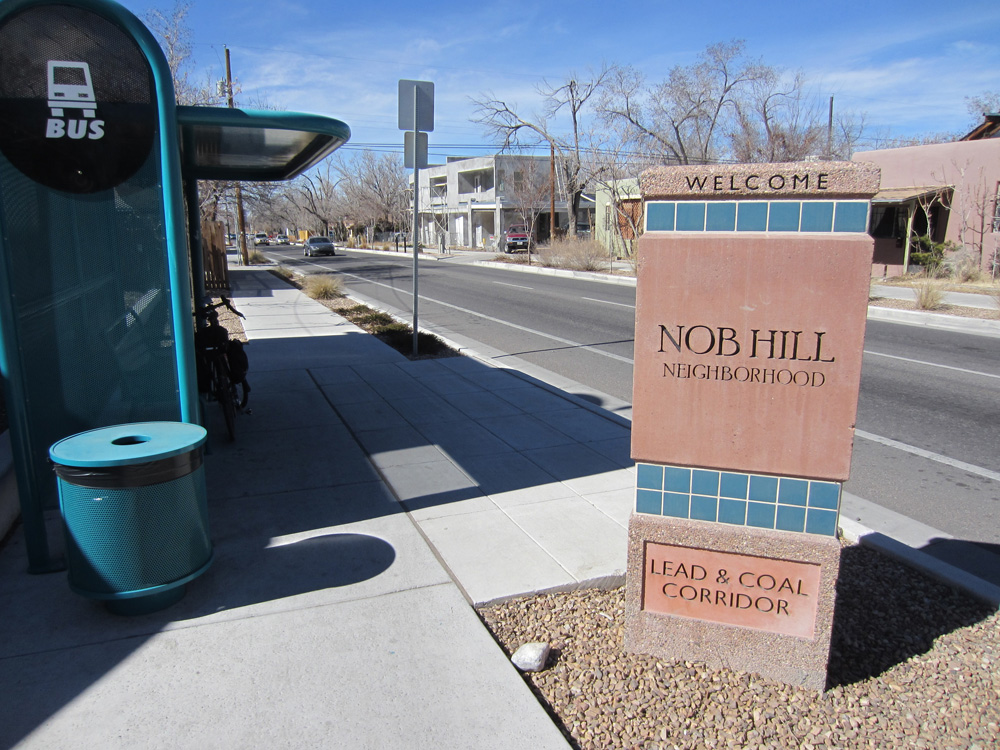
If I were to find work in this neighborhood, would I be justified in calling it a Nob job? No, don’t answer that.
I know, I know, the term is “Hump Day.” But it’s gonna be Hump Month around here, and maybe even Hump Quarter, because Herself has gone and landed a new job — in Albuquerque.
Ay, Chihuahua.
It will be a homecoming of sorts. We met and married in Santa Fe, but left New Mexico for Bibleburg in 1991 to take care of my mom, who was developing Alzheimer’s and had begun acting nearly as outlandishly as me. We’ve lived in Colorado ever since, either here (twice) or in Weirdcliffe (once).
We’ve been in residence at the ultra-chic Chez Dog in the upscale Patty Jewett Yacht & Gun Club Neighborhood for going on 12 years now — 12 years! — and I figured we were all done moving, that my years of rocketing pointlessly around North America like a turpentined ferret had finally come to an end.
I’ve lived in two countries, 11 states and 18 towns that I can remember, and in several of those towns more than once. Hell, I’ve lived in five different houses right here in Bibleburg. And the appalling state of three of them is none of my doing, no matter what you may hear from the few neighbors who survived.
Well, looks like we can toss No. 19 up there on the Big Board. Some people around here insist on having actual jobs, my shining example to the contrary notwithstanding, and next month Herself starts work as a technical librarian in electronic resources and document services at Sandia National Laboratories.
And me? Well, God willin’ and the creek don’t rise — which it appears to be doing as we speak — I’ll keep doing what I’ve been doing since 1989, to wit, annoying the readers, staff, advertisers and ownership of various bicycle publications. My primary residence will always be a Mad Dog state of mind.
Editor’s note: The Twitterati are abuzz with references to various wave/not wave essays, which goes to show you that the times, they are not a-changin’, no matter what Mr. Dylan said. I wrote this piece for Bicycle Retailer and Industry News back in 1995.
I swear to Eddy Merckx, the next time I wave cheerily at a passing cyclist and he just gives me The Look, I’m gonna chase his arrogant ass down, knock him off his bike, drag him back to my house and chain him to a wind trainer in front of the television, where a steady diet of anaerobic-threshold intervals and “Full House” reruns — coupled with a chamois full of red ants and occasional encouragement from a Bull Buster cattle prod — should drive home the argument that courtesy is the grease which keeps society’s bottom bracket spinning freely.
What is with these guys? Unlike passing motorists, I generally wave with all five fingers on a given hand, and there are no pentagrams tattooed on my palms. Has the mousse that grips their so-carefully coiffed ’dos soaked through their scalps to enmire the already-sluggish machinations of their brains? Are their Oakleys so dark that they simply can’t see my friendly salutation? Have they heard the ugly rumors about me, their sisters and the Sonoran donkey?
Beats me. I have no answers. But, as you might expect, I have a few theories. And here they are:
• Me Cool, You Lame — You, the non-waver, may think that your bike and/or cycling attire is way neater than mine, and that to wave would be to compromise your coolness. But I’m a Media Dude, see, and that means my bike is so much cooler than anybody else’s that I have to let it get all grunged up and filthy-looking just to keep wanna-bes like Claudia Schiffer and Tom Hanks from trying to steal it. Should anyone make off with this bike, of course, I can track them by the hideous shrieking of its 4-year-old, unlubed Dura-Ace chain. But I won’t bother, because I’ve got three or four even cooler ones at home that I never, ever ride, and I didn’t pay a nickel for any of them. Hahahahah.
• I Have a Goatee and You Do Not. This is a corollary to Me Cool, You Lame. It’s also on a par with thinking a Murray preferable to a Merlin. I sport a full salt-and-pepper beard and a sizable bald spot because of a nagging case of testosterone poisoning picked up in Vietnam when I was teaching Chuck Norris all about karate. You, on the other hand, wear a straggly soup-strainer named for a smelly barnyard animal fond of eating garbage, and it doesn’t even cover your zits all that well. As my daddy was fond of saying, if you can’t grow more hair on your face than you can on your butt, you should shave.
• I’m Too Scared to Take One Hand Off the Bars. This is a theory with potential, since most velo-snobs seem to spend all their free time rifling Mom’s purse for the cash to buy purple chainrings and trying to trials-ride the tables at Espresso Yourself instead of practicing basic cycling skills, like waving to other cyclists, riding a straight line, and and blowing your nose without getting boogers all over your Banesto jersey.
• I’m Dumber Than a Food Stamp Office Full of Suntour Executives. Also a theory with potential, this assumes big lag time between the eyes registering an occurrence — a friendly wave, a big smile, the development of trouble-free indexed shifting — and the brain processing the information: “Duhhh … hand up; smile on face; duhhhh … he was WAVING, George! Yuh, yuh, that’s right … he was WAVING, George! Can I pet the rabbits now, George?” That’s a Steinbeck reference, dude. Jeez, four years in grammar school and four years of reform school, and you didn’t learn nothing in either place.
• Don’t Bother Me, I Am a Racer. “Look, Marlin, it’s a USCF licensee! And here we thought they were extinct! We’ve got to move quickly — I’ll get the tranquilizer rifle and the ear tags; you call the Smithsonian and National Geographic!”
• Exercise is Serious Business. Sure it is. So is getting chained to a wind trainer by an irate stranger with a sound-proofed basement, an ant farm and a cattle prod. Think about it … then wave.
Miss me? I drove to California for Theresa Coursey’s memorial service, and while it was swell to be among friends, people I hadn’t seen in a spell, a guy likes everyone to be present and accounted for, and we were one fine woman short.
Theresa’s service drew a standing-room-only crowd, the sort we’d all secretly like to have, but few of us deserve. Theresa had it coming. Her husband and their children all spoke, and if there was a dry eye in the house it was not one of mine.
Afterward we ate and drank, talked and took long walks, and after a few days together we all scattered, returning to our lives in Prescott, Philly, Tempe, New York, Colorado. But I’m still thinking of Theresa, wishing I’d spent more time around her, and I know I’m not alone.
Being present these days is not always easy, but it remains vital. In “Taking the Path of Zen,” the late Robert Aitken Roshi recounted the evening message of sesshin as given at Hawaii’s Diamond Sangha:
I beg to urge you, everyone:
Life-and-death is a grave matter,
all things pass quickly away;
each of us must be completely alert:
never neglectful, never indulgent.
That’s my evening message to you. In the morning, the comedy will resume.

 Mad Blog Media