Road work

On the road again?

On Christmas Day Herself and I were chatting on the phone with my sister and her husband when the topic of New Year travel plans arose.

“Now, I know he never wants to go anywhere, but how about you?” my sis asked Herself.

Well. Sheeyit. It’s a true fact that I hate to fly, because air travel combines the joie de vivre of the DMV, the ER, and the county lockup with the airborne equivalent of a midsummer greydog ride from Bakersfield to North Las Vegas in the company of refugees from dentistry, flat-assed hookers, and a shoeless, flatulent freegan with facial tats, fresh from a FoodMaxx Dumpster.

But there’s more than one way to travel. And somebody sure put a ton of hard miles on the eight motor vehicles I’ve owned since 1977.

That was the year I drove from Greeley, Colo., to Burlington, Vt., and back again, mostly because I could. I had a used Datsun pickup, a friend who needed a lift to Wellsville, N.Y., and the promise of a couch to crash on in Burlington (Winooski, actually, but Burlington sounds hipper, though no hipsters ever proposed building a dome enclosing Burlington).

While I was in the neighborhood I took a spin up to Montreal to collect another friend at the Dorval airport, and landed a job as a dishwasher who also delivered pizzas to the local college kids. Or a delivery guy who also washed dishes. There was free beer and the kids tipped in weed; the memories fade.

Despite these perks it wasn’t long before I found myself light in the wallet pocket and motoring back to Greeley for a third friend’s wedding. I didn’t expect the marriage to last (it didn’t), but I’d already had a taste of what Burlington called “weather,” a “living wage,” and “Mexican food,” and it was either learn to like them or be elsewhere pronto.

See the USA in your Chevrolet (or Datsun, Toyota or Ford)

Maybe the Great American Road Trip appealed to me because I was late to the whole driving scene (no license until the end of my first year of college in 1972, lost it almost immediately, and didn’t slide back behind the wheel until I graduated in ’77). Or maybe it was that when I was a sprat my family nearly always took its vacations by automobile, to Montreal, Toronto, the Redneck Riviera, Iowa, Arizona, and the like.

Whatever. Turned out I liked driving places. I would drive somewhere at the drop of a hat and drop the hat myself.

After leaving Greeley for good I drove that Datsun to my second, third, and fourth newspaper jobs, in Bibleburg, Tucson, and Corvallis, Ore. In between relocations there were local digressions and adventures further afield, to Phoenix, Nogales, Riverside, San Diego, Flagstaff, Eugene, Portland, Ashland, Spokane, and Seattle. In California and Oregon I drove haplessly up and down the coast, mesmerized by the Pacific but unable to land a job of work within eyesight of it. Corvallis, a speed bump with a college on the wrong side of the Coast Range, was as close as I ever got.

A brand-new Toyota pickup took me away from Oregon and back to Colorado — another daily in Pueblo, then a chain of weeklies in Denver — and fueled by unemployment insurance from the latter I made one last run at California, annoying friends with couches in Santa Rosa and Ventura and mooning at the goddamn ocean like a fish who wished he’d never learned to walk, or drive. Still no sale. Back to Denver where a buddy had an extra room in a ramshackle house on the site of a former plant nursery.

With the unemployment insurance knocking up against the E on my fiscal fuel gauge, I coasted to a stop in Española, N.M. — and California finally gave me that long-awaited come-hither look. The Ventura paper, which had snubbed me some months earlier, decided I might do after all and offered me a job. Sorry, already got one, in Santa Fe, I replied.

Driving to ride

And thus the Great Bicycle Racing Travel Era commenced. From first Española and then Santa Fe I drove the Toyota to races in Los Alamos, Albuquerque, Los Lunas, Ruidoso, Moriarty, Las Cruces, Grants, Durango, Glenwood Springs, and Bibleburg. When Herself and I quit our jobs (mine in Santa Fe, hers in Los Alamos) and moved to Bibleburg the races were up and down the Front Range, from Pueblo to Fort Collins and all points in between, with occasional detours to outliers like Pagosa, Durango, Gunnison, and Salida.
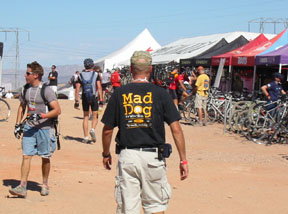
Outdoor Demo 2005
Working Outdoor Demo at Interbike.

By this time I was getting paid to watch other people race bikes, or make them, or sell them, so I was off to Boulder, Scottsdale, Monterey, Laguna Seca, Laguna Hills, Anaheim, Las Vegas, Casper, Seattle, Breckenridge, Bellingham, Bisbee, Santa Rosa, Petaluma, Palo Alto, San Francisco, and Prescott. I drove when I could and flew when I had to.

Some events, like Cactus Cup, Sea Otter, and the North American Handmade Bike Show, I visited more than once. Interbike I attended — was it really 19 times? — in two different cities (Anaheim and Las Vegas), for three different publications (VeloNews, Bicycle Retailer and Industry News, and Adventure Cyclist), from three different hometowns (Bibleburg, Weirdcliffe, and The Duck! City), driving six different vehicles (three Toyotas, two Subarus, and one Ford F-150).

Come to think of it, when we closed on El Rancho Pendejo in The Duck! City back in 2014 I had to drive here from Bibleburg, scrawl my Juan O’Hancock on the paperwork, and before the ink dried scamper off to Vegas for that year’s Interbike. Afterward I roared back to spend the night in ’Burque before returning to Bibleburg — a 2,138-mile dash, all in all — to continue the back-breaking process of what I hope will be my last move ever, barring that final trip to the camposanto. Which will be someone else’s problem.
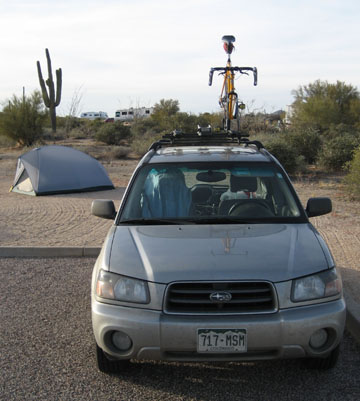
Sue Baroo and Steelman at McDowell Mountain.

I did skip five Interbikes — the 2007-10 editions in Sin City and 2018’s Grand Finale in Reno — the first because Bicycle Retailer and Industry News grew weary of paying me to remind the industry that its annual “Gathering of the Tribes” was primarily a vector for upper-respiratory ailments, cirrhosis, and other bad ideas, many of them involving bicycles, and the latter because not even Adventure Cyclist, which treated me to Interbikes 2011-17, would spend good money to have me perch upon a bust of Pat Hus at the Reno-Sparks Convention Center, croaking, “Nevermore!” I wouldn’t pay my own way to Reno even if God promised to meet me at the Silver Legacy Resort Casino, forgive all my sins, and let me win a couple-three mil’ at blackjack.

Whenever I wasn’t motoring for money I would drive for free — to Wyoming to see Charles Pelkey get his head shaved; to Santa Rosa, Moab, or Truckee to ride bikes with Chris Coursey and Merrill Oliver; to Fountain Hills to pitch a tent and shred the gnar at McDowell Mountain Regional Park; or to Tucson, to ride the Adventure Cycling Association’s Southern Arizona Road Adventure.

For one 2012 outing I did without the automobile entirely, taking a leisurely three-day bicycle tour that started right at our front door in Bibleburg and looped through Penrose, Cañon City and Pueblo before heading back to B-burg.

There were occasional bouts of air travel, too, to Tennessee, Maryland, North Carolina, and Hawaii. Plus one daylong clusterfuck of a preposterously buggered U-turn from Bibleburg to DIA and back again (I was supposed to be flying to Sacramento for the 2012 NAHBS) that set me to hating on United Airlines via social media for months until the sons of bitches finally refunded my money. I spent about 40 minutes in the air and the rest of what turned out to be a very long 12-hour day split between two Colorado airports only to wind up right back where I started. Shortly thereafter I abandoned both air travel and social media.

Don’t Bug me

I’ll confess that my wanderings shrank dramatically in scope starting in 2018. We lost Mister Boo, Field Marshal Turkish von Turkenstein, some equally dear two-legged friends, and Herself the Elder over the next few years. I broke an ankle but survived, though with the Bug in full swing I decided against physical therapy and out-of-town travel, even by car. Entrusting one’s health to the whims of strangers suddenly seemed unwise, especially considering what they’d done to the government in 2016.

My income dwindled from marginal to laughable, so I sat up, let capitalism roll on up the road, unpinned my number, and climbed into Uncle Sammy’s socialist broom wagon. I was expecting a Coupe deVille with color TV but it looks a lot more like Ghost Dancing, the 1975 half-ton Ford Econoline with the bald tires and bum water pump that William Least Heat-Moon herded around America’s blue highways in 1978: “It came equipped with power nothing and drove like what it was: a truck. Your basic plumber’s model.”

In 2022 I attended two celebrations of lives, but wasn’t paying much attention to my own. Suddenly 2023 was hitting the door running and I wasn’t going anywhere. So I suppose I can see how someone might get the idea I didn’t want to.

But I do. As it happens I have a new Nemo Dagger Osmo tent that’s only been pitched once, in the back yard. A copy of AAA Explorer landed in our mailbox yesterday. And Sue Baroo the Fearsome Furster is going in for her 150,000-mile checkup on Jan. 4, 2024.

Eight automobiles down the long and winding road I’ve lost track of my own mileage, but I’m not worried about either of us. I don’t know where we’re headed next, but I refuse to believe it’s the junkyard.

For sure it’s not the airport.
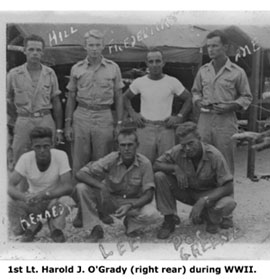
A tale of two Harolds

“I would like to tell you how genuinely proud I am to have men such as your son in my command, and how gratified I am to know that young Americans with such courage and resourcefulness are fighting our country’s battle against the aggressor nations.”
—Lt. Gen. George C. Kenney, Allied air chief in the southwest Pacific, in a 1943 letter to my grandmother, Clara Grady, noting her son’s receipt of the Distinguished Flying Cross

Kind of a gloomy November morning here in The Duck! City.

But not as gloomy as it must have been back in the Forties, when the men of the 433rd Troop Carrier Group were fighting the Japanese in and around New Guinea.

I was surfing lazily across the Innertubes when I stumbled across a Library of Congress collection of interviews with some of the men who served in the 433rd with then-1st Lt. Harold Joseph O’Grady, who was awarded the Distinguished Flying Cross in 1943 but rarely discussed his wartime service, even with family.

One of the interviewees, another Harold — Harold E. “Vick” Vickers — discussed his service from right here in Albuquerque back in 2005, and again in 2012. What a small world it is.

Vick wanted to be a pilot like my old man, but didn’t have the vision for it — “You had to have perfect eyes,” he said — and so he served in a support role, in operations, with the 433rd.

And he had to take ahold to get that job. He enlisted in what then was called the U.S. Army Air Corps (later the Army Air Forces), but instead found himself in the Signal Corps. Vick wasn’t having any of that — he fought to be Air Corps and got his wish.

“Be careful what you wish for,” they say. And they ain’t just a-woofin’.

Vick was supposed to ship out — for real, on an actual ship out of San Francisco — but wound up ordered to travel to New Guinea with the air crews in a formation of brand-new C-47s.

His plane blew an engine and missed the departure, and once the aircraft was squared away his crew had to play catchup, solo, with a brand-new navigator, island-hopping across the Pacific to Brisbane and finally to Port Moresby, New Guinea, which had yet to be pacified by the Allies.

And that’s where things got really hairy. Not a memoir for the faint of heart. It gave me some idea of why the old man might not have been eager to share his war stories with snot-nosed kids.

Here’s to Vic, Hank, and all the rest of the men and women who did their best in far-off lands, especially the ones who never came back to tell their tales.

R.I.P., George Gladney

My old mentor George Gladney.
Photo uwyo.edu

George Gladney has gone west.

You won’t know the name, unless you worked with him or read him at the Los Angeles Times, the Colorado Springs Sun, the Gazette Telegraph, The Denver Post, or the Jackson Hole News, or studied under him at the University of Wyoming in Laramie.

But George stands tall in my personal history. He was one of the people who showed me by word and deed that there was a place in the newspaper game even for those of us who were a bubble or two off plumb.

When I got hired as a copy boy at the Colorado Springs Sun I was at loose ends following a brief tour of the dead-end gigs available to a dropout from a third-rate college. George was the police reporter, as I recall, and came to the Sun from the L.A. paper.

Back in 1974 the newsroom was stiff with talent, the best possible haven for a wannabe cartoonist shambling out of his teens into nowhere special if he didn’t pull his hairy head out of his hippie arse.

Bill Woestendiek and his wife, Kay, ran the outfit, sister paper to the Las Vegas Sun in Sin City. Carl Miller, who would move on to helm The Denver Post, was city editor. Bill Buzenberg, who would rise to veep of news at National Public Radio, was his assistant and an investigative reporter.

Bill McBean, another reporter, would abandon his typewriter for a paper route, claiming afterward that he made more money from delivering the Sun than he ever did writing for it. That didn’t last; he eventually got back on the scribbler’s horse in Denver, at the Post.

I was an actual scribbler; a cartoonist, or so I thought. But an adviser at Adams State College had told me just how few full-time, paid editorial cartoonists there were in the country and suggested that I cast a wider loop, maybe consider taking a reporter’s job as my entrée, a foot in the door.

Well, there I was, with both feet in and my dumb ass for company. Not a reporter; just a copy boy. And I didn’t even have the chops for that. When Carl handed me a stack of press releases to rewrite I told him I didn’t know how to type.

“Better learn,” he replied. And I did, whenever I wasn’t stripping and sorting copy from the wire-service teletypes, running copy and art to and from composing and engraving, and doing other scutwork so real journalists didn’t have to.

I learned something from all these people, starting with typing, thanks to Carl, who also passed on some firm hints about how to write for newspapers. Bill Buzenberg let me tag along and watch him interview hookers for a piece on the massage parlors infesting Bibleburg. The Woestendieks let me sit in on the copy desk on slow nights, learning how to fit copy, size art, and write heds.

George and Bill McBean took me out for drinks, told me war stories, had me over to their houses for dinner, introduced me to their wives; I soaked up their experience like a bar rag and felt as though I had become part of a family.

When I left the Sun to go back to school, this time at the University of Northern Colorado, George told me he hoped I’d come back as a reporter. And I did. But not to the Sun — to the Gazette, the bigger of the two papers in town. Because George was there, this time on the city desk.

He helped me sneak in the back door as a contractor — a little glimpse of the future there, yeah? I compiled the annual industrial edition, drew a few cartoons, and even wrote a couple of stories before getting hired in early 1978 as a for-reals general-assignment reporter at $155 a week.

And that’s where the rubber met the road. As George’s obit notes, he was “a meticulous editor and dedicated teacher.” He was not above crumpling up your copy and tossing it back to you. (We were still working on typewriters in 1978, and other people in the newsroom could actually see it when an editor threw your copy back at you.)

After a few rounds of journalism badminton George would call me over and explain in detail, citing irrefutable examples, precisely why I was a toothless cog in the Gazette‘s well-oiled machinery. Sometimes he and his opposite number Joe Barber would tag-team me. This could be like getting tossed around the ring by Mad Dog and Butcher Vachon.

It was the school of hard knocks, for sure. But man, if you don’t get kayoed, you learn how to roll with the punches and throw a few of your own. As Carl had told me once at the Sun, “We can teach you more about newspapering in a year than you’ll learn in four at college.”

But Carl also insisted I go back to college. Once again, good advice at the precise moment it was needed. Because without that journalism degree I would not have been able to stay and learn at the Sun, or follow George to the Gazette, where I learned even more, in the company of comrades from other schools, other papers.

Sadly, I suspect Carl’s advice is no longer relevant. Back in the early Seventies, at the minor-metro papers that hired me, editors like Carl and George could spend some time breaking in the noobs. An assistant city editor would call you over to demand an act of contrition for some sin of commission or omission. A copy editor might have some thoughts about condensation and clarification. A typesetter could catch an error that had eluded everyone else and that observation would find its way back to you like a bad check.

If the error slipped past the typesetter, the page proofer, and the press check, and actually made it into print, the managing editor might want a word. This would be truly educational. Envision a very angry principal, swinging a larger “board of education.”

Even George made a few mistakes, and like good students we did too. (Actually, we did not require coaching in making these kinds of mistakes, but we were finally getting paid, and could afford to make bigger and better ones.)

This was why the list of phone numbers taped to a drawer at the city desk listed as many taverns, titty bars, alehouses, grog shops, gin mills, cantinas, and buckets o’ blood as it did home numbers. In extreme cases some expenditure of shoe leather was required, but by then we were seasoned reporters, kinda, sorta, and dogged in the pursuit of The Story, or whoever was supposed to write or edit it.

After a few years we all moved on to other opportunities, because in the newspaper game this is how you get a raise or a better job, or at least a different one. If you’re inclined to keep making some of the old mistakes or maybe acquire a few new ones, it’s also how you get a fresh nest to shit in.

George suggested I start keeping a journal, and Lord, have I ever kept ’em.

George eventually left the newsroom entirely and settled down in academia, where he could continue gently and relentlessly squeezing the dumbass out of young eejits afflicted with delusions of grandeur.

One of his students recalls: “I learned so much from that man that I still find myself quoting him and referring to him as someone who influenced my life in important and meaningful ways.”

Me too. And you as well. You probably never read George Gladney, or worked with him, or studied under him. But if you’re reading this, you are under his influence.

Because it was George who told me back in 1974 that I should start keeping a journal. And that’s just another word for “blog.”

For what it’s worth

Looks like the tree’s bringing the heat.

Some like it hot, they say.

Not me, Bubba.

There are moments when the summertime heat feels almost bearable. Say, when there are no pressing matters and a pool sits nearby. There is an iced beverage sweating in a tall glass and a broad umbrella throwing a soupçon of shade. Someone else is picking up the tabs.

But even then. …

When I was a kid on Randolph AFB the San Antonio summers were murderous. Crouch under the Fedders window unit and play board games or haunt the officers’ club pool like a toasty ghost.

Tucson? Don’t get me started. I drove a 1974 Datsun pickup with no air conditioning, and my guest-house rental (also sans a/c) was a long, slow-rolling, late-afternoon drive from The Arizona Daily Star, where I labored in dubious battle with Young Republicans and old fascists.

Mostly I passed my days at the pool there, too. Not at the Star; at the University of Arizona, where the coeds weren’t yelling at me all the time unless they caught me drooling.

Now here I am in The Duck! City, where everything I do makes life hotter and the windows of opportunity are quickly closed and curtained against the sun.

Cycling. Running. Cooking. Especially cooking. Sometimes I feel as though it’s me browning in the skillet.

Not an early riser by nature, I find myself compelled to rush through the morning’s rituals so I can get out and back in while Tōnatiuh is still warming up in the bullpen.

Coffee. The New York Times, The Washington Post, The Guardian, the Albuquerque Journal. More coffee, with toast this time. The litter box. Not for me, for Miss Mia, who has already been in there a time or two while I was ethering my sputtering carburetor. Then the baño for me.

A bite of breakfast — yogurt with granola, oatmeal with nuts and dried fruit, a mandarine, or some combination of these. No tea, it’s already too hot, and we don’t want to overclock the old CPU. Dole out some water to the parched foliage.

And then — hey, what’s that sound, everybody look, what’s going down? — it’s raining. Not for long, not in any quantity (0.01 inch), and it evaporates from the chip-seal in the cul-de-sac before the echo of the raindrops fades.

But still. Music to the ears. Maybe I’ll have that cup of tea after all.

Hey, cool.

Going Fourth

Incoming! No, that’s outgoing. And not very far, either. Them’s the rules.

The cul-de-sac was rockin’ last night.

Grandpa Doug was in charge of the boom-boom. We got a courtesy call from the fire marshals. And the crowd — well, you could actually call it a crowd. Lots of folks, not all of them residents of the cul-de-sac. Young and old, men and women, right and left, brown, black, white. Your basic melting pot.

Old Glory, catching some rays.

We stayed up a little later than is our practice, and I slept a little later than is practical for a Fourth of July with a heat advisory in effect.

So by the time we’d broken fast, handled our morning chores, and just kinda-sorta gotten our poop more or less in a group, the menu of exercise options had shrunk like a spider on a hotplate.

We settled on a short road ride, which inexplicably saw me roll off without a water bottle. Duh. So we had to circle back after a couple miles to collect that, after which I decided we might as well keep on heading south since that was where the wind was coming from.

For old times’ sake we noodled on over to have a look at Herself the Elder’s first residence here in The Duck! City, now a private home rather than an assisted-living residence.

Then we got a little random, hopping onto and off of a couple bike paths linking various suburban streets, before agreeing that it was just about as hot as we cared to have it and rolling back to the rancheroo for some light refreshment.

By noon the temperature was 93° if you believe our little weather widget, and 88° if you don’t. And the weather wizards say we ain’t seen nothing yet.

When the high temp matches my average heart rate on a road ride I sometimes think about getting back in the pool, churning out the laps in the cool, chlorinated fluids, where the distracted drivers and earbudded pedestrians mostly aren’t.

But I don’t know that I want to be the 69-year-old dude in the banana hammock trying to relive his glory years (Mitchell High School swim team, 1969 South Central League champs). Aren’t the bib shorts and Lycra jersey bad enough?