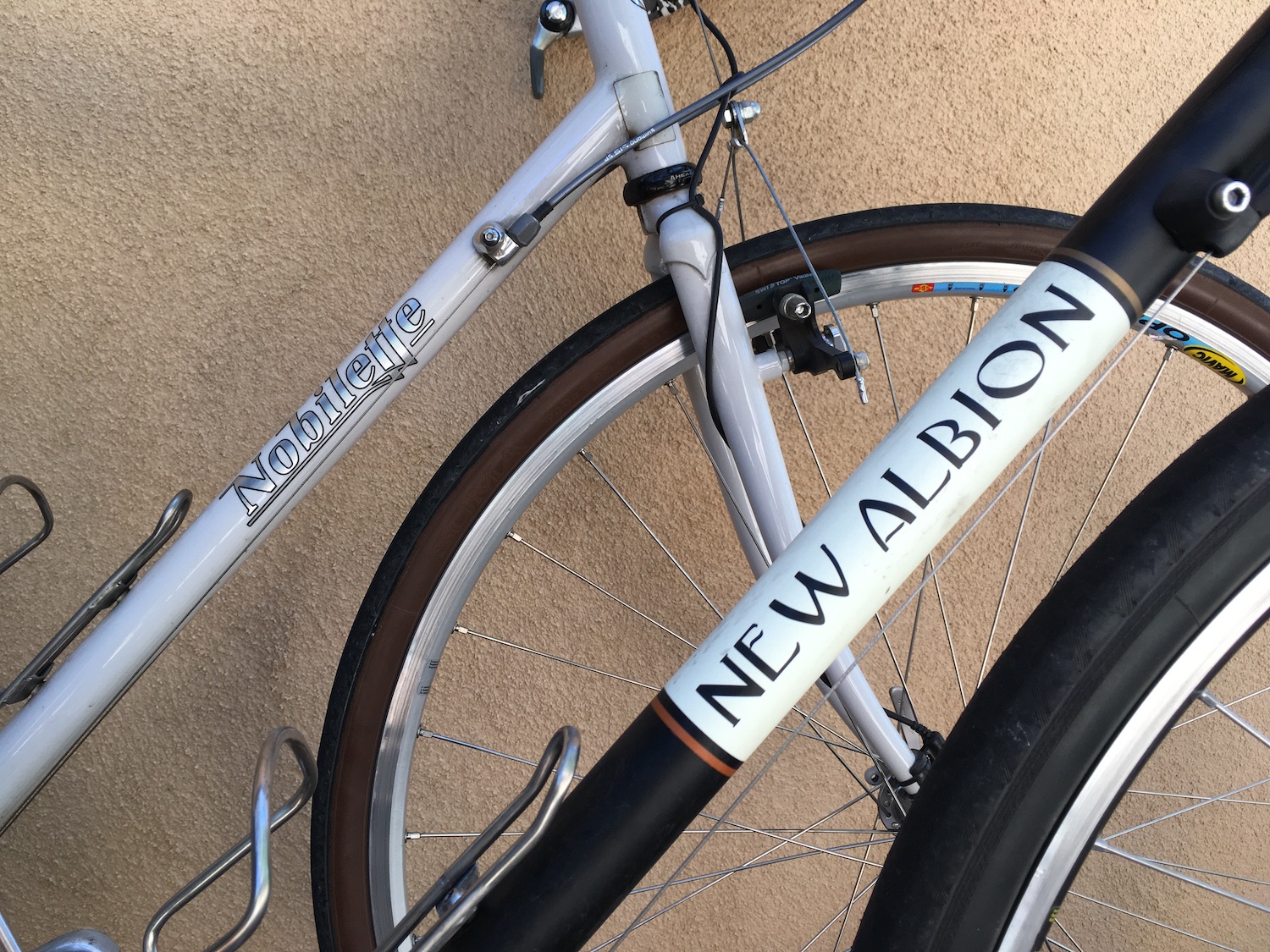
The plan was to roll down toward the Rio and climb back up again, but I got no further than Tramway and Montgomery when the rear tire on the Nobilette went pssssshhhhhhht.
No biggie. In fact, it was my first flat since January. So briskly I relocated from the highway shoulder to the nearby bike path and effected repairs.
But this left me with just one spare tube for a 25-mile loop through goat-head country on a sunny July day in The Duck! City.
Well. Shit. Back to the ranch. Not to stay, mind you, but to grab another bike.
The New Albion Privateer was off its hook and leaning against the Subaru in the garage. Bingo. There were two tubes and tools in the saddlebag and a frame pump slung under the top tube. Moved the headlight and taillight over and off we went.
It’s not so bad, the Dark Side. Just a horse of a different color. Who’s your daddy, Luke?
December. The relentless march through the holidays toward year’s end upshifts into doubletime. Hup hroop hreep horp.
I don’t know but I been told
Winter ain’t gonna get real cold
Climate change done stole our snow
Endless summer for New Mexico
Sorry, Sarge, but that’s how it feels when the thermometer reads 63 degrees, a dozen or so degrees above normal, on Dec. 1.
Herself went for a late-afternoon run in her summer kit. Me, I rode in long sleeves and knickers, but I got out earlier than she did and was generating a slight wind chill despite my usual torrid pace.
The Soma Double Cross, back to its dirty roots.
The mean streets did not appeal (something to do with drink-addled, lead-sneakered gunsels), so I chose the Soma Double Cross with its fat tires and we skulked around various dusty foothill trails and side streets for about 90 minutes.
The DC in its present incarnation — cantilever brakes, eight-speed drivetrain with bar-cons, etc. — is kind of an old-school cyclocross bike, if you overlook its triple crankset, long-cage XT rear derailleur, and 43mm Soma Cazadero tires. Plus its stem is too long and too low. And I wouldn’t use a wide-profile brake like the IRD Cafam II on the rear end if I were jumping on and off the bike the way I did when I was a sprightly young fellow. I carved my right leg like a Christmas turkey once and further instruction was not required.
The too-long stem makes me think about adding a set of top-mounted brake levers, but it would be simpler to just replace the stem, if I could find a replacement, which I can’t. The Great Parts Drought of 2021 continues, especially where weirdo bikes and oddball dimensions are concerned.
Later it was movie night, with pizza and salad. Jane Campion’s “The Power of the Dog” is a beautiful, disturbing film, and we’re probably going to have to watch it again this weekend to see if what we think we saw was actually what we saw. This ain’t exactly John Wayne, pilgrim. Afterward I had to break out the old family Bible and use it as a decoder ring.
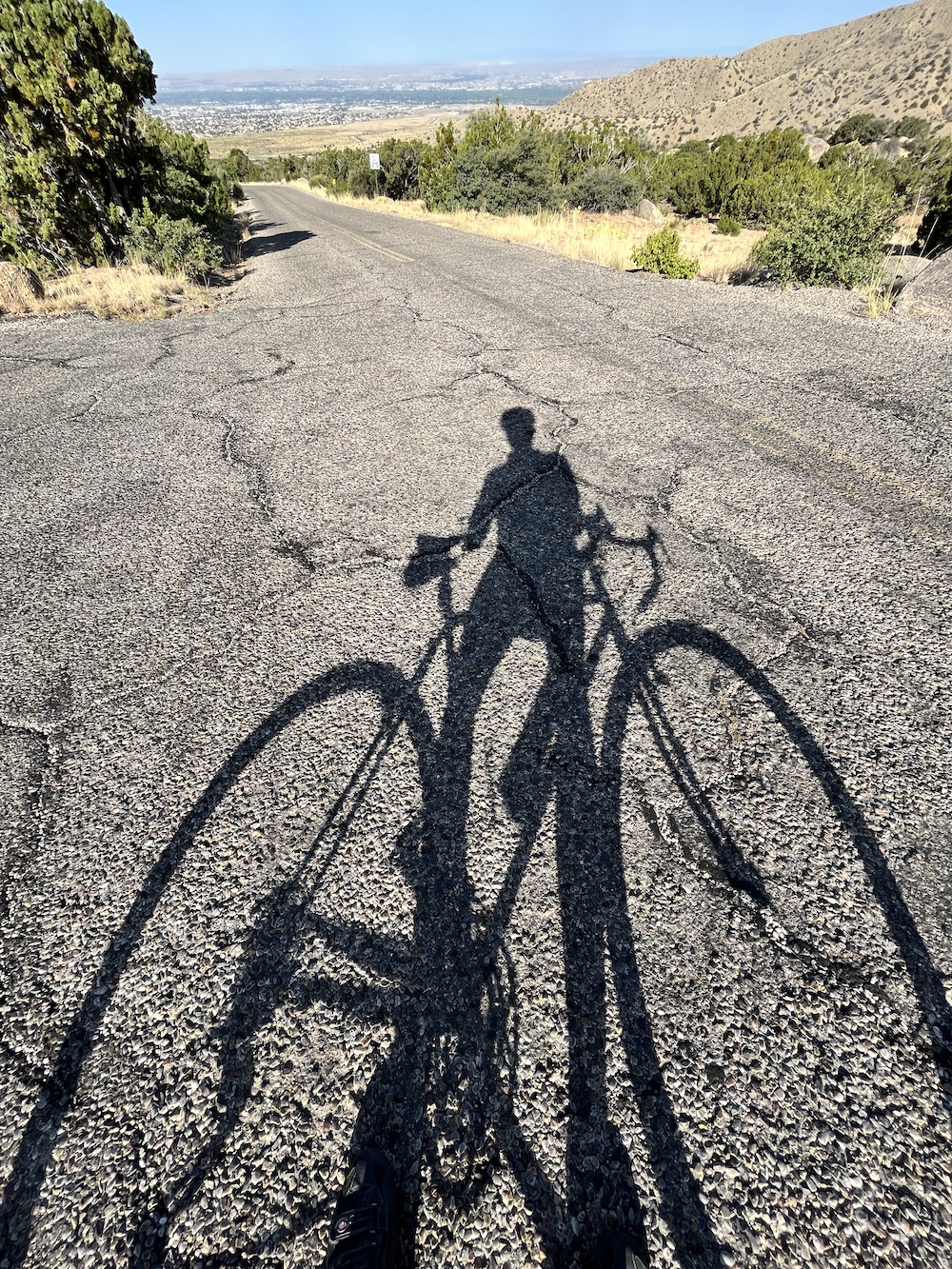
I’m not casting a very long shadow around here lately.
Frankly, there’s not been much to report. That little tease La Niña is in town again and I’ve been chasing her around on the ol’ bikey bikes.
While all you Left Coast/PNW types deploy your parasols and Gore-Tex your loins against the Million-Pound Aquahammer, we here in the desert Southwest are enjoying a balmy period which makes us forget that before long we will be drinking our own sweat and tears, like Paul Atreides and his mom in “Dune.”
Yep, we watched Part I on HBO Max, and it was a’ight, pretty damn fine actually, not bad atall atall. Made the 1984 David Lynch flick look even worse than it actually was, which was pretty fucking bad.
Denis Villeneuve’s take on the Frank Herbert novel might’ve worked better as an HBO series; then he could’ve used a scalpel instead of a cleaver to move things along over the course of a season or two. But only a geek like myself, a science-fiction dweeb who’s read the book 1,207,275 times, is liable to grouse about the subtleties steamrollered to make the narrative march.
Too, if a series proved successful, there would be the temptation to milk the rest of the “Dune” tales. (We may have to deal with this in any case.) Me, I lost interest after trudging through “Dune Messiah” and “Children of Dune,” which is a very short trek indeed through the vast Duniverse.
Anyway, Rebecca Ferguson is the best of the bunch as Lady Jessica, and Timothée Chalamet is a whole lot better than I expected as Paul. He brings a whiff of Nic Cage and maybe a soupçon of Christian Bale to the role. Meanwhile, Javier Bardem as Stilgar is definitely channeling Anthony Quinn’s Auda abu Tayi from “Lawrence of Arabia.”
And the Hans Zimmer score is a character all its own, though digging it through our obsolete surround-sound system was like listening to the London Philharmonic performing Metallica over a walkie-talkie.
Still, it beat squeezing into the old stillsuit, flagging down a passing sandworm, and crossing the Duke City desert to the Harkonnen IMAX. We got beverages around here ain’t even been drunk once yet.
And I didn’t hear about the 1969 Harlem Cultural Festival until 2021, when Ahmir “Questlove” Thompson carved a mountain of forgotten concert imagery into a Black Mount Rushmore, creating the documentary “Summer of Soul” for Hulu.
The Tulsa massacre was buried with its victims for reasons that should be all too obvious. And the Harlem Cultural Festival was strangled by the largely white Woodstock — until Thompson brought the late Hal Tulchin’s long-buried footage back to life.
For nearly 50 years, this just sat in a basement and no one cared. … History saw it fit that every last person that was on that [Woodstock] stage now winds up defining a generation. Why isn’t this held in the same light? Why was it that easy to dispose of us? Instead, the cultural zeitgeist that actually ended up being our guide as Black people was “Soul Train.”
We watched “Summer of Soul” last night, and man, what a blast from the past it was. So many cuts from the pivotal days of this whiteboy’s personal soundtrack.
David Ruffin, fresh from an acrimonious split with The Temptations. A young Gladys Knight and the Pips, very much on their way up. Sly & the Family Stone. B.B. King. Hugh Masakela. Stevie Wonder. The 5th Dimension. The Edwin Hawkins SIngers. And artists whose work I didn’t come to appreciate until later, like Max Roach, The Staple Singers, Mahalia Jackson, and Nina Simone.
All of them on stage in Harlem’s Mount Morris Park, playing for a largely Black audience of 50,000 people at a pop, guesstimated at 300,000 over six shows. Admission: Free.
And to think all that sound and glory wound up in a basement tomb, waiting for someone to roll away the stone.


 Mad Blog Media