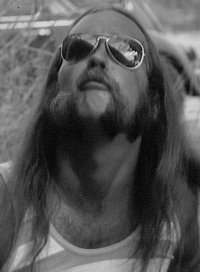
Augie Meyers rocking the Vox with Doug Sahm and a revived Sir Douglas Quintet in 1975.
Augie Meyers, whose work on the unheralded Vox Continental organ gave the Sir Douglas Quintet its signature sound, and drew the admiration of Bob Dylan, The Beatles, Willie Nelson, Tom Waits, and Your Humble Narrator, has bid us all adios. He was 85.
I was just starting to find my own musical way in the Sixties after the old man got us transferred to Randolph AFB at San Antonio, Texas. My folks were into the big bands — Glenn Miller, Tommy Dorsey, Benny Goodman, etc. — but there was this whole new rough beast slouching toward America’s AM radios, and local boys Doug Sahm and his sidekick Augie were riding it.
“She’s About a Mover” was getting a lot of airplay in San Antone back in 1965. And while I didn’t know diddly about Tex (folks on base were from wherever) or Mex (beyond the little taco shop just outside the main gate), Augie’s Tex-Mex fingers grabbed me by the ear and held on tight.
Tweedle … deedle deedle deedle. …
Sahm left Texas for California because of course he did. Meyers eventually followed, and in 1969 we got “Mendocino,” which brought that old Sir Doug sound back to this newly and only moderately hairy (with a covert assist from a Mexican barber) would-be-hippie kid, now in Colorado Springs.
It was fun stuff to listen to; made you want to get up and move around. According to his New York Times obit, Meyers liked the Vox sound, “reminiscent of a merry-go-round or a circus calliope,” because “it could cut through the guitars onstage.”
Meyers would join Sahm again in the Texas Tornados, with Freddy Fender and Flaco Jiménez. He was the Tex-Mex supergroup’s last surviving original member, until March 7. Peace to him, his family, friends, and fans.
“Periwinkle blue, boys,” the color Mickey the Pikey wanted for his ma’s caravan in “Snatch.”
The Duck! City was smokin’ the day after the State of the Union crashed and burned, reaching a high of 72 degrees — 18 degrees above average.
It’s nice to be above average in something. But still, damn.
The roses are budding and so is everything else. The primates who call this desert home may view with alarm the federal knuckles being dragged into the Colorado River Compact, which remains an insoluable dilemma to its signatories and will join the long list of issues about which His Excremency King Piggy the Sticky-Fingered knows nothing and cares even less.
And Your Humble Narrator, who ordinarily yearns to piss off to someplace toasty about this time of year, finds himself in the awkward position of grumbling about beautiful weather in February.
All of which means — yes, yes, yes — it’s time for a Coconut Telegraph edition of Radio Free Dogpatch. Apologies to the late Jimmy Buffett, from whom I liberated the headline.
• Technical notes: RFD uses the Ethos mic from Earthworks Audio; Audio-Technica ATH-M50X headphones; Zoom H5 Handy Recorder; Rogue Amoeba’s Audio Hijack; Apple’s GarageBand, and Auphonic for a quick wash and brushup. The dog drinking from his dish and the car failing to start come from Freesound. The background music, “Easy Stroll,” is from YouTube’s audio library. Other sound effects are the work of the thirsty, sunburnt, untraveled Irish-American behind the bar at this non-alcoholic pub.
The two men were so very different in so many different ways — one a conservative white, born into an admiral’s family in San Diego; the other a liberal Black, spurned by birth father and stepfather in the segregated South — yet both came to immerse themselves completely in their respective roles, impatient with and often heedless of direction.
My favorite version of Duvall was Mac Sledge, the washed-up, alcoholic country singer-songwriter in the 1983 film “Tender Mercies.” He looked like post-Muskogee Merle Haggard and sounded like — well, like Robert Duvall if he’d gone outlaw with Willie and Waylon, because he sang the damn’ songs, after test-driving his pipes with a country band and motoring around East Texas “looking for accents,” according to The New York Times.
But Duvall likewise was top-notch — or maybe top gun — in “The Great Santini,” a 1979 movie based on the book of the same name by Pat Conroy. The titular character he portrayed, Marine fighter pilot Lt. Col. Wilbur “Bull” Meecham, reminded me very much of a certain Southern-fried Air Force colonel who flew C-47s out of New Guinea during World War II.
Duvall’s favorite role was that of Augustus McCrae, a crusty old ex-Texas Ranger in the 1989 TV miniseries “Lonesome Dove,” based on the Larry McMurtry novel … a revelation that weirded me right the hell out because that book is on my nightstand right now, as I’m between books I haven’t already read a few hundred times. Gus is right up there as characters go, and Duvall knew it.
“Let the English play Hamlet and King Lear,” he told interviewers, “and I will play Augustus McCrae, a great character in literature.”
Jackson had the misfortune of being the understudy to the Rev. Dr. Martin Luther King Jr., and after King’s assassination he spent the rest of his life auditioning for that elusive starring role. Some in the Southern Christian Leadership Conference thought him a spotlight hog, and some outside the SCLC found him easy to caricature, especially the white folks who ran the big casino — though plenty of them stopped laughing after he turned in strong performances as a presidential candidate in 1984 and ’88.
He lost the nominations to Walter Mondale and Michael Dukakis, who went on to get beaten like rented mules by Ronald Reagan and George H.W. Bush, and Jackson gave up tilting at that particular windmill.
Jackson continued trying to remind America that there were choices other than wrong right, hard right, and centrist, though as The Times notes, “for all his rhetorical thunder the Democrats never fully embraced his vision of an unashamedly liberal party based not on the white middle class but rather on his coalition of poor and working-class people of all colors.”
More’s the pity.
I don’t remember who I voted for in 1984. I was in a union then, and it’s possible that I pulled the lever for the old commie Gus Hall, because after brief flirtations with the Socialist Workers Party, the October League and the Communist Party (M-L) I occasionally enjoyed being a red pain in the ass. And no way was I gonna vote for a Hollywood cowboy who wasn’t Robert Duvall.
Four years later I was all about Gary Hart, until he self-destructed, and then I caucused for Jackson, for all the good it did him. His people charged that Colorado slow-walked its count to give Dukakis a boost going into the Wisconsin primary, but in the end, Jackson lost the caucus and the nomination to Dukakis.
Later that year at the behest of political pals I worked one event for the Democratic candidate. The people his campaign sent to Denver proved to be outlandish assholes, so much so that I didn’t bother to vote come November. It seemed pointless, another dry well in a decades-long drought. Barack Obama was light-years away.
But Jackson didn’t give up. And neither did Duvall. Both continued to find roles to play, and both helped make our lives worth the price of admission. Peace to them, their families, fans, and friends.
Bob Weir fronting the Grateful Dead in Switzerland back in 1972.
“Lately it occurs to me / what a long strange trip it’s been.” — Robert Hunter, Jerry Garcia, Bob Weir, Phil Lesh
Bob Weir is off truckin’ for real now. The Grateful Dead mainstay was last seen headed west at 78. Years, not miles per hour.
I was never a huge Grateful Dead fan, though for years I looked more or less like their target market.
But who in their right minds, or even the wrong ones, didn’t love “Truckin’?” I mean, other than Robert Crumb, who came to hate his iconic “Keep On Truckin'” cartoon after it took off without him seeking someone else’s fortune, copyright law be damned.
I saw the Dead just once, on Sept. 3, 1972, at Folsom Field in Boulder. No idea how I got there — I may have had a driver’s license by then, but certainly no car. Could be I caught a ride with my old high-school bro’ and fellow music lover Bruce Gibson, if he wasn’t already in the Navy by then. I was in my first year at Adams State College in Alamosa, missing the dean’s list by light-years but probably making it onto a few less sought-after rosters.
We were way up in the cheap seats, and someone in the band — Jerry Garcia, maybe? — started throwing shiny objects to the crowd. Couldn’t quite make out what they were, thanks to our distance from the stage and the platoon of brain invaders setting up a perimeter in my cerebellum.
“Hell’s that?” I mumbled. “Cans of beer? Silver dollars?”
Nope. It was lids. Of weed. Oh, how I wanted me some of that San Francisco treat. But I seemed to have been lag-bolted to my seat in the nosebleed section and my mind soon wandered off by itself, muttering, “Forget this dude, he ain’t going nowhere.”
It came back, of course. Hence this blog.
It may be a while before we see Bob Weir again, Dog willing. But when we do, he’ll be jamming with Jerry, Phil Lesh, Pigpen, Robert Hunter and the rest of the old gang. Peace to him, his family, friends, and fans.