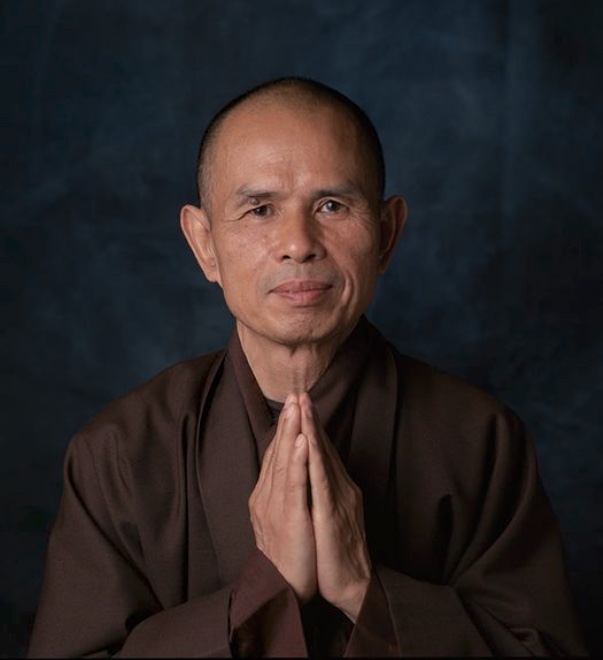
The Vietnamese Buddhist monk and teacher Thich Nhat Hanh has gone. He was 95.
A champion of mindfulness, compassion, and peace, he departed from the Tu Hieu Temple in his homeland, where once — as an opponent of the Vietnam War — he was not welcome.
He returned twice to teach, publish, and lead retreats and ceremonies before finally going home for good in 2018, following a stroke four years earlier.
In his book “At Home in the World,” published in 2016, Nhat Hanh addressed his inevitable leaving. He wrote:
This body of mine will disintegrate, but my actions will continue me. If you think I am only this body, then you have not truly seen me. When you look at my friends, you see my continuation. When you see someone walking with mindfulness and compassion, you know he is my continuation. I don’t see why we have to say “I will die,” because I can already see myself in you, in other people, and in future generations.
Even when the cloud is not there, it continues as snow or rain. It is impossible for the cloud to die. It can become rain or ice, but it cannot become nothing. The cloud does not need to have a soul in order to continue. There’s no beginning and no end. I will never die. There will be a dissolution of this body, but that does not mean my death.
Sonny Rollins doesn’t play anymore because he can’t.
But there was a time when he stepped out of the jazz spotlight voluntarily, because he felt he wasn’t living up to his own musical expectations.
Rollins spent the next two years playing to the sky from the Williamsburg Bridge, spanning the East River in New York City. And 60 years ago this month, he returned to the studio for a session that led to his comeback album, “The Bridge.”
“What made me withdraw and go to the bridge was how I felt about my own playing,” says Rollins, now 91. “I knew I was dissatisfied.”
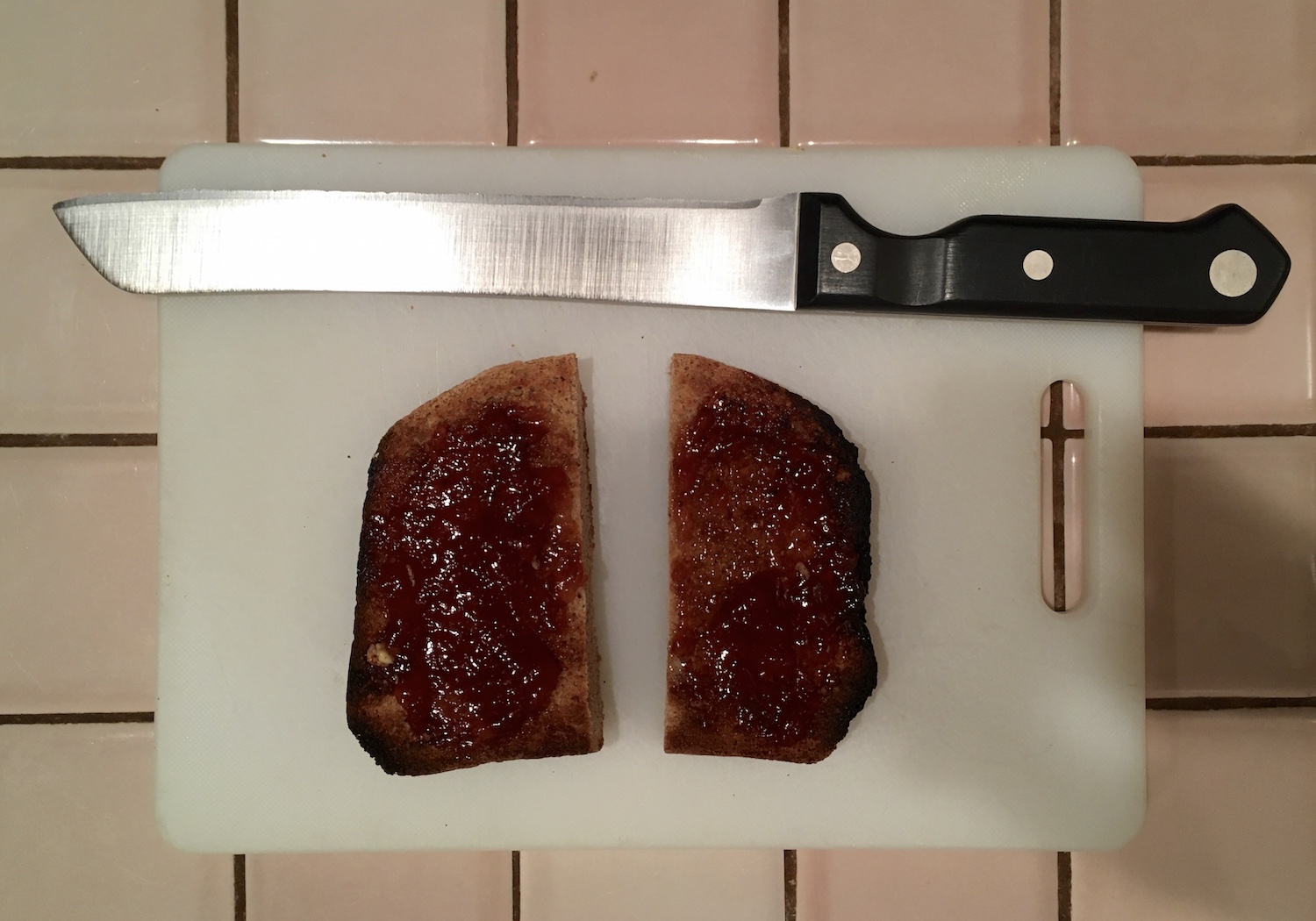
The tenzo at the Juan Hand Clapping Memorial Zendo & Bicycle Warehouse wandered off the Path yesterday and forgot to bake a fresh loaf of bread.
Thus this morning’s Solomonic treatment of the one remaining slice from the old loaf. As Baba Ram Jimbo Harrison has taught us in “The Raw and the Cooked: Adventures of a Roving Gourmand,” the great cuisines of the world — and I would argue, the not-so-great as well — tend to arise from economies of scarcity.
“This calls for resourcefulness in the kitchen, or what the tenzo in a Zen monastery would call ‘skillful means,'” he wrote.
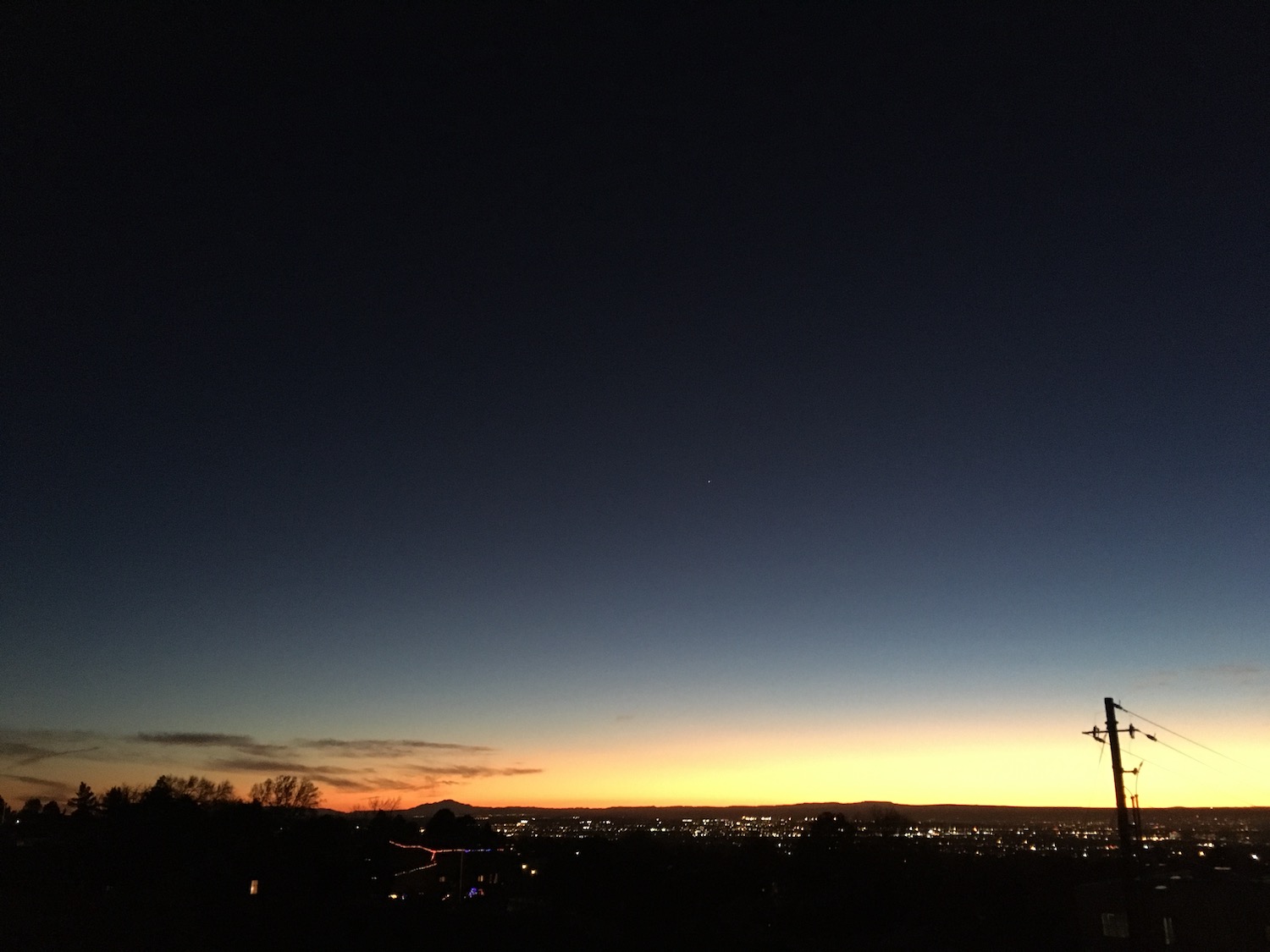
We were on the trail past the high side of Comanche, waiting on the Great Conjunction, when I saw the owl.
It was just before sunset as he flew in from the south, spread his wings wide, and coasted to a landing atop a utility pole down the hill from our own perch.
“I bet that’s Steve come to say adios,” I thought.
We had spoken with his wife, Christina, earlier in the day. She told us Steve was near the end of his struggle against an aggressive cancer. And when I saw the owl, well. …
And sure enough, as I creaked out of bed and began dressing to greet the day, Herself gave me the news: “Steve died.”
Steve and Christina were librarians, like Herself, who met Steve sometime in 2005 when they both worked for Pikes Peak Community College in Bibleburg. Christina did her bit at the University of Colorado-Colorado Springs. Funny thing was, they lived just a couple blocks around the corner from our place in the Greater Patty Jewett Yacht & Gun Club Neighborhood. So we could’ve met them pretty much any old time. Small world.
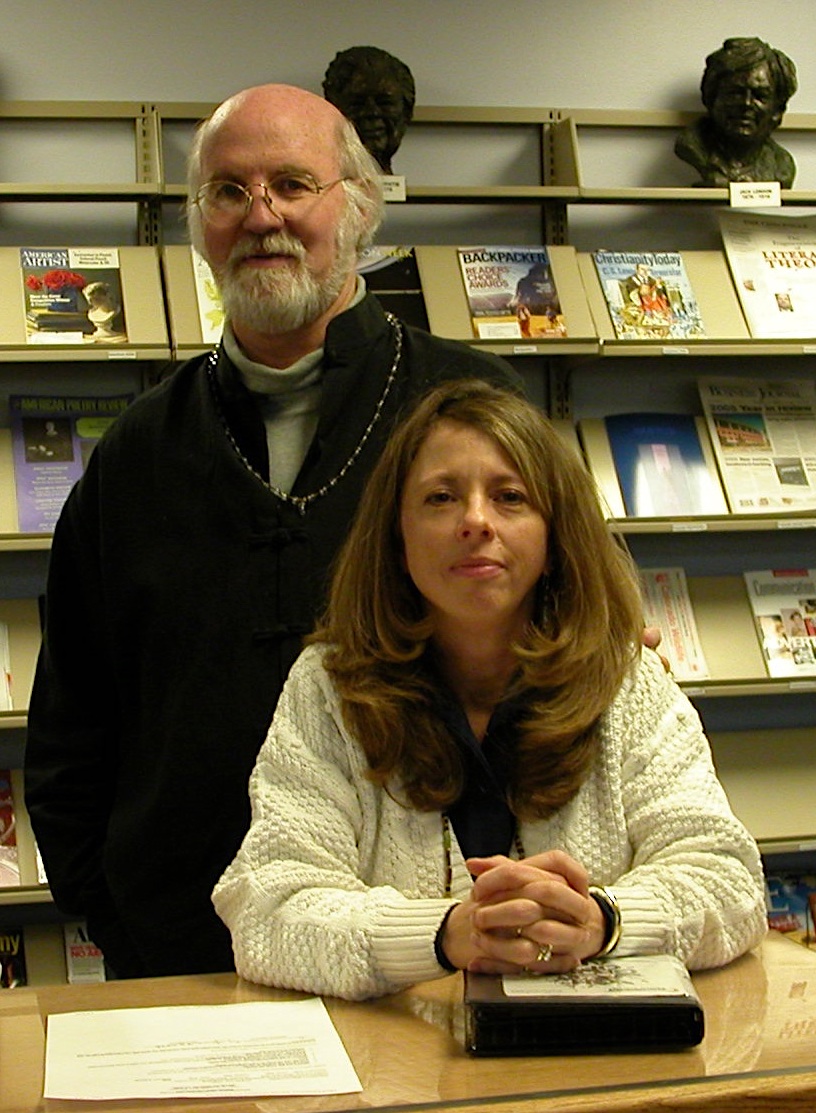
Steve and Herself at PPCC.
Herself developed this notion that we might all get along, be “couples friends,” a social wall she has been banging her head against for more than 30 years. I’m a surly old dog wary of strangers at the gate.
In this instance, however, she was correct. Steve picked right up on my suspicions about any plan I had not personally devised and his nickname for me became “Mr. Three Words.” If there was something Christina wanted to do and Steve didn’t, he’d say, “I have three words for you: Patrick O’Grady.”
These are of course two words, and constitute a koan of sorts, I suppose. And no surprise, because Steve was a Zen Buddhist, a member of the Springs Mountain Sangha. We had something in common there; some years earlier I had met Joan Sutherland Roshi, who would go on to become the founding teacher of The Open Source network that includes the SMS.
Joan had worked with John Tarrant Roshi, director of the Pacific Zen Institute and Robert Aitken Roshi’s first dharma heir. And Steve and I both appreciated Tarrant’s book, “Bring Me the Rhinoceros,” a sampler of classic Zen koans and a Western approach to them.
All this is not intended to say that Steve and I were Han Shan and Shih Te. Steve and Christina and Herself and I were not itinerant locos who did a little casual day labor to keep rice in the bowl (well, Steve, Christina and Herself weren’t, anyway). We were simply friends, people of like mind who enjoyed books and movies, food and wine, chin music and a few yuks.
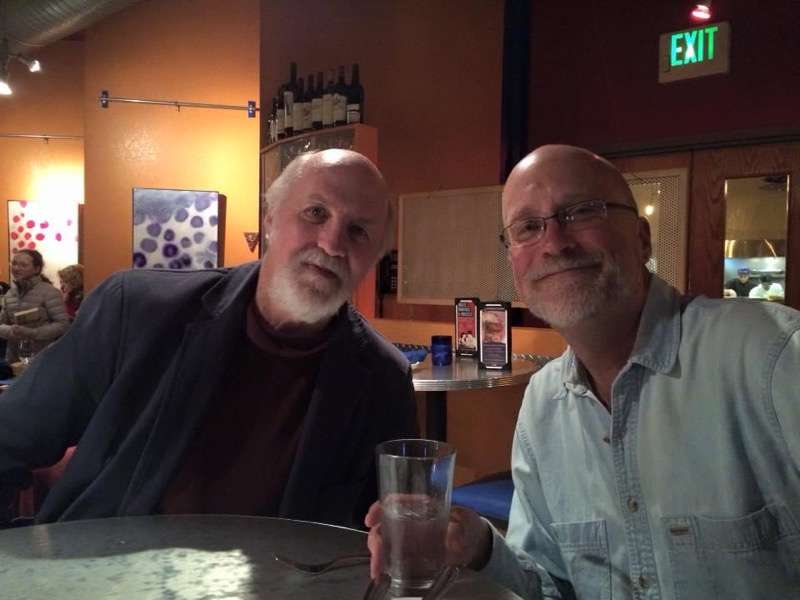
One of many dinners at the Blue Star.
They would cook for us, and we would cook for them. If we weren’t cooking, we were eating, at Blue Star, Springs Orleans, Tapateria, Pizza Rustica, or Vallejos. Taking in movies at Kimball’s Peak Three. Hanging out and shooting the shit.
After we moved down here in 2014 we saw them less often, but both Steve and Christina have relatives in New Mexico, so they’d pop down from time to time and we’d catch up. And whenever we were back in Bibleburg they were at the top of our list of people to see.
Steve was a big fella, like me a bearded baldo, but while I am prone to rant and rave like some stewbum on a sidewalk he was inclined to uncork a dry wit and serve it in a confidential tone, as though the State might be listening in. Whenever he had a bon mot to deliver he would take a step closer, right into your personal space, drop his volume to a conspiratorial level, and let fly.
Christina? More of a Buddha, less entranced by her own sermons, occasionally raising a flower. She speaks in measured tones with quiet amusement and nothing I do or say surprises her because she spent decades with her own bull-goose loony and knew all that honking and flapping was strictly ornamental.
There was less of that sort of thing as Steve’s disease progressed, Christina told me today as we three, once four, shared a long-distance cry. But at least Steve was in the nest, at home, in the care of his wife and son. And that was where he left them, and us, at age 73. Gasshō, bodhisattva.
We can’t say that human lives have a purpose, since a purpose would be smaller than we are. It’s true, though, that the impulse to give freely to the world seems to be at the bottom of the well of human intentions where the purest and cleanest water arises. To be able to offer back what the world has given you, but shaped a little by your touch — that makes a true life. Eventually we find our song and remember it and sing it. And we can never know who else will sing the song, or how the story will turn out in the end; its ripples widen beyond us and there is no end in sight.— John Tarrant, “Bring me the Rhinoceros”

 Mad Blog Media