Forward sprung

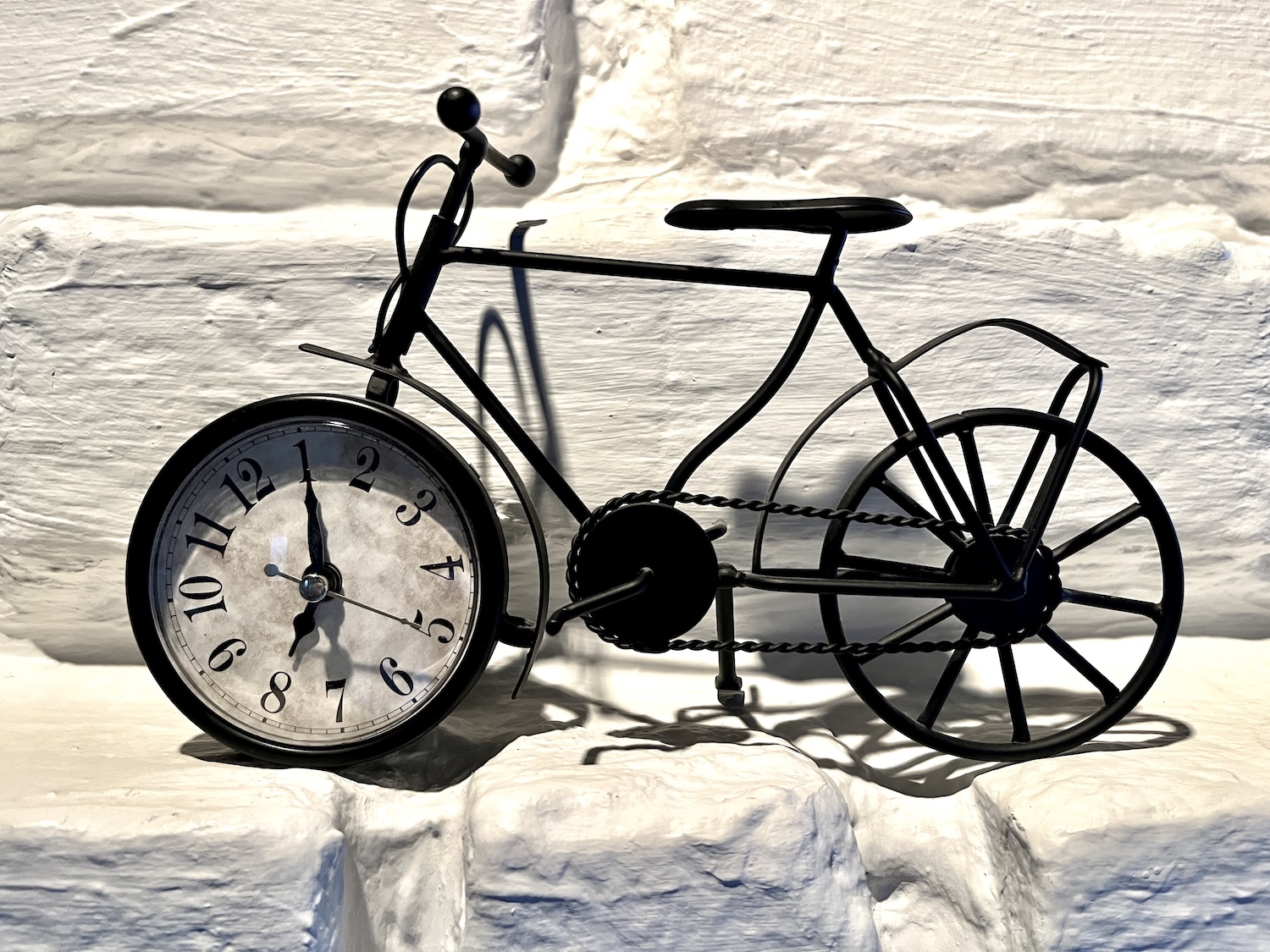
It’s always time to ride.

Daylight Saving Time is stupid.

Still, this year’s “spring forward” meant we spent one less hour today stacking sandbags against the tide of bullshit flowing downstream from the Orange House.

So, winning? Maybe. We must take these little victories wherever we find them.

This morning I burned a little of my saved daylight by reading an essay in The New York Times, in which the daughter of two former American revolutionaries found the Oscar-nominated “One Battle After Another” to be “nothing more than entertainment” rather than “a battle cry for a generation.”

Huh. Hollywood veterano Paul Thomas Anderson cranks out a rapid-fire rom-com inspired by a rambling mythical history by Thomas Pynchon, and Hope Reeves — who herself is working on a comic memoir of being raised by retired Weatherpersons James H. Reeves and Susan Hagedorn — finds it regrettably unserious.

Well. Shit. Can’t have that. Can we?

Why not?

• • •

I myself have been regrettably unserious since — well, since forever — and, like the thought of suicide, it has gotten me successfully through many a bad night. And a few fairly grim days, too, whether shortened or lengthened by government fiat.

My upbringing was unremarkably middle-class — Catholic Republican father, Presbyterian Democrat mother — and yet somehow I came to cast myself in the role of atheist radical son.

A diet rich in Warner Brothers cartoons, Marx Brothers movies and Mad magazine will give a kid a taste for anarchy. Who do you root for? Not The Man, that’s for sure. It was one battle after another and Elmer Fudd lost every one of them.

So while I would eventually become interested in Weatherman, and personally sample various flavors of Marxism — Socialist Workers Party, October League, Communist Party (M-L) — these last two, like Weatherman, offspring of the Students for a Democratic Society — my first real political infatuation was with the Yippies.

• • •

Elmer wanted to cut off my lovely hair and send me to Vietnam. I wanted to Bugs Bunny his ass. And so did the Yippies, whose regrettably serious alias was the Youth International Party.

Abbie Hoffman and Jerry Rubin were probably the most famous of these Groucho Marxists, whose theater was the street. Levitating the Pentagon. Throwing money at traders at the New York Stock Exchange. Running an actual pig — Pigasus the Immortal — for president. 

The Yippies invaded Disneyland, taking over Tom Sawyer’s Island, threw pies, and applied for a permit to blow up the General Motors building. When it was denied, the Yippies shrugged and said it only proved that it was impossible to work within the system to change the system.

Alas, that old system sure proved durable, resisting change from within and without.

Some Yippies became yuppies. Rubin traded his Viet Cong flag shirt for the suit and tie of a businessman. He died in 1994 after being hit by a car while crossing Wilshire Boulevard, in front of his penthouse apartment. He was 56, well past the 30th birthday after which nobody was to be trusted.

Hoffman jumped bail after a dope bust and went underground. He eventually resurfaced, did some light time, and returned to activism.

But it was the Eighties — remember those fabulous Eighties, kids? — and the old act didn’t seem to be going over so well with a new audience. Hoffman died, reportedly by his own hand, in 1989. He was 52.

• • •

By then, mockery had already begun infiltrating (or was being co-opted by) The Establishment. “Saturday Night Live,” which debuted in 1975 with guest host George Carlin, somehow remains relevant in an aw-shucks-just-kiddin’ sort of way. David Letterman, Jon Stewart and Stephen Colbert have had their innings, and Jimmy Kimmel is still in there pitching despite some booing from the luxury box at Fudd Stadium.

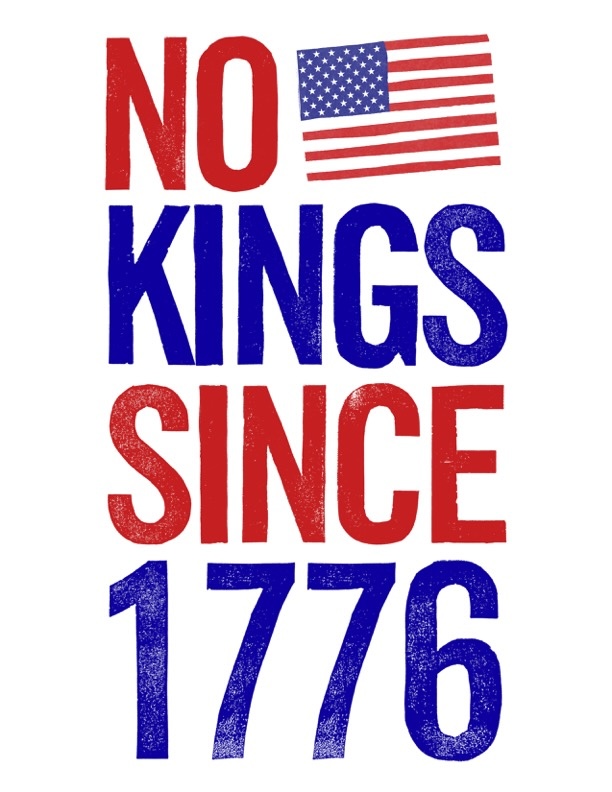
But there’s something about old-school, street-level mockery that really gets The Man’s dander up. The reigning Man, Elmer Befuddled, who hires out his shotgunning of critters at home and abroad because bone spurs, watches a shit-ton of TV. And if he sees yuuuuge crowds from coast to coast rocking the next No Kings rallies on March 28, giving him the old Warner Bros.’ sendoff — “Th-th-that’s all, folks!”— he might just do a John Belushi, spin right out of his chair, and hit the deck in a slobbering, shitting sayonara.

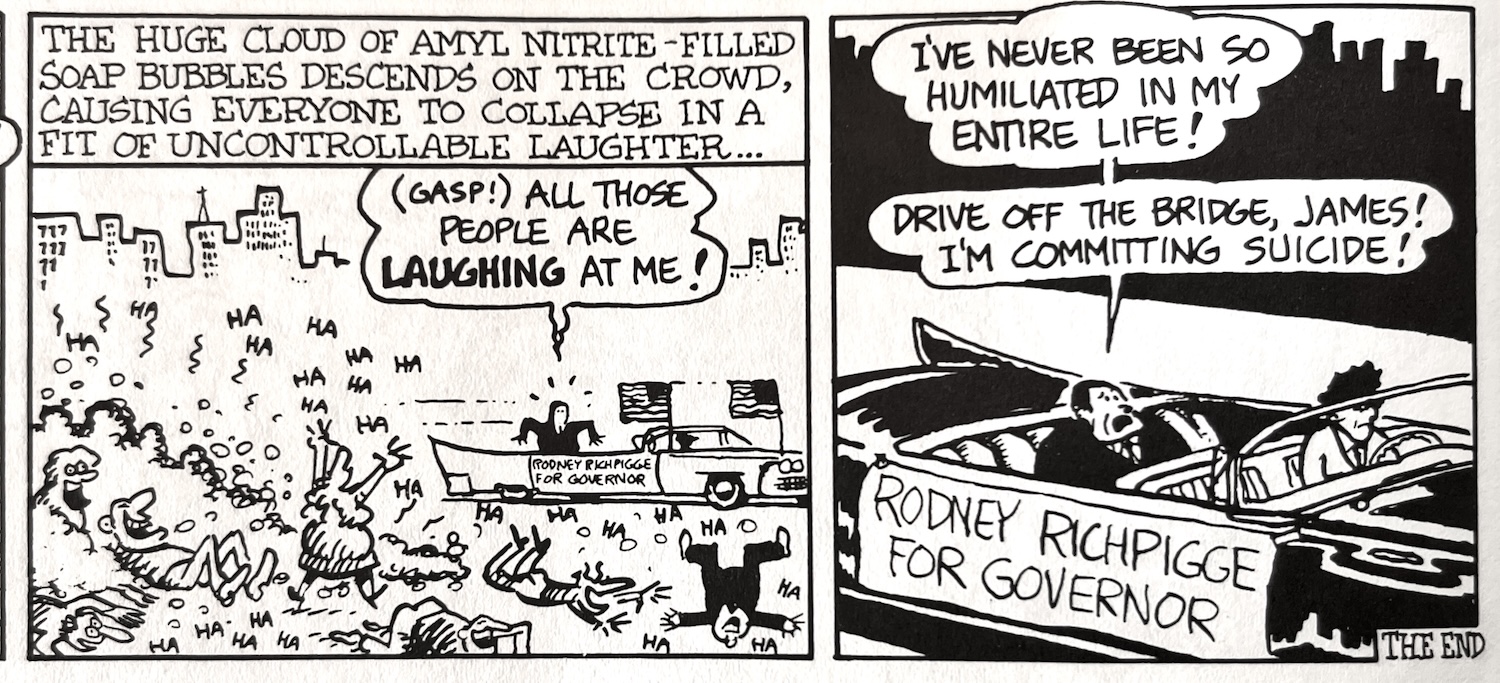
It comforts me to think back to one of Gilbert Shelton’s “Fabulous Furry Freak Brothers” cartoons, in which political candidate Rodney Richpigge commits suicide by proxy, ordering his chauffeur to drive off a bridge because he thinks people are laughing at him (a half pint of amyl nitrite getting an unexpected wash in Fat Freddy’s jeans was the actual giggle-trigger).

Hope, as they say, springs eternal. No matter what time it is.
Th-th-th-that’s all, folks!

A bowl, empty

This bowl would be super with some soup in it.

I’m not very interested in my opinion of football.*

A scrawny child, I clearly wasn’t cut out for the game, and never really paid it any mind growing up. That I chose competitive swimming as my sport at age 8 should tell you much. It certainly told my dad a thing or two.

Swimming was a great sport for a bookish kid who mostly lived for the undiscovered country in his head. Especially the distance events. Back and forth I’d glide between flip turns, undisturbed by cheering spectators (our meets never drew much of a crowd, and what you hear in the pool is mostly a dull rumble) or the jeering of teammates (that would come in the locker room, after the meet).

Frankly, the whole attraction of sports — especially the stick-and/or-ball variety — eluded me. Just one more opportunity for public failure and vituperation. I had school for that; a new one every couple of years. I liked being outdoors doing things, but bristled at structure and governance.

I just wanted to, y’know, like, do shit, an’ shit.

Swimming in its individual aspect was basic. “Swim fast.” That about covers it. The sportiest components were the relay events, medley and freestyle. Teamwork was very much in play there. If one guy screwed the pooch, three others had to unfuck that mutt. Lots of shrinkage in the ol’ Speedo if you were swimming the anchor leg and starting a handful of seconds down.

Too much pressure for The Kid. I just wanted to go back up into my head and play with my toys. And after 10 years in the pool I did exactly that, after a half-hearted attempt to make the swim team at Adams State College in my first quarter there.

I’d discovered drugs and alcohol in high school, and turned out they had them in college, too. Even better, my parents were back in Bibleburg, where I couldn’t hear them asking why I was growing all that hair, digging Jimi at top volume (“Actin’ funny and I don’t know why. …”) and quitting the swim team after we went 11-0 in the South Central League in 1969-70 (coach didn’t like all that hair either, and I didn’t like coach trying to repo my varsity letter).

I did eventually get into sports, obviously. Bicycling was my gateway drug. I started cycling to lose weight, tackled the occasional century, and began watching what little of the Tour de France I could find on American TV. Eventually I entered a time trial, just to see what would happen, and the bug bit. To coin a phrase, I was off to the races.

When I quit newspapering to freelance for bicycle magazines I described it as a marriage of profession and passion. And I watched the marquee events the way my countrymen watched football, only with less frequency and considerably more difficulty. American TV didn’t cover bike racing the way it covered football — it was strictly soft-focus, personality-driven, 30-seconds-of-action fluff, centered on the Tour, with a soundtrack nobody could dance to, especially in cleats.

Some years later a cyclocross promoter once gave me a pirated videotape of a World Cup race that had been converted from PAL to NTSC so we Yanks could get in on the fun. It was like watching cyclocross underwater, through swim goggles, on acid. Dieter Runkel was pioneering top-mounted brake levers. John Tesh was conspicuous by his absence. I watched it over and over and over again.

But over the decades it got to be too much of a good thing to stay good. Everything I did to earn a living — reporting, writing, editing, cartooning, website maintenance, live updates — had something to do with bicycling. And I burned a lot of daylight doing those things instead of doing the actual bicycling. I quit racing, skipped group rides, and finally lost all interest in watching the races. Does a line cook watch cooking shows on his days off?

I knew bicycling was a business. One of the magazines I worked for covered the business of bicycling. After the Pharmstrong years anybody who didn’t know pro cycling was a business would definitely flunk a dope test. But it was starting to feel like bicycling was giving me the business.

In the end, I got my own dope-slap from the invisible hand of the market. The vulture capitalists swooped down and did what buzzards do — eat and shit, eat and shit — and as my earning opportunities dwindled my love for cycling rekindled. I quit watching, and got back to doing.

First to go was pro cycling. Leave that noise to The Wall Street Journal, I thought. Or The Lancet. And maybe Interpol.

Now I can’t remember the last Tour I watched. So you can bet the farm that I didn’t watch the Super Bowl yesterday. I don’t have any idea who won — hell, I don’t even know who played.

Herself tells me that the MVP was someone name of “Bad Bunny.” Bugs I know, but he played baseball and raced cross country, dabbled in bullfighting, even boxed a bit.

“Bad Bunny?” Jesus. And they call football a “sport?” At least pro cycling had Cannibals and Badgers.

* Hat tip to Jim Harrison, who was speaking of Boston in his book, “Wolf: A False Memoir.”