But hey, if we’re going to be dumb enough to elect a venomous orange man-baby as the Pestilence of the Benighted Snakes — twice! — I guess we deserve to be pig-ign’ant of what he’s doing, too.
Anyway, the only thing raving about shitty newspapers ever got me was an invitation — more than one, actually — to leave the one I was raving about and drag my surly ass off to some other shitty newspaper, posthaste, s’il vous plaît, don’t let the door hit ya where the good Lord split ya, etc. I managed my final escape from The New Mexican in 1991, one step ahead of the publisher’s spike heel, and that was that.
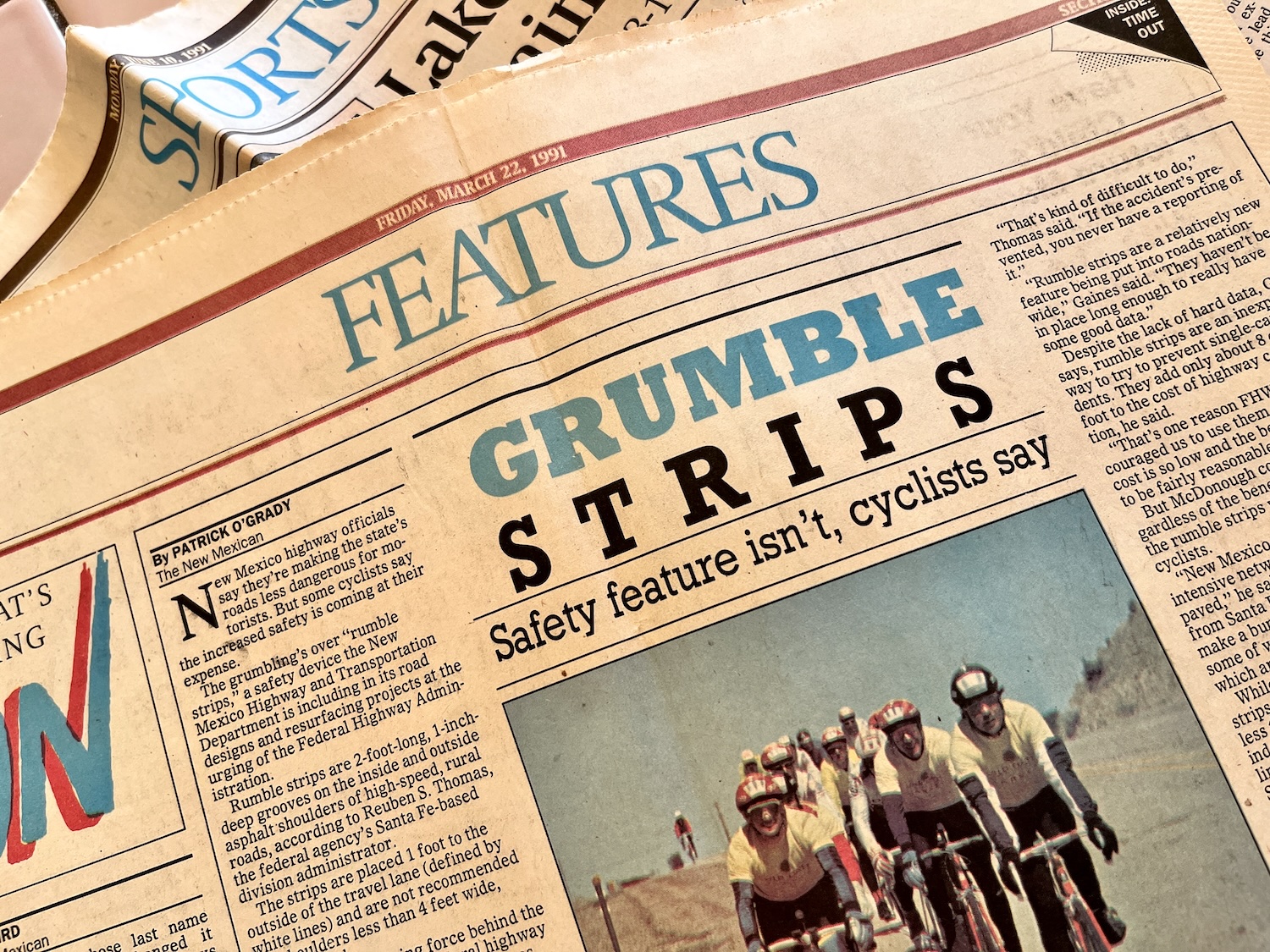
You regulars know the story. I had joined that paper in 1988 as a copy editor, then cycled (har de har har) through a number of gigs — assistant sports editor, assistant features editor, and finally features editor, doing a little cartooning and cycling reportage on the side — before taking it on the Jesse Owens in ‘91 to do as a freelancer what pretty much every Damon Runyon character did on Broadway, to wit: “the best he can, which is an occupation that is greatly overcrowded at all times. …”
Boy howdy.
Still, 15 years of newspapering set me up pretty well for freelancing, because while I wasn’t exactly great at anything, I had learned to be OK at a number of things: writing hard news, soft features, and commentary (and fast, too); editing other people’s work and proofing pages; drawing cartoons and taking photos. I would try just about any old thing for any old crook who could spell my name right on a check and remember to mail it while I could still remember what I did to earn it.
So there I was, just doing the best I could and plenty of it, because freelancing paid less than newspaper work, and the kind of newspapers that would hire a hairy pain in the ass like Your Humble Narrator didn’t pay shit. If you wanted to get a raise, you had to move to another newspaper, and without being kicked, too.
Or maybe that was just me.
Happily, freelancers basically pioneered the concept of “remote work,” which kept my pain from manifesting itself daily in various editors’ asses. For a while, anyway. I developed a long reach. Nevertheless, I managed to log 30 years as a freelancer, twice the time I spent raving my way through a half-dozen Western dailies and one weekly outfit, and only had to move four times.
And newspapers taught me how.
I liked newspaper work, when I wasn’t hating it. The people were smart, except for the ones who weren’t, and you could try your hand at damn near anything unless you wanted to get paid more for it, in which case nix. The shift was basically hours of fuck-all peppered with seconds of cardiac arrest and/or stroke and we had to remake the entire fucking product every fucking day.
And no do-overs. Once your mistakes were off the press and soiling the readers’ greedy little paws they were yours forever, like misspelled tattoos.
God, it was fun. Except when it wasn’t. But sometimes even then, too. Plus it fed and housed me for 15 years, and set me up for the next three decades.
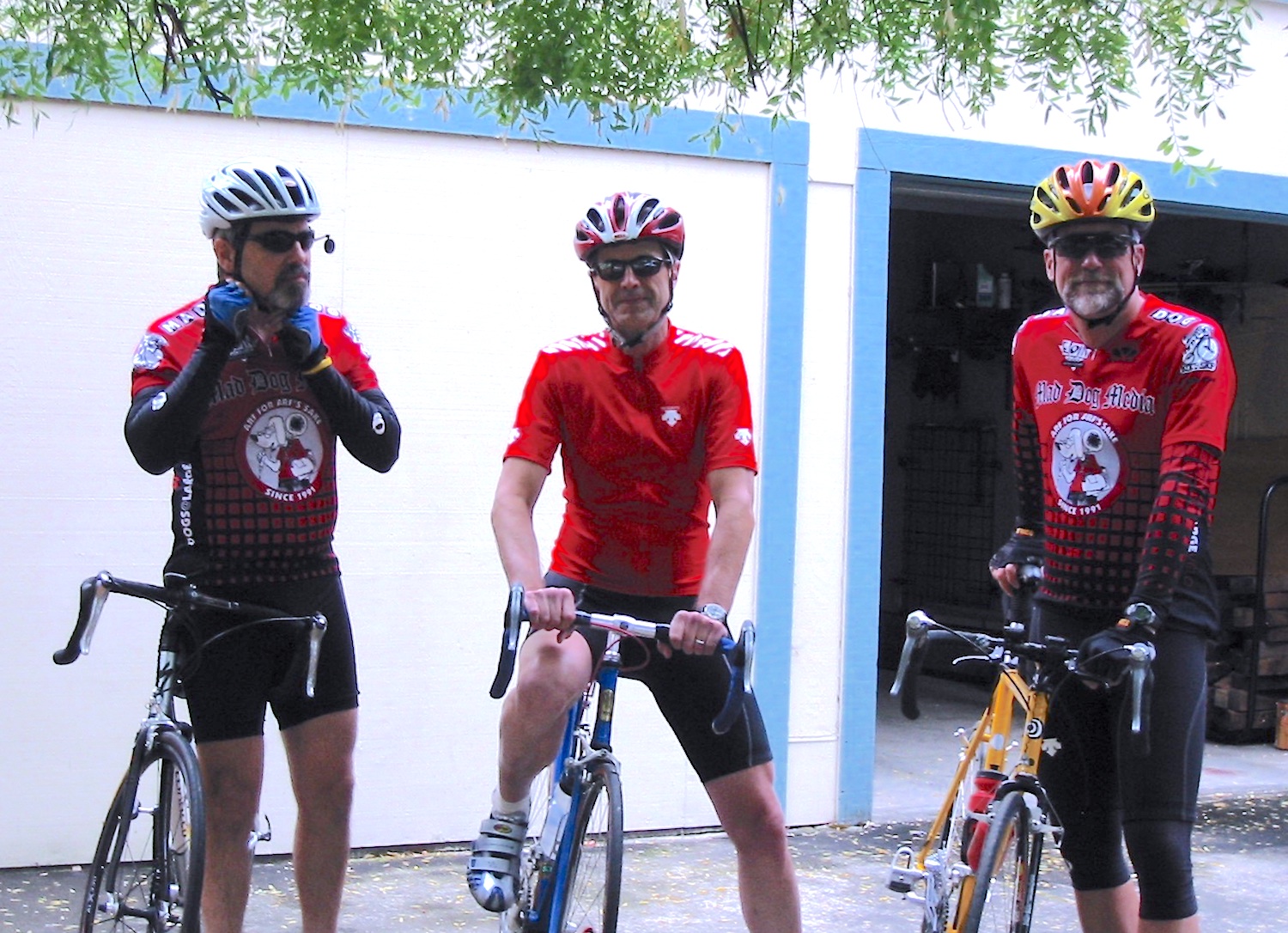
The Supervisor, the M-Dogg, and Your Humble Narrator gear up for a 63-mile ride from Santa Rosa to Hopland in August 2006.
Looking back over some old training logs I was smugly congratulating myself on what I thought was a strong start to this, the Year of Our Lard 2026.
“366 miles for January,” sez I to myself, no one else being handy. “Wrapped it up with the first 100-mile week of the New Year. Not bad; not bad at all.”
And then I checked in with a couple old velo-newsie bros. No, not fellow refugees from that once-storied journal of competitive cycling — rather, fellow refugees from the Colorado Springs Gazette Telegraph. Like Your Humble Narrator, they also ride bicycles.
The Supervisor and the M-Dogg both live in Northern California now, and it’s been nearly 20 years since the three of us last saddled up together. I’m the only one who’s fully retired, in part because I’m the only one who has a wife with a job of work, which for an old slacker keen to skip his pulls into the wind is like drafting a UPS truck on a summer day.
Anyway, there we were, chatting away via text, and the M-Dogg mentions that he just wrapped a 49.6-mile ride with 2,020 feet of vertical.
Yow.
I mentioned having done a leisurely 3-mile trail run, explaining that I got a late start and didn’t feel like kitting up for a ride.
“And here the M-Dogg is already cranking out the half-centuries,” I added.
“Mo, tell him your January mileage,” says The Supe.
“760 in January,” replies the M-Dogg, “only possible in a very dry January.”
That’s 760 miles. Not kilometers, furlongs, cubits, rods, or whatever the hell it is that Californicators use to measure the distance between organic vineyards and fair-trade java shops. And here I was, cackling over the little 366-mile egg I laid last month, which was even drier here in the Duck! City desert.
“Comparisons are odious,” they say. Ho, ho. When When John Fortescue wrote that shit he was probably on the short end of a miles-gobbling contest with Henry VI, who covered a lot of ground during the Wars of the Roses.
“Better luck next year, Forty old chum! Oh, dear, here comes Edward, with that ‘Oo’ d’ye think is the bloody king around here, mate?’ look on his face. Right, I’m off. …”
Which brings us to this poem from James Crews, “Winter Morning,” from which our headline comes. Unwrap your gift and be grateful for whatever it is you find inside.
You won’t know the name, unless you worked with him or read him at the Los Angeles Times, the Colorado Springs Sun, the Gazette Telegraph, The Denver Post, or the Jackson Hole News, or studied under him at the University of Wyoming in Laramie.
But George stands tall in my personal history. He was one of the people who showed me by word and deed that there was a place in the newspaper game even for those of us who were a bubble or two off plumb.
When I got hired as a copy boy at the Colorado Springs Sun I was at loose ends following a brief tour of the dead-end gigs available to a dropout from a third-rate college. George was the police reporter, as I recall, and came to the Sun from the L.A. paper.
Back in 1974 the newsroom was stiff with talent, the best possible haven for a wannabe cartoonist shambling out of his teens into nowhere special if he didn’t pull his hairy head out of his hippie arse.
Bill Woestendiek and his wife, Kay, ran the outfit, sister paper to the Las Vegas Sun in Sin City. Carl Miller, who would move on to helm The Denver Post, was city editor. Bill Buzenberg, who would rise to veep of news at National Public Radio, was his assistant and an investigative reporter.
Bill McBean, another reporter, would abandon his typewriter for a paper route, claiming afterward that he made more money from delivering the Sun than he ever did writing for it. That didn’t last; he eventually got back on the scribbler’s horse in Denver, at the Post.
I was an actual scribbler; a cartoonist, or so I thought. But an adviser at Adams State College had told me just how few full-time, paid editorial cartoonists there were in the country and suggested that I cast a wider loop, maybe consider taking a reporter’s job as my entrée, a foot in the door.
Well, there I was, with both feet in and my dumb ass for company. Not a reporter; just a copy boy. And I didn’t even have the chops for that. When Carl handed me a stack of press releases to rewrite I told him I didn’t know how to type.
“Better learn,” he replied. And I did, whenever I wasn’t stripping and sorting copy from the wire-service teletypes, running copy and art to and from composing and engraving, and doing other scutwork so real journalists didn’t have to.
I learned something from all these people, starting with typing, thanks to Carl, who also passed on some firm hints about how to write for newspapers. Bill Buzenberg let me tag along and watch him interview hookers for a piece on the massage parlors infesting Bibleburg. The Woestendieks let me sit in on the copy desk on slow nights, learning how to fit copy, size art, and write heds.
George and Bill McBean took me out for drinks, told me war stories, had me over to their houses for dinner, introduced me to their wives; I soaked up their experience like a bar rag and felt as though I had become part of a family.
When I left the Sun to go back to school, this time at the University of Northern Colorado, George told me he hoped I’d come back as a reporter. And I did. But not to the Sun — to the Gazette, the bigger of the two papers in town. Because George was there, this time on the city desk.
He helped me sneak in the back door as a contractor — a little glimpse of the future there, yeah? I compiled the annual industrial edition, drew a few cartoons, and even wrote a couple of stories before getting hired in early 1978 as a for-reals general-assignment reporter at $155 a week.
And that’s where the rubber met the road. As George’s obit notes, he was “a meticulous editor and dedicated teacher.” He was not above crumpling up your copy and tossing it back to you. (We were still working on typewriters in 1978, and other people in the newsroom could actually see it when an editor threw your copy back at you.)
After a few rounds of journalism badminton George would call me over and explain in detail, citing irrefutable examples, precisely why I was a toothless cog in the Gazette‘s well-oiled machinery. Sometimes he and his opposite number Joe Barber would tag-team me. This could be like getting tossed around the ring by Mad Dog and Butcher Vachon.
It was the school of hard knocks, for sure. But man, if you don’t get kayoed, you learn how to roll with the punches and throw a few of your own. As Carl had told me once at the Sun, “We can teach you more about newspapering in a year than you’ll learn in four at college.”
But Carl also insisted I go back to college. Once again, good advice at the precise moment it was needed. Because without that journalism degree I would not have been able to stay and learn at the Sun, or follow George to the Gazette, where I learned even more, in the company of comrades from other schools, other papers.
Sadly, I suspect Carl’s advice is no longer relevant. Back in the early Seventies, at the minor-metro papers that hired me, editors like Carl and George could spend some time breaking in the noobs. An assistant city editor would call you over to demand an act of contrition for some sin of commission or omission. A copy editor might have some thoughts about condensation and clarification. A typesetter could catch an error that had eluded everyone else and that observation would find its way back to you like a bad check.
If the error slipped past the typesetter, the page proofer, and the press check, and actually made it into print, the managing editor might want a word. This would be truly educational. Envision a very angry principal, swinging a larger “board of education.”
Even George made a few mistakes, and like good students we did too. (Actually, we did not require coaching in making these kinds of mistakes, but we were finally getting paid, and could afford to make bigger and better ones.)
This was why the list of phone numbers taped to a drawer at the city desk listed as many taverns, titty bars, alehouses, grog shops, gin mills, cantinas, and buckets o’ blood as it did home numbers. In extreme cases some expenditure of shoe leather was required, but by then we were seasoned reporters, kinda, sorta, and dogged in the pursuit of The Story, or whoever was supposed to write or edit it.
After a few years we all moved on to other opportunities, because in the newspaper game this is how you get a raise or a better job, or at least a different one. If you’re inclined to keep making some of the old mistakes or maybe acquire a few new ones, it’s also how you get a fresh nest to shit in.
George suggested I start keeping a journal, and Lord, have I ever kept ’em.
George eventually left the newsroom entirely and settled down in academia, where he could continue gently and relentlessly squeezing the dumbass out of young eejits afflicted with delusions of grandeur.
One of his students recalls: “I learned so much from that man that I still find myself quoting him and referring to him as someone who influenced my life in important and meaningful ways.”
Me too. And you as well. You probably never read George Gladney, or worked with him, or studied under him. But if you’re reading this, you are under his influence.
Because it was George who told me back in 1974 that I should start keeping a journal. And that’s just another word for “blog.”
Reg’lars here at the Chuckle Hut know I once was a fan of all the Marx Brothers (Groucho, Harpo, Chico, Zeppo, Gummo and Karl).
Well, not so much Zeppo and Gummo.
Groucho, Harpo and Chico I stumbled across early on. Karl and I became acquainted in my second stab at college, where I enjoyed a brief flirtation with non-comedic Marxism — the Young Socialist Alliance/Socialist Workers Party, a Trotskyite crew, and the October League, a Maoist group that later became the Communist Party (Marxist-Leninist).
I’m not sure why a middle-class white boy wandered so far afield from the Republicrat-Demublican game of musical thrones.
There was the war in Vietnam, of course, but I was a year too young for the lottery and wouldn’t have volunteered until the Viet Cong were actually in Colorado and executing dope dealers.
The Yippies’ street theatricality appealed to me — I even tried to register as a Yippie for Nixon-McGovern ’72 — but the SWP and CP(ML) were decidedly unfunny, like a Marx Brothers movie starring Zeppo and Gummo.
Maybe it was working as a janitor as a college dropout. (Check out this NYT story about janitors then vs. janitors now.)
I didn’t push the idiot stick for big outfits like Kodak or Apple, but for smaller shops that were already outsourcing their cleanup to even smaller shops, like the one that employed me. My work took me to a couple downtown banks, a northside UPS location, a Salvation Army youth center and a southside sales office. No car, so I pedaled from place to place on a Schwinn Continental, a bicycle commuter before it was cool.
There were no opportunities for advancement at that job, or any of the others I worked before finally landing a copyboy gig at the Colorado Springs Sun. I found I liked newspaper work, and wanted to stay, but the managing editor said I’d be going nowhere fast without that ol’ sheepskin, so back I went to college, where Karl, Leon and Mao were loitering around, waiting for me to turn up.
Then the war finally ended, the Revolution fizzled, and I moved on, eventually finding myself with a B.A. in journalism and a job at the other newspaper in Bibleburg, the Gazette Telegraph.
The GT was a libertarian rag, owned by Freedom Newspapers out of Orange County, Calif., and it leaned so far right it was almost left. As a consequence the wages were low and the hours illegal, but it wasn’t long before I was offered a chance for advancement: heading up the education desk, which consisted of two other reporters plus Your Humble Narrator, who was so wet behind the ears you could have raised goldfish in my hair.
It was at that moment that I knew management was incompetent, and perhaps insane. And my sympathies returned to labor, where they have remained ever since.


 Mad Blog Media