‘We have met the enemy,’ etc.

Norman Rockwell’s “Freedom of Speech” revisited for the modern era.

Choices.

At times when we cast our ballots it seems we’re doomed to choose between getting stomped by the Hell’s Angels or chain-whipped by the Gypsy Jokers when all we wanted to do was ride our motorcycles. Or decide whether we should buy our bacon and beans from Safeway or Albertsons when we feel peckish. Just another shift in the barrel, and the view through the bunghole rarely changes for the better.

There simply is no “good choice.”

Six decades later every can we open is full of worms. We couldn’t care less about what they want, and they feel likewise about what we want. Nobody loves us, everybody hates us, we’re gonna eat some worms. Thus we shit the bed that our forefathers built for us.

Oh, but we’ve done our research. A podcaster on YouTube, this gal on TikTok, a Facebook group. Even worse, some dipshit blogger.

Nope. Democracy is not a spectator sport. Sure, you can pick a side, be a fan, follow “your” team online, on TV, or even in the newspaper … if your town still has one, and informing the readership still outweighs entertaining an audience. But you didn’t pick a single person in the lineup, from the head coach right on down to the waterboys. “Your” team was presented to you by its owners, who won’t even give you a ball cap. Not for free, anyway.

Citizens of a republic have to come off the bench and find the time, somehow, to engage with The System: study its mechanisms, learn how (and whether) they work, decide who might be best qualified to pull its levers and punch its buttons, and dismiss the time-servers and shovel-leaners who always seem to be on a coffee break or beavering away at some more lucrative side hustle.

Many if not most of us gave that up long ago, just like that Marine gave up looking for Mom’s apple pie in those C-rat tins. There just aren’t enough hours in the day.

Examining voter turnout in 2020 and 2024 the Pew Research Center observed:

Nonvoters tend to be younger, with no college and lower family incomes, the Pew research indicates. So, the future’s not so bright that we need to wear shades at the old ballgame. Or so it seems to this geezer on the dole with his cowtown B.A. in journalism.

I could rave on, but it all seems kind of obvious, yeah? Back in the Day® there was a bumper sticker — a hippie riposte to the rednecks’ “America: Love It or Leave It” challenge — that read “America: Fix It or Fuck It.”

Hm. Which one do you think we picked? Pass the C-rats, bruh, maybe there’s some chicken salad in one of ’em instead of the usual.

Paint Your Wagon Black

Worm Moon. Earworm optional.

I’m not even pretending to understand how my mind works (or doesn’t) anymore.

What sane person wakes after a restless sleep with the songs “Paint It Black” and “Wand’rin’ Star” conflated into a mental Spotify loop? Something like:

Do I know where Hell is?
Hell is in “hello”
I have to turn my head
Until my darkness goes

—”Paint Your Wagon Black,” Jagger, Richards, Lerner, Lowe & O’Grady

Just picture, if you dare, Mick Jagger and Lee Marvin croaking along in duet before your first cup of coffee, after a long Night of the Worm Moon. As earworms go this will not crack anyone’s Top 40. Not even in Hell.

Barking my shins on ancient pop-culture references as I stumble drowsily through my hoarder’s skull with the Voices cackling at my missteps — A 1966 Rolling Stones hit? A 1969 musical-comedy miss? And what’s all this about worms? — is hardly a recipe for refreshment.

Whose fingerprints are all over this sonic crime scene, anyway? Well, Clint Eastwood, whose various shoot-’em-ups I have seen far too many times and may have triggered (har har har) my Magnum fetish, is said to have called “Paint Your Wagon” “Cat Ballou II.” You may recall that the Jane Fonda flick “Cat Ballou” — which, like “Paint Your Wagon,” co-starred Lee Marvin — was filmed in part in the Wet Mountain Valley, near the old home place I call Weirdcliffe.

Then we have the Nitty Gritty Dirt Band cameo in “Paint Your Wagon.” Years before Herself and I set up shop outside Weirdcliffe I got to hang around backstage at a whole passel of NGDB shows throughout Colorado, thanks to some San Luis Valley bros with connection to the Nitty Grittys’ road manager.

Worms, you inquire? Night before last, I was revisiting the Don Marquis collection “The Lives and Times of Archy & Mehitabel,” in which Archy threatens to organize a revolutionary society of insects — The Worms Turnverein — to avenge themselves upon their human oppressors. The works of Marquis, along with Frank Herbert’s sandwormy “Dune,” and “The Short-Timers,” the book by Gustav Hasford that was the basis for “Full Metal Jacket” — whose closing credits roll to “Paint It Black” (also, note the Lee Marvin reference at the Hasford link) — are among the books I’ve read many more times than once.

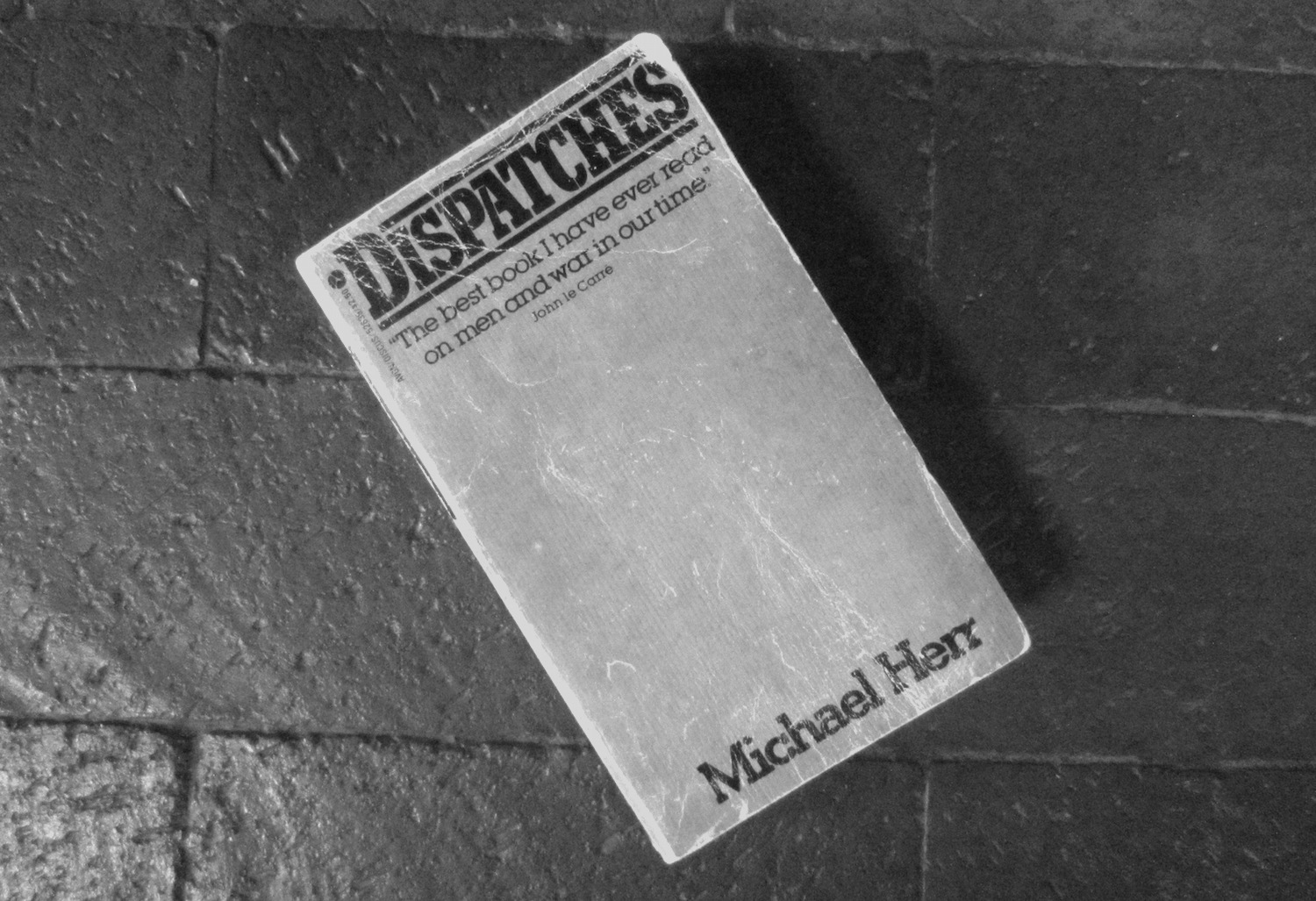
Michael Herr, who worked with Hasford and director Stanley Kubrick on the “FMJ” screenplay, wrote another of my favorite books, “Dispatches,” which with “All Quiet on the Western Front” by Erich Maria Remarque may be tied for the best book about war ever written. From the vantage point of someone who’s never been there and done that, anyway.

I know, I know. This is an awful lot of fuel for a mighty small fire. Happily, Herr, Hasford and Herbert never sat in with the Dirt Band, and Kubrick and Marquis never made a musical (“Paint Your Ornithopter?” “Cat & Roach Ballou?”) so let’s count our blessings. We already have more than enough to keep us awake at night, and most of it is nonfiction.

Hell sucks

You may never have read "Dispatches" by Michael Herr, but chances are you've shared some of his experiences at the cinema, in "Platoon," "Apocalpyse Now" or "Full Metal Jacket."
You may never have read “Dispatches” by Michael Herr, but chances are you’ve shared some of his experiences at the cinema, in “Platoon,” “Apocalpyse Now” or “Full Metal Jacket.”

Michael Herr deserves his own post, if only for “Dispatches,” a work I’ve mentioned here before.

He went to Vietnam for Esquire, not for Uncle Sam, and he had to have a breakdown before he finished the book for which he would be best known.

If you saw “Apocalypse Now,” you’ve heard his work (he wrote the narration). You got some more of it in “Full Metal Jacket” (he wrote the screenplay with Gustav Hasford, author of “The Short-Timers,” for his friend Stanley Kubrick).

But “Dispatches” was the real deal. Seventies reportage from the scene, slightly fictionalized, deeply admired, by the king of Gonzo journalism, Hunter S. Thompson, and by me, too.

Rest in peace, Mr. Herr.

Extra-credit reading

“Hell Sucks,” which became part of “Dispatches,” reprinted in its entirety at Esquire.

“Breathing In,” also from “Dispatches,” excerpted by NPR.

• Herr’s New York Times obit.

A remembrance by Graydon Carter.

A 2000 interview in The Guardian by fellow war correspondent Ed Vulliamy.

Illumination rounds

You may never have read "Dispatches" by Michael Herr, but chances are you've shared some of his experiences at the cinema, in "Platoon," "Apocalpyse Now" or "Full Metal Jacket."
You may never have read “Dispatches” by Michael Herr, but chances are you’ve shared some of his experiences at the cinema, in “Platoon,” “Apocalpyse Now” or “Full Metal Jacket.”

Once we fanned over a little ville that had just been airstruck and the words of a song by Wingy Manone that I’d heard when I was a few years old snapped into my head, “Stop the War, These Cats Is Killing Themselves.” Then we dropped, hovered, settled down into purple lz smoke, dozens of children broke from their hootches to run in toward the focus of our landing, the pilot laughing and saying, “Vietnam, man. Bomb ’em and feed ’em, bomb ’em and feed ’em.”

That quote from Michael Herr’s “Dispatches” just snapped into my head as I read this New York Times piece about the prez authorizing the sale of “lethal military equipment” to Vietnam.

Pretty much describes our entire foreign policy, doesn’t it?

Bomb ’em and feed ’em; bomb ’em and feed ’em.

The summer grasses remain

I neglected to post something yesterday about Veterans Day, thinking I didn’t have anything fresh to say, and finding the outpouring of social-media thank-yous to the military slightly irksome. I never served, but if I had, I expect I might not enjoy being pandered to any better than I would being ignored.

Like Charles P. Pierce, when I was a squirt I didn’t know anyone whose father was not a veteran. Since the old man was career Air Force, we mostly knew the kids of Blue Zoomies, but in the course of affairs we would meet others; sons and daughters of soldiers, sailors, Marines.

dad2We’d hear the tales secondhand (none of the dads I knew bragged to kids about his service, so the kids bragged for them). This one was at Omaha Beach, that one at the Battle of the Bulge; this one got shot down in a B-29 after bombing Tokyo, that one flew unarmed Gooney Birds out of New Guinea.

It all sounded really cool, especially while consuming a steady diet of war movies at the base theater, like “The Longest Day,” “The Dirty Dozen,” or “PT 109.” And then we got a little older, and a little smarter, and we came to realize that going to war involved a strong probability of getting one’s arse shot off.

We realized that we never got to hear kids tell about their dads who didn’t make it back, because those kids died unborn with their would-be fathers, figments of an unrealized imagination. And we didn’t get to hear about the men who returned from war damaged in body, mind or spirit, or meet them; not until our own war, Vietnam, came along.

Books like “All Quiet on the Western Front” took on new meaning. And there were others, like “Dispatches,” by Michael Herr; “A Rumor of War,” by Philip Caputo; and “Everything We Had,” by Al Santoli.

In “Narrow Road to the Interior,” Japanese poet Matsuo Bashō (1644-94), following a visit to the ruins of Yasushira — and riffing off a line from the Chinese master Tu Fu about how war had left “the whole country devastated,” a place where “only mountains and rivers remain” — wrote:

Summer grasses:
all that remains of great soldiers’
imperial dreams

In “The Poetry of Zen,” co-author Sam Hamill calls this poem “a brilliant indictment of the stupidity and cruelty of war,” one that reminds us how little we have learned over the millennia. How does one say “Thank you for your service” to the grass?

By seeing to it that subsequent generations get to spend as much time as is humanly possible enjoying the sunny side of it, I suppose.

Peace to those to served, and especially to those who never came home.