The question is “What will A.I. do to jobs?” And the answers come from right, left and center, from tech CEOs to academic economists to Steve Fucking Bannon — yes, that Steve Fucking Bannon.
It’s smartly reported and cleverly written and the accompanying graphics from Stephan Dybus are top notch.
You will probably not find the story comforting, as it considers the irksome human factor’s effects, if any, upon the Rise of the Machines. The long and the short of it is that where job security in Meatworld is considered, A.I. will either be just ducky or something like a pickleball dustup in Florida.
I shouldn’t do any deep reading on a single cup of joe at stupid-thirty on a Tuesday.
Then again, maybe I should do it more often. I might be inspired to compose a new Zen text: “Empty Stomach, Empty Mind.”
If artificial intelligence hasn’t already beaten me to it.
Thus we arrive via the usual scenic route at the first item that got my attention this morning: “A Tool That Crushes Creativity,” by Charlie Warzel, a staff writer at The Atlantic, who fears that generative A.I. slop, once a toxic byproduct of our latest technological Great Leap Forward, has become the shit sandwich du jour.
The second, also from The Atlantic, was “What the Founders Would Say Now,” Fintan O’Toole’s speculation about how the deep thinkers who got our national party started might be surprised that the Republic — as stove-up, surly, and senile as we perceive it to be today — survives at all.
That first one may have been more depressing than the second. The Republic has been in a state of collapse ever since I first took note of it. Maybe even longer. America’s very own Leaning Tower, possibly of pizza, almost certainly from Domino’s. We knew it was wrong, but we ate it anyway.
But creativity — an appeal to hearts and minds with words, sounds, and images — freed me to sing for my supper, the tab paid by all the poor suckers who actually had to work for a living. And now Warzel says that, like made-in-China Marxists, my tools have risen up against me.
Writes Warzel:
The people selling these tools are doing so with a powerful narrative: Generative AI supposedly supercharges all that it touches, democratizing creativity, eliminating friction, increasing productivity, and pushing the boundaries of what is possible. … [But] the loss of friction deprives people of something crucial. What happens between imagination and creation is ineffable—it entails struggle, iteration, joy, and frustration, disappointment, and pride. … It is how we make meaning and move through the world.
I have not consciously employed any form of A.I. as I move through the world, making meaning. If I sniff its spoor in an online search, I tiptoe gingerly around it, trying not to get any on my shoes. WordPress offers a “Generate with A.I.” option when inserting images in a post, but I mostly generate my own images.
Or do I?
I’ve been a scribbler for as long as I can remember, and probably longer. Created my images in crayon on Big Chief tablets; in pencil, pen and ink on Bristol board, augmented with Zip-A-Tone; using Adobe Photoshop or Apple’s Preview; whatever was handy and could enhance my limited skillset.
“Enhance,” you say? Yup. The legendary editorial cartoonist Pat Oliphant tipped me to the Zip-A-Tone crosshatching shortcut when I interviewed him in the late Seventies for the Gazette. And I discovered the value of Photoshop a couple decades later when the bicycle magazines I worked for decided they wanted my cartoons in digital form, and in color, too.
I was no artist, as you probably already know. I tried using colored pencils and pens after first penciling an initial sketch and then inking it in. But when I fucked up — as I did, frequently — I had to start over from scratch, penciling and then inking and finally risking everything yet again on the whim of a Prismacolor Premier or Sharpie in my pig-ig’n’ant fingers. Digitizing the original black-and-white ’toons and coloring them in Photoshop let me magically undo what I had done and keep on keepin’ on.
It was so much easier. Frictionless, you might say.
I’ve been writing nearly as long, since George Gladney at the Colorado Springs Sun suggested I start keeping a journal back in 1974. Started with a Bic pen and a Vernon Royal composition book, then shifted to manual typewriter when I became a sure’nough reporter like Gladney, and finally went digital when the newspapers did.
If spell-checkers, grammar-checkers, and autocorrection had been available I might have used them, but back then we had angry editors for that sort of thing, and it was either learn or leave. I had bills to pay, so I learned. When I became an angry editor myself word-processing software had made everyone a writer, or so they thought. The software processed their words and I processed what the software shat out.
And yet some people wondered why I was angry.
Well, soon I had company.
I was a terrible photographer and filmmaker when cameras still used film. I had something of an eye — woefully uneducated, in need of vision correction, yet basically operational — but there were so many aspects of the craft to learn if I really wanted to make the magic happen.
Happily for me — and unhappily for pro shooters — digital cameras came along, followed by phone cameras. And before you could say “Ansel Adams” three times fast even I could make an image for a blog post on the cookie-cutter, dot-com version of WordPress (shout-out to the folks at Automattic), with a little help (OK, sometimes a lot) from software (Photoshop early on, and now Apple’s Preview).
I never thought I was a photographer, but plenty of other people thought they were, including one middle-management type who emailed a lame phone-camera snap of a sprint and expected us to use that as “art” for an online race report.
Video got a whole lot easier about the same time, for the same reasons, and I actually made a little money off that, using GoPros and iMovie to assemble bike-review shorts for Adventure Cyclist. Occasionally, and strictly for laughs, I called myself Quentin Ferrentino (h/t to the Grimy Handshake). Meanwhile, podcasting let me walk a few squeaky klicks in the Firesign Theatre’s inflatable clown shoes, with an assist from Zoom, GarageBand, Auphonic, and Libsyn.
So am I a photographer? A moviemaker? A spoken-word artist? Is the driver a car?
The only legit titles I can claim are writer and cartoonist, I think. I can write or draw with a Bic pen on a blank sheet of paper and then staple that shit to a telephone pole if I want to. Less effort than Ben Franklin put into his Pennsylvania Gazette. Nothing between me and you but a little time and sweat equity.
A.I. won’t help me make it, and Google probably won’t help you find it.
But at least we’d know we made the effort while we wait to see whether these new tools become trusted advisers instead of questionable servants — or worse, malevolent masters. That teetering Republic ain’t gonna prop itself up.
Writing at The Atlantic, freelancer Erin Sagen says today’s kids are very much not riding their bicycles, and for a variety of perfectly defensible reasons, too:
Since the 1990s, speed limits have ticked upward. Each year (minus a few temporary dips), drivers have progressively clocked more collective miles and driven ever larger cars. According to a 2023 report by the nonprofit Insurance Institute for Highway Safety, “Over the past 30 years, the average U.S. passenger vehicle has gotten about 4 inches wider, 10 inches longer, 8 inches taller and 1,000 pounds heavier.” These machines may be protecting drivers and passengers, but they can be much more intimidating to people on bikes. The annual number of children killed on bikes has actually fallen, a 2021 CDC report found, but the report acknowledges that this is likely in part because fewer kids are out riding.
Boy howdy. Citing stats from the National Sporting Goods Association, Sagen writes that during the 1990s, an average of 20.5 million children ages 7 to 17 rode a bike six or more times a year. By 2023, a few decades later, that number dropped to about 10.9 million. And of those kids, less than 5 percent rode their bikes “frequently.”
Six or more times a year? Sheeyit. We hopped on our bikes six or more times a week. Some of us still do. It’s fun, it’s exercise, it’s transportation … it’s liberation. Damn The Man! Let’s get big air at the gravel pit! Using one chain to break another, as it were.
No mas, no mas. !Que triste es la vida velo!
No wonder the Adventure Cycling Association has put its storied headquarters up for sale. Once a must-see for the membership, it’s only visited now by a handful of overripe saddle tramps in saggy wool shorts who just herded a 36-pound steel bike, hung about with tattered ripstop sacks stuffed with camping gear, canned beans, and one change of underwear, from Miami to Missoula without once stopping for a shower.
According to the ACA board of directors, the group’s membership has been dwindling for at least five years as its demographic “ages out” of bike travel. Tours and map sales are likewise struggling, and the association is failing to attract a younger crowd because ACA’s “brand” is seen as a raggedy-assed herd of sunburnt old roadies who just aren’t hep to the latest jive (gravel, bikepacking, insert your thrill of the minute here).
So, bam! The ACA HQ goes on the block, listed for $2.7 million, reports The Missoulian, its hometown newspaper.
I don’t know how this sale might save the ACA, because I haven’t seen any actual rescue proposals put forward. Just some MarketSpeak® in Bicycle Retailer about how ACA is “facing a crossroads,” “grappling with challenges,” and “addressing brutal truths while maintaining faith in the mission,” and how selling the HQ will “help us adapt to our reality, giving us the runway to reshape our programs and resources to continue inspiring transformative bike travel experiences.”
Friend of the Blog Diane “The Outspoken Cyclist” Lees is among those not convinced. She has viewed with alarm at her Substack, and former members of the organization — including its founders — are among the people who put together this petition urging that the sale be stopped.
Now, $2.7 mil’ may sound like a lot of money, especially if you don’t have it. But since Bikecentennial hit the road in 1976 I have, despite an appalling shortage of investment capital and absolutely no plan at all, pissed away at least that much on cigarettes, booze, drugs, guns, comic books, actual literature, albums, CDs, stereo gear, Toyota trucks and Subaru cars, road trips in three countries, moving violations in one of them, cheap motels, pet-friendly rentals, real estate, meals remarkable and questionable, vet bills, drawing paper, pencils, and pens, countless Apple products and peripherals, cable TV, streaming video, Internet hookups (no, not that kind of Internet hookup), blog/podcast hosting, and audio-visual gear.
And the only person who got any bicycling out of it all was me — in 1976, because I had been doing without a driver’s license for a few years thanks to a minor traffic accident (hit by a train), and afterward because I learned to love it (the cycling, not being hit by trains).
By the time Bikecentennial blossomed into the Adventure Cycling Association in 1993 I had settled down a great deal. It helped that after 15 years of newspapering I was officially and permanently unemployed, building a second career of sorts as a freelancer peddling vicious libels, ugly scribbles, and outright lies to niche magazines with the circulation of a week-old murder victim. I had also begun racing bicycles, and acquiring them, the latter a jones which haunts me to this day.
And after a decade and a half of that, thanks to the risk-taking spirit of the late, great Mike Deme, and his successors, Alex Strickland and Dan Meyer, I even sold some word count to Adventure Cyclist, at a time when the decline and fall of the for-profit bicycle magazine had left me short on runway and having trouble adapting to my reality.
Those dudes, and the other great advocates for and facilitators of bicycle travel I met while scribbling bike reviews for Adventure Cyclist, have all left the building that ACA plans to sell for … whatever. I’m sorry that I never visited them there, because now I never will. The building will become a bespoke hotel, law office, or assisted-living residence, whose half-daffy inmates will swear to their keepers that in the wee hours of the darkening night they hear the clicking of wide-range cassettes and catch a whiff of overworked chamois cream.
Sell the real estate? That’s what vulture capitalists do when they add another newspaper to their portfolio. I’ve seen it with my own eyes. A storied newspaper building becomes office space, condos, or a parking lot, the printing gets outsourced, and the few remaining journos who produce the paper are exiled to some soulless strip-mail shithole with all the joie de vivre of a happy-ending massage parlor — chances are the space used to be a happy-ending massage parlor — because the vulture capitalists don’t have any souls of their own and can’t imagine why anyone would want one. Bad for the bottom line.
Sell the real estate? Would the pope sell the Sistine Chapel? Puh-leeze. Dude won’t even Airbnb his summer place at Castel Gandolfo. Even a fucking Realtor will tell you it’s all about location, location, location.
Sell the real estate? It’s like eating your seed corn. Nothing down that long and winding road except for maybe one big dump and then death. Remember the wisdom of another intrepid traveler, Buckaroo Banzai, who has taught us: “No matter where you go, there you are.”
Is it too late for all these weak-in-the-knees whippersnappers askeered of the big, bad cars to revisit their cushy lifestyles, take a big ol’ bite out of life, savor the flavor of adventure cycling? And save the Adventure Cycling Association’s venerable headquarters, the hub around which America’s bicycle-travel universe revolves?
For the love of Deme, put that smartphone down, Rain, Drain or Spokane, whatever the hell your helicopter parents named your sorry ass, unless you’re calling Soma Fabrications to order up a damn’ Pescadero. Listen to the Voices. Here’s your panniers, there’s the door, what’s your hurry?
It’s a Dropkick Murphys kind of Fourth around the Dog House. Up the rebels!
As Dropkick Murphys release a new album, “For the People,” frontman Ken Casey has a few thoughts about the big red pickle in which we find ourselves during our annual Independence Day picnic.
Speaking with Jeffrey Goldberg, editor-in-chief of The Atlantic, Casey said he was shocked that so many people in his life fell for Trumpism:
“My father died when I was young, and I was raised by my grandfather, who was basically like, ‘If I ever see you bullying someone, I’ll kick the shit out of you. And if I ever see you back down from a bully, I’ll kick the shit out of you.’”
“I’ve just never liked bullies, and I don’t understand people who do. It’s really not that hard. I wish more people would see that it’s not hard to stand up.”
So stand up with Dropkick Murphys and the people on this Fourth of July, and all the other ones, too, even after we kick the shit out of these bullies. And sing along, if you can keep up. Here are the lyrics for anyone who’s not fluent in Celtic punk.
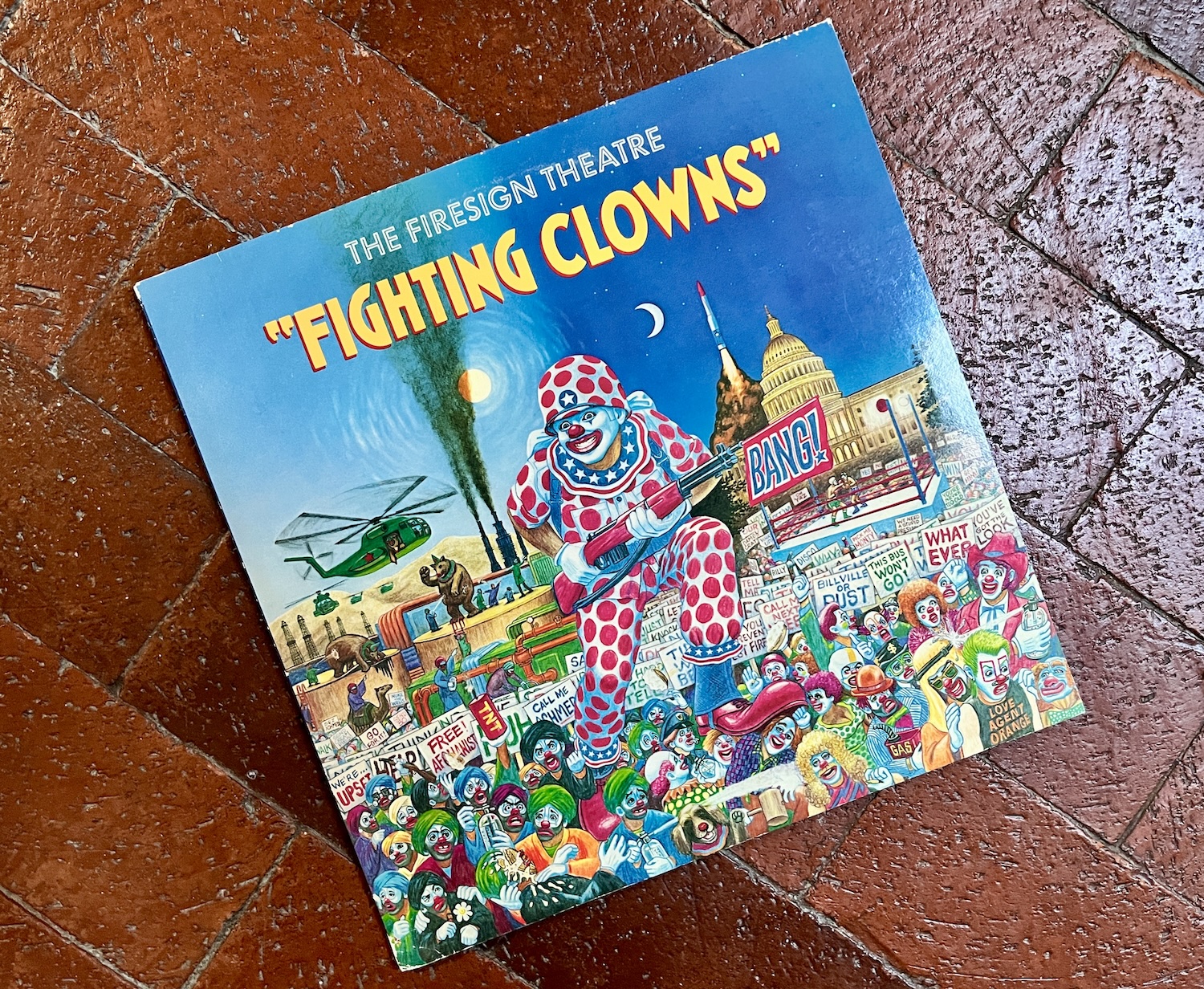
There’s a Firesign Theatre album for just about any occasion. This one, like the now-infamous Houthi PC small group chat, was released just in time for April Fool’s Day, but back in 1980.
The 101st Fighting Clowns (2025 edition) sound like a cross between Adderalled preteen gamers and your Pee-Paw who never learned not to hit “Reply All” on an email before talking shit on someone in the family.
We’re gonna need a bigger bus for all these bozos.

 Mad Blog Media