Doesn’t look like we’ll be needing the ol’ kiva fireplace in the master bedroom for a while, if the long-range forecast is any guide.
Actually, we’ve never needed it, nor the bigger one in the living room neither. We both got our fill of wood-burning Back in the Day®, when we lived at 8,800 feet in frosty CrustyTucky and tossed big chunks of aspen, cedar, piñon, and oak into the Lopi fireplace insert faster than ICE Barbie’s masked goons throw brown people out of the country, only with less horseshit and gunfire.
Here in scenic cosmopolitan Duck!Burg, a couple-three thousand feet lower and more than a few Fahrenheit degrees higher, we manage to skate by with fossil fuels. This keeps Your Humble Narrator away from chainsaws, always a good idea, especially in these dark days. Will he do an injury to himself or someone else? Stay tuned!
The chainsaw always made me nervous, actually. What I liked was splitting rounds with the ax, another implement that should probably be under lock and key for the duration. The chainsaw is long gone, but I still have an ax, a couple smallish camping hatchets, and a few handsaws in case I need to dispose of a body … uh, of some downed limbs! Tree limbs!
Goddamnit, this is what comes of reading the news of a morning. Some days there just isn’t enough coffee in the world.
But it does look like we will have oddly springlike conditions for the near future, and so instead of burning wood or anything else, I can expend a few calories on the old bikey-bike. And without all the heavy-weather gear, too.
At this rate, an old white guy could find himself browning up enough to get deported. I hear South Sudan is lovely this time of year.
The ever-readable Mike Ferrentino has a meditation on “garbage miles” in his “Beggars Would Ride” column over at NSMB.com.
No spoilers. Pop over and have a squint. I will say only that his thoughts on the topic have evolved over the decades, because he is mos def one of the higher primates.
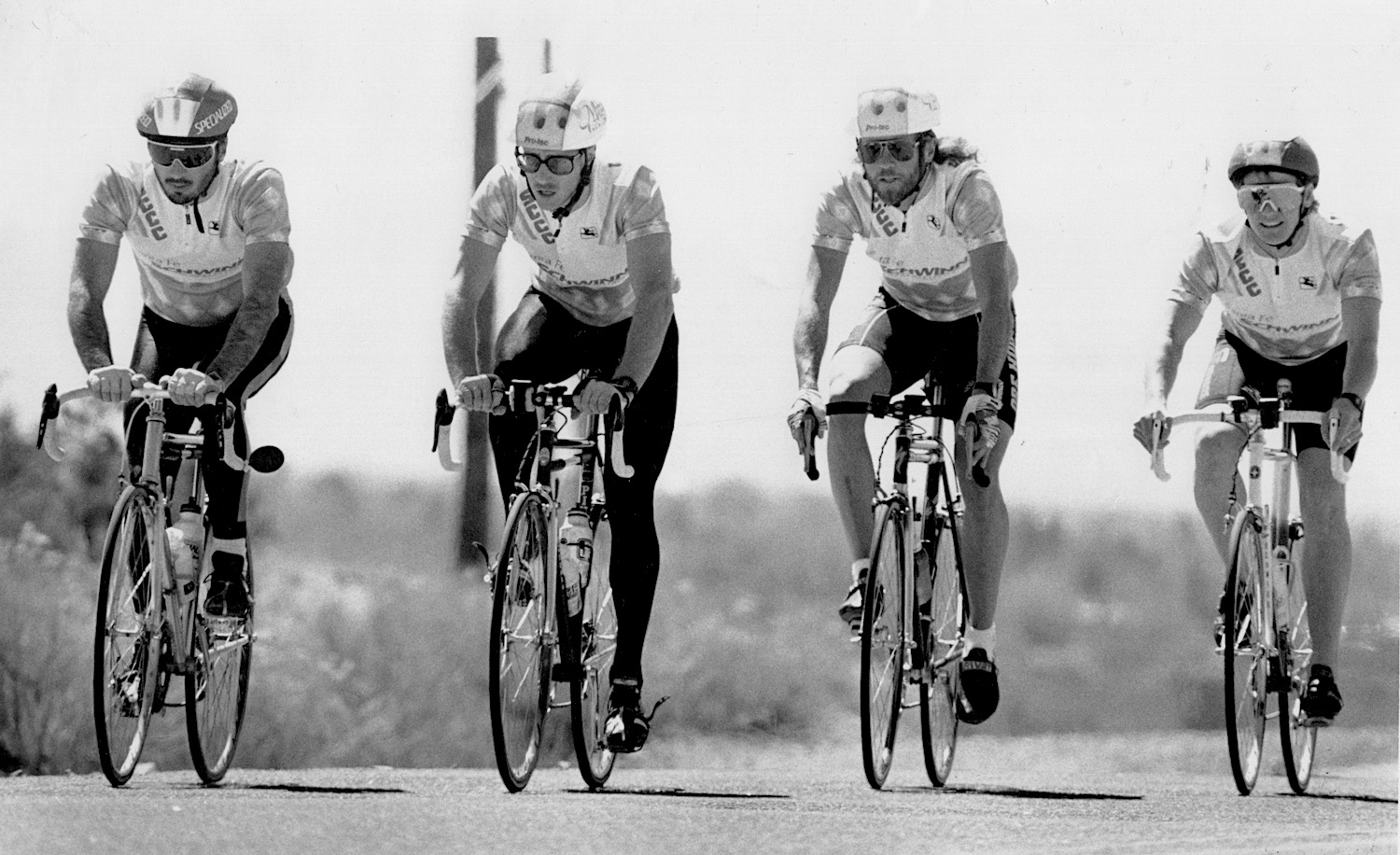
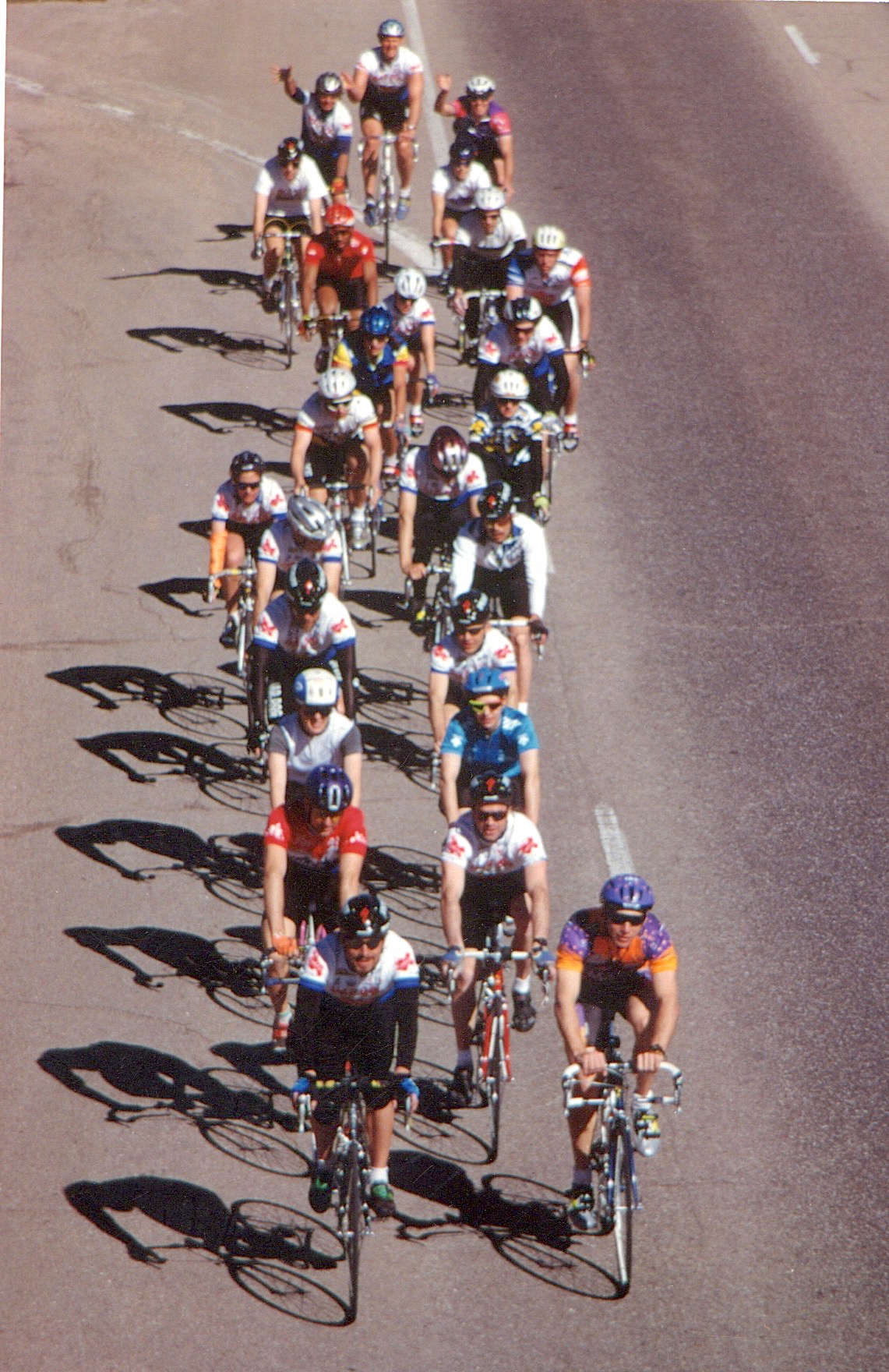
This photo was taken three days before my 36th birthday. I was single, I had a job, and yes, that is a ponytail you see peeking out of the back of my helmet. Photo by Larry Beckner | The New Mexican
I first encountered the concept of garbage miles back in the Eighties, while racing bikes out of Fanta Se. Logging a ton of miles I was, and getting ruthlessly flogged on race day by people doing half my weekly average, or less.
“The fuck?” I inquired.
“Too many junk miles,” they replied.
Junk miles, garbage miles, all samey same. Unfocused and thus unworthy. Or so they said, the rotten, podium-hogging sonsabitches.
But not me. Because whenever I was in the saddle spinning I was not parked at the The New Mexican‘s copy desk, where I had to log many junk miles indeed to underwrite my cycling habit. Many, many of them.
At least the bike miles, like crucifixion, got me out in the open air.
Once we moved to Bibleburg in fall 1991 I kept it up. The Sept. 15 entry in my training journal after a 157.5-mile week was: “A few respectable miles. Nice to not work — nothing like a job for fucking up your training.”
The fabled 115 ride from B-burg to Penrose and back, circa 1995 or thereabouts.
“Training,” he calls it. This is the hee, and also the haw. Oh, I was riding on road and off, first with Rainbow Racing, then later with the Mad Dogs. And I was running regularly, even doing a little inline skating and snowshoeing because I was freelancing pieces to a sports-and-fitness outfit in Boulder between my chores for VeloNews (see, I was actually trying to work and earn, kinda, sorta).
But at my first few Colorado cyclocrosses I was either OTB or DFL, eventually settling into a fairly reliable fourth-place kind of fella, out of the money yet very much in the way. Seventh of 11 finishers at the state championships at Chatfield State Park that year, after which I called it a season.
Too many junk miles. Garbage miles. Whatevs.
Oh, I got better. Or maybe they got worse, as one of the fast guys mused in my presence after I finally managed to finish a race in front of him. In any case, by the mid-Nineties I could podium at a ’cross every now and then, even win, rarely, if the weather got truly evil and the fast guys stayed home.
Solo on the home course.
This could’ve been because I actually trained for cyclocross, which by this time was the only cycling discipline I really cared about.
I worked on technique, ran a ton to counter my lack of snap in the saddle, and even built my own course at altitude (at the base of our 43-acre plot at 8,800 feet outside Weirdcliffe in CrustyTucky).
During the seven years we lived there I rode a ’cross bike just about everywhere, because pavement was miles away and when I finally got to it I didn’t want to be herding the old mountain bike with its 26-inch knobbies and boingy fork. Though I missed its 24-tooth granny ring while cursing my way up the long dirt mile back to the house, 430 feet up from the washboarded county road.
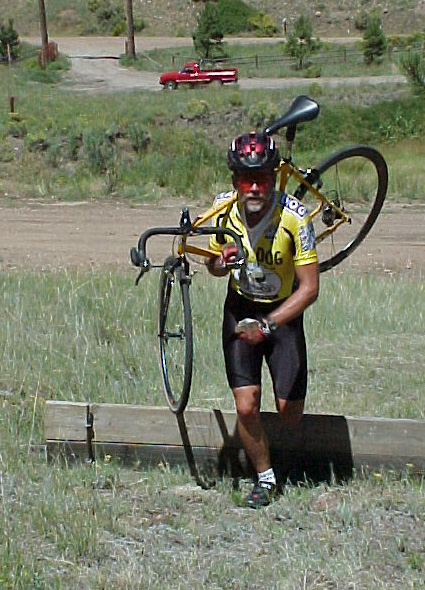
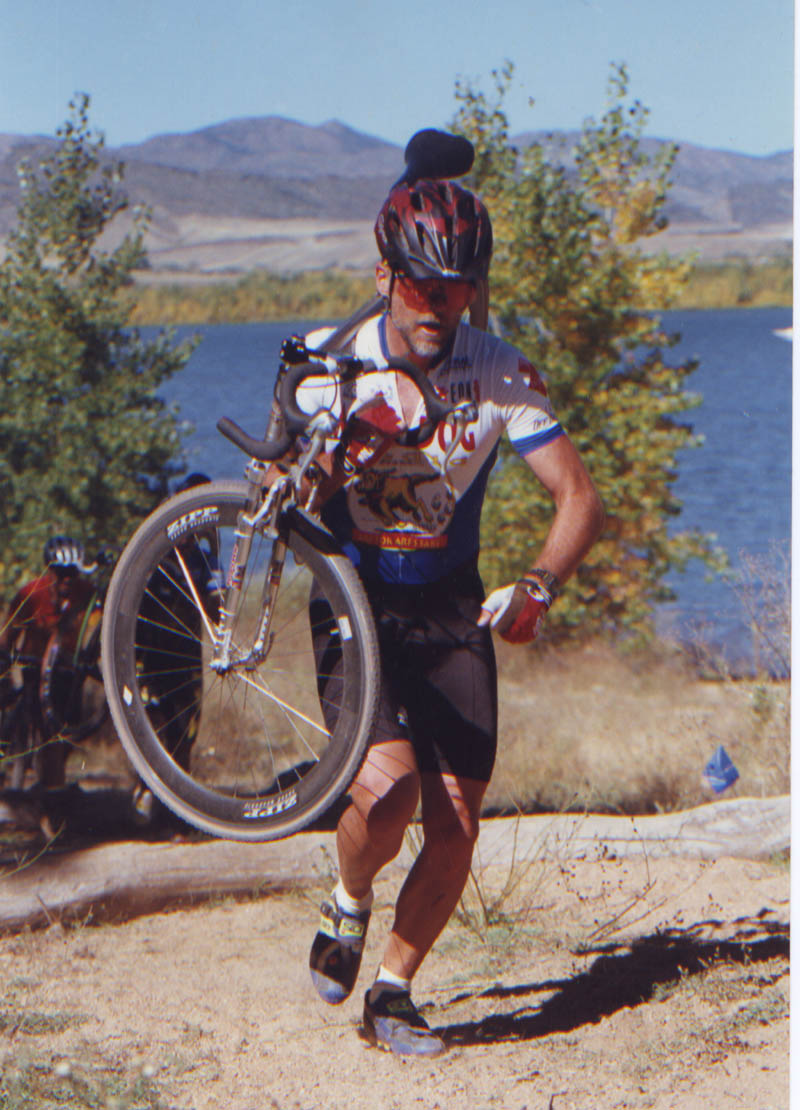
Dogging it at Chatfield.
Not a lot of junk miles in CrustyTucky.
In those years I logged my junk miles behind the wheel of a Toyota pickup, with my bikes in the bed. Our Mad Dog cyclocrosses were in B-burg, a 150-mile round trip from home base. The bulk of the state race series meant an even longer slog up the Front Strange, to Littleton, Denver, Franktown, Boulder, Mead, and Fort Collins. The weather was frequently wintry, masters were always first to race, and more than once to make the start I had to hit town the day before, overnighting in some low-rent motel.
Talk about your junk miles.
After a few years of that my training logs crumbled into random entries followed by none at all. It was starting to feel a whole lot like work — which was also suffering in part because the cycling community in CrustyTucky consisted of me, myself and I. It felt like being sentenced to Stationary Trainer Without Parole. I was taking all the pulls and yet going nowhere. In terms of fiscal and mental health it seemed prudent to seek out a few voices that weren’t coming from inside my head.
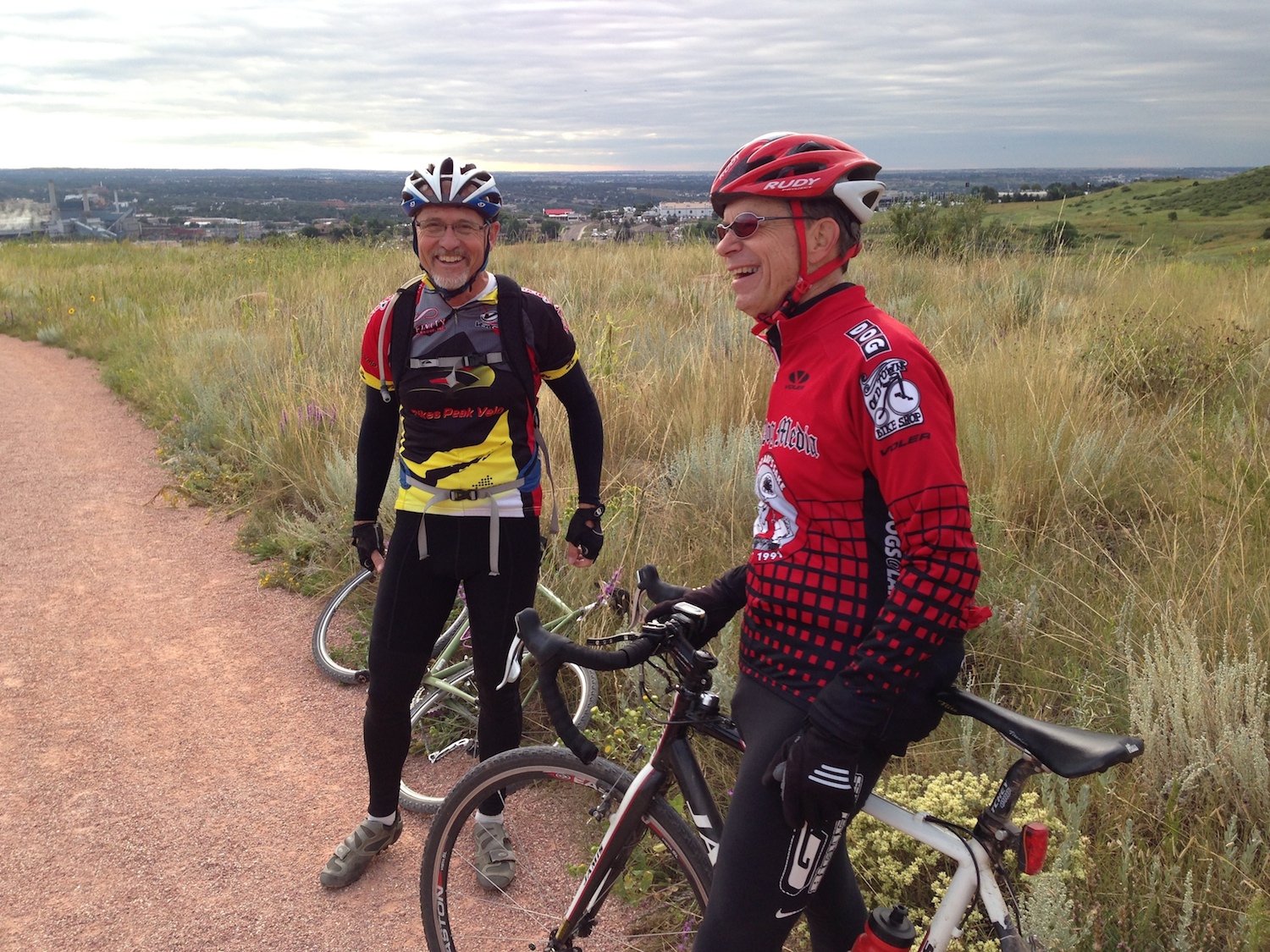
Dennis the Menace and Dr. Schenkenstein take the long view atop Bear Creek East, a once-active cyclo-cross venue.
In those first years back in Bibleburg I had a good crew. Quite a few of the Mad Dogs owned the clocks we punched and could rearrange at least one business day a week to log junk miles and devise solutions to the various crises facing the world (you’re welcome). Big Bill “Shut Up and Ride” McBeef and his bro Other Bill. Usuk and The Geek. Dr. Schenkstein and Dennis the Menace. The Old Town Bike Shop crew. And the rest of you lot; you know who you are. So in 2002 we went back there.
Took me right back to my riding roots it did. I no longer felt as though everything was uphill and into the wind in all directions. A couple years later I quit racing because I didn’t need it anymore. I had my junk miles. Garbage miles. Whatevs.
A wee dose of winter in the backyard, just in time for Election Day.
My brother geezers were already abandoning the Monday ride on Sunday. Cold, wet, no thank you, please, etc.
I bailed too, mostly because I’m taking antibiotics and steroids to beat down a sinus infection, but also because I had my fill of cold and wet in the Before-Time™, when I fancied myself a cyclocross racer.
My interest in the activity started to flag after a few years living on our wind-whipped rockpile outside of Weirdcliffe, in Crustytucky County, Colo. (“Gateway to Gardner”).
I actually had some of my best races while we lived there, because I was living at 8,800 feet and training even higher, running a ton, riding a ’cross bike almost exclusively on the indifferently maintained and largely unpaved roads, and doing laps on my own short homemade course.
But evil weather was both my strength and my undoing. I needed a course with lots of running to have a chance against the roadies, who are like cowboys, reluctant to dismount from their steeds and proceed on foot. So, yeah: rain, mud, snow, anything to suck a few mph out of those tree-legged, leather-lunged sonsabitches.
But getting to the races in the kind of conditions that favored my limited skillset — run around for 45 minutes while wearing a perfectly rideable bike — could be something of a project. The nearest one was 90 minutes down and north in good weather, and it was the race I and my club put on twice a year in Bibleburg. The others were in Franktown, Littleton, Lakewood, Longmont, Boulder, Mead, Fort Collins, and like that there.
It got to where I would book a motel room, drive north the night before a race, eat dinner out, breakfast on coffee and energy bars in the room, get my ass handed to me at the event, clean up in a car wash, find something to eat, and drive home. After a while it began to feel a lot more like work than recreation, even if I did well, which mostly I did not.
Unless I saw heaps of snow on the deck when I got up on race day. Yay. And even then I had to drive home in it.
The travel got a little easier when we moved back to Bibleburg, but the racing never did. I was working a lot while training less, and at a lower altitude, too. The flesh was unwilling and the spirit was weak.
I could tell I was over it in 2004, when I rode my main race bike to a ’cross in Bibleburg . No spare bike, not even a spare wheel. And when I flatted about halfway through my race, I wobbled off the course, resolved the puncture (who brings a pump and saddlebag with spare tubes and tire irons to a friggin’ race?), and rode home.
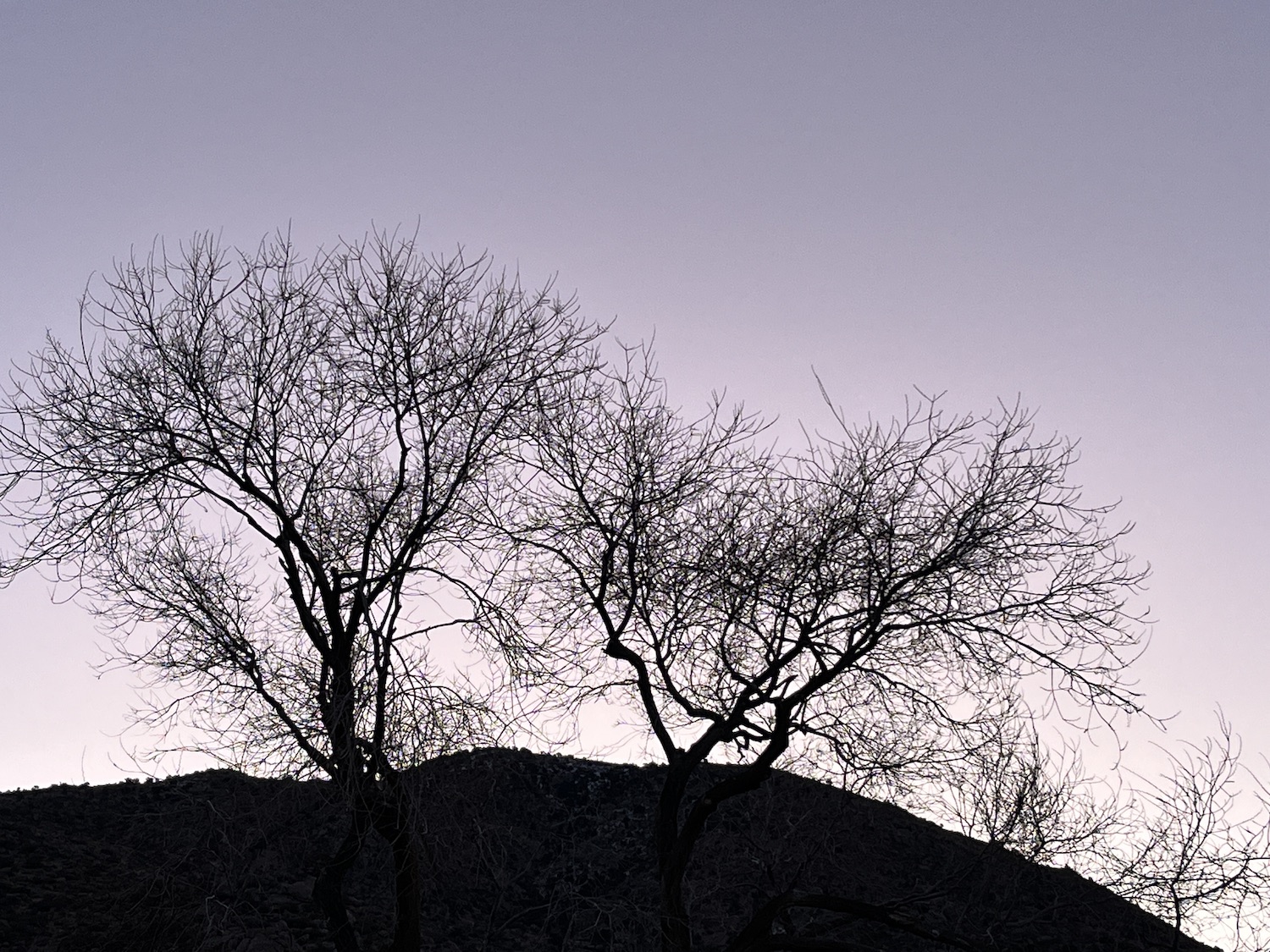
Bare trees, gray light. Oh, yeah, it was a cold night.
We’re still in the freezer section here in The Duck! City.
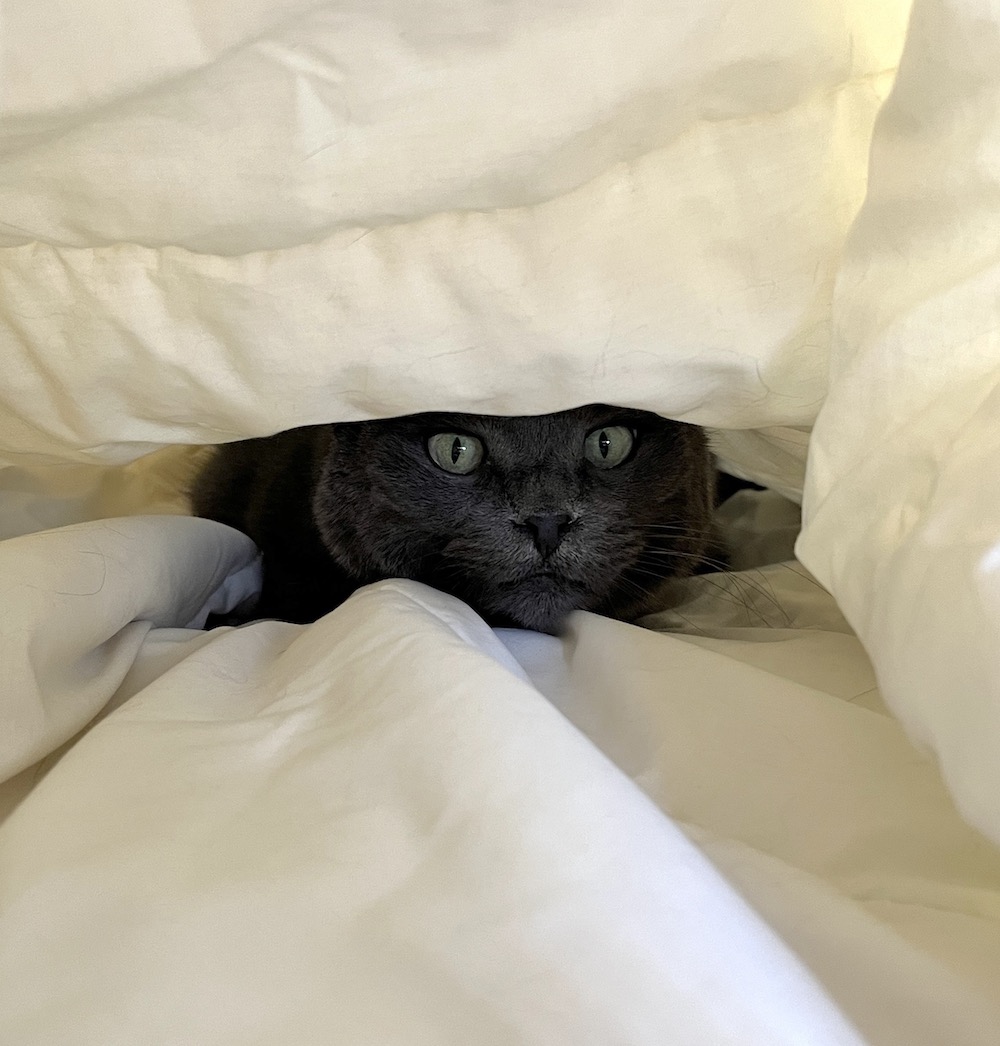
The thermometer has been pegged at 13° since I got up way too early this morning because I was feeling chilly even in the bed, which Miss Mia Sopaipilla appropriated after I had adjusted the thermostat (and provided her a couple helpings of kibble, a tuna-water ice cube, and a soupçon of butter from my morning toast).
“I’d like my meals delivered, please. As in ‘now.'”
Of course, 13° ain’t shit to you stolid Midwesterners, Canucks, and other polar explorers. And my man Hal reports minus-11° this morning at his compound in our old stomping grounds of Crusty County, which makes me miss the place not at all, not one itty-bitty bit.
I remember stuffing chunks of cedar, oak, and aspen into our Weirdcliffe woodstove like a Vegas bluehair shoving nickels into a one-armed bandit. But Hal can’t even do that, because his stove is on the DL.
Thus he burns propane and electricity like a city feller while he awaits parts for his wood-burner, a Drolet Outback Chef, some Quebecer deal with an Eyetalian overlay.
I don’t suppose Hal will pass the time by reading the continuing adventures of The Count of Mar-a-Lago, now available on Twatter andButtface. But he does have a perverse streak. How many people do you know who cook their meals on a woodstove in the the Year of our Lard 2023?
• Editor’s note: It’s your lucky day, folks. We have a guest post by my old pal Hal Walter, who invested a portion of his increasingly rare downtime in telling us a tale of that long and winding road.
By Hal Walter
I do a lot of driving these days. Between coaching a rural 2A cross-country team at Custer County School, and overseeing my autistic son Harrison’s transition to college life this fall, I am becoming more intimate with the Central Colorado highways than I really care to be.
Our cross-country team is traveling to nine different meets this fall, from one to three hours away, by bus. Sometimes I am the bus driver too.
My son is attending Colorado Mountain College in Leadville, where he also runs on the cross-country team — which means even more mountain driving to see his competitions. Because of issues surrounding his being on the autism spectrum I spend some nights and partial days in Leadville and also bring him home for weekends.
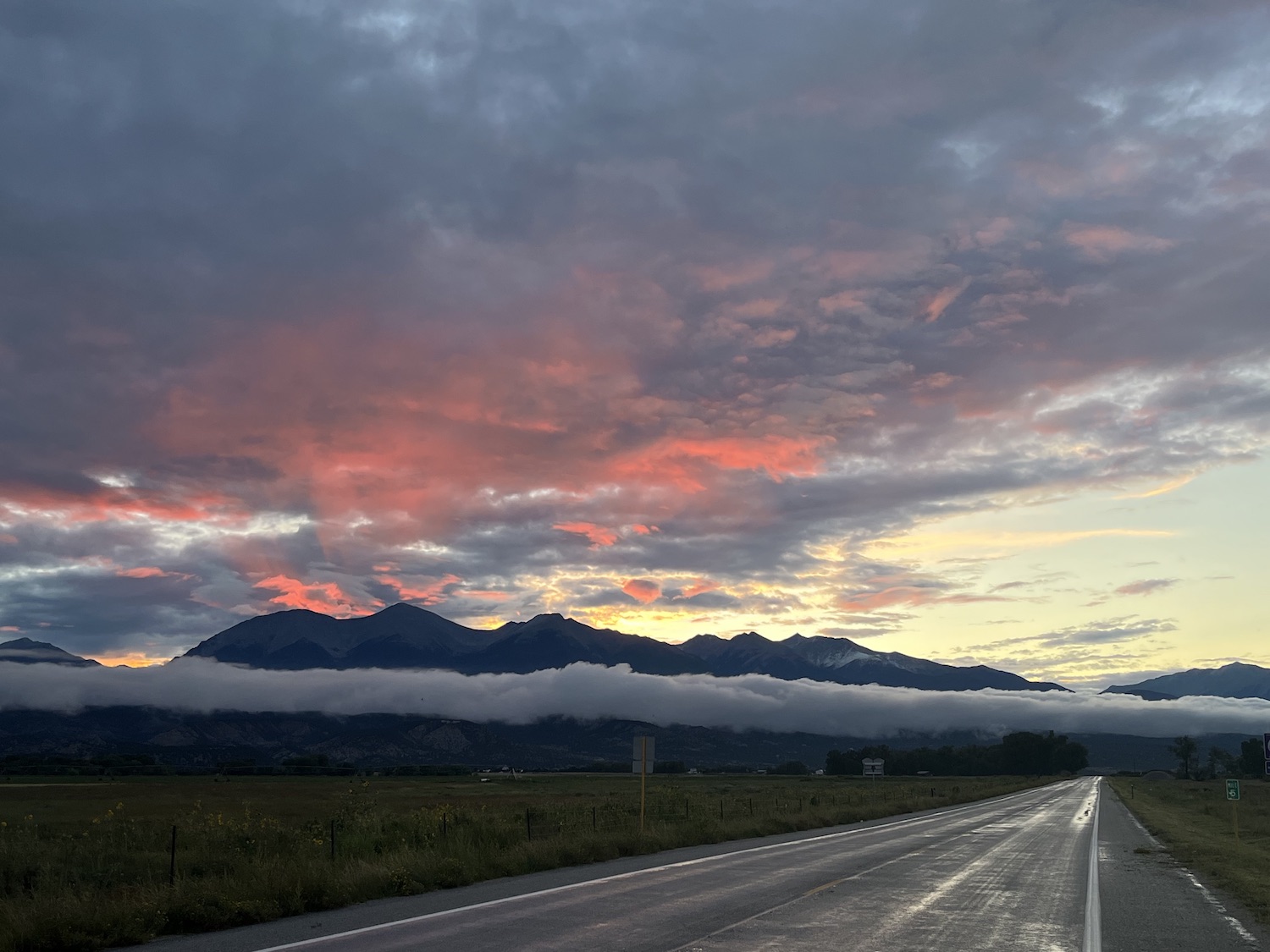
Recently on a Sunday evening, I conned my wife into joining Harrison and me for dinner on our way to Leadville. After an excellent meal at the new Thai restaurant in Westcliffe, Mary headed back to the ranch while Harrison and I pressed on to the Timberline Campus as the sun sank behind the Sangre de Cristo range.
About 12 curvy miles north, nearing the small settlement of Hillside, I saw something cross the highway in the dim light ahead. It seemed fairly tall so I immediately thought it might be an elk and slowed down. I don’t want to hit anything after some road debris tore a hole in my gas tank on an earlier trip, but I especially do not wish to hit an elk in my 10-year-old Suzuki SX4.
I also encounter a fair number of Amish travelers in this area, on horses, in carriages and more recently, riding e-bikes, which I reckon to be their version of motorcycles.
I hit my brights but they were useless in the twilight. Slower, slower. I finally rolled up to the place where I was expecting to see elk, but instead spied an odd-shaped object on the left-hand side of the highway where there is basically no shoulder. I’m thinking, “What the heck is that?”
It was initially a tallish Thing, segmented and rectangular. Then I realized it was a hand truck stacked with white boxes. It seemed at once to be moving yet standing still. That’s when I saw the smallish guy behind it, head barely above the load, pushing it along.
I coasted forward and looked to my left as I passed but could not get a good read on what sort of person this was. As I drove on I saw in the rearview mirror the hand truck crossing the highway right after I passed. Was that a homeless dude or an Amish person? It almost seemed like an apparition, yet I knew it was real.
At the next curve I slowed down again for a big Amish carriage in the oncoming lane with clomping horse, headlights and flashing taillights. A mile or so later at a ranch driveway I made out the silhouette of an Amish man astride a horse. After I passed he spurred the horse out onto the highway and in the fading red glow of my taillights disappeared south into the darkness. I drove on, still puzzled by the guy with the hand truck.
It’s about 105 miles from Westcliffe to Leadville. After a short stop at the Salida Safeway to stock up on some necessities for Harrison’s week ahead, we arrived at the CMC residence hall after 9 p.m. We schlepped the clothes, electronics, groceries, running shoes, and other items into the room. We straightened up a little, got the coffee ready for the morning, and went to sleep.
The next morning Harrison wandered off for breakfast in the cafe. I did some more organizing of his things, then headed off to the nearby trail system for a hike-jog. I then accompanied Harrison to meet one of his instructors before his first class. I spoke with the assistant dean. I talked with Harrison’s counselor. I went back to the room and did some cleaning, got a shower, packed up, and left Leadville right after noon, bound for cross-country practice back in Westcliffe.
I stopped about halfway home, in Salida, and got lunch to go and the necessary coffee. I also went to the running shop, tried on, test-ran, and bought new shoes. I ate while driving, then stopped to change into my coaching/running gear just before Hillside. I drove on. Just as I arrived at Westcliffe I saw up ahead something curious on the road.
As I drew near in the bright daylight I realized it was indeed a homeless guy still pushing his hand truck of white boxes, like something right out of “The Road.” He was moving so slowly the motion was barely discernible. In the time I had driven more than 200 miles and done countless other tasks that I viewed as necessary, this man had pushed his hand cart of boxes about 12 miles.
The testament to human endurance notwithstanding, a flood of thought coursed through my road-weary brain about the pace of our lives and the pace of others, what we view as necessary and how little others have. The spectrum of my own First World problems as compared to someone living at a snail’s pace. The craziness of our lives, and of our times.
Hal Walter hangs his hat outside Weirdcliffe, Colo., whenever he’s home long enough to take it off.
 Mad Blog Media