The shoes say “Yes, yes, yes,” but the cold feet say “No.”
My old copy-desk comrade Hal Walter and I have a habit of carpet-bombing each other in the morning with news items hot off the digital press, guaranteed to elevate the heart rate.
This morning he hit me with a grim item about a cyclist bludgeoned to death by Florida Man, observing, “Cyclists piss people off for some reason.”
I fired back with some AAA advice for driving in winter weather, since Hal has to take his son Harrison up to Leadville today and snow is in the forecast.
Next, since the lads were doing a 14-mile run before leaving Weirdcliffe, I doubled down with a running mag’s top-10 tips for legging it in the cold — guidance that seemed heavy on the buying of various items.
And finally, for the coup de grâce, I tacked on a hastily freestyled top-10 list of my own, possibly because the wind was blowing about 666 mph here in The Duck! City and the going outside seemed contraindicated. Also, I may have been slightly overcaffeinated.
Dr. DogByte Sez: “Run Right Out and Buy Some Shit!”
Tip No. 1: Buy shit.
Tip No. 2: Buy more shit.
Tip No. 3: You know you can’t be happy without buying shit, so buy some more shit.
Tip No. 4: Buy some shit, then run around the corner to the coffee shop and buy some more shit there.
Tip No. 5: Buy some shit, then step outside, mumble, “Fuck me, it’s cold out here. I should really go back inside and buy some more shit.”
Tip No. 6: Buy some shit for your squeeze. Maybe your squeeze will then buy some shit for you, or even suggest taking your exercise indoors and under the covers, where it’s warm.
Tip No. 7: No, probably not. In fact, she’s out running. So while the cat’s away, you might as well just buy some shit for yourself.
Tip No. 8: Now that you’ve got the carpal tunnel from buying shit, you should probably schedule an appointment with a physical therapist. Which is kind of like buying shit, except you can’t brag about it while showing it to your friends.
Tip No. 9: So fuck that shit. You’d have to go outside, if only to get in the car. Better stay inside and buy some more shit, using your good hand.
Tip No. 10: That knock on the door? Not UPS. Collection agency. Looks like it’s time to run after all. If you don’t have a back door use a window. Think of it as parkour. We’ll have some tips for that if you make it back. With a viable credit card, of course.
Can a weekend be both long and short at the same time?
The answer is yes, if you’re driving from The Duck! City to Manitou Springs and back again to join some old comrades in honoring the spirit of one who’s gone west.
The friends and family of John O’Neill crowded into Mansions Park in Manitou on Saturday to eat, drink, and swap tales of a grumpy old sumbitch who loved his wife Cindy, dogs, running, the Three Stooges, mountain biking, and margaritas, and who left the party far too early at 69.
Herself and I had to think fast to arrange the 400-mile trip north. Do we drive up the day of the celebration, spend the night, and come back on Sunday? Or the day before, spend the night, and then race home right after the gathering on Saturday? Who’s going to keep an eye on Miss Mia Sopaipilla now that she’s an only cat? We’re short a couple of neighbors, one who’s off with the family on her own road trip and another who just had knee-replacement surgery. Decisions, decisions. …
In the end we arranged a room, engaged a pro pet-sitter to check in on Mia, got up at stupid-thirty on Saturday, and roared north in the recently reconditioned Fearsome Furster, making it to Bibleburg with just enough time to spare for a detour down Memory Lane, which in this case led to Bear Creek Regional Park, where John and I and the rest of the Mad Dogs put on so many cyclocrosses Back in the Day®.
From there we drove straight to Manitou, grabbed a parking spot across the street from the park, puzzled out the robo-meter (Is everything smart these days except me?) and did a quick bit of recon.
The uniform of the day was to be flannel shirts and jeans, and we soon saw one, then another, and another. Many, many of them, as the hour approached. We helped shift a few picnic tables and folding chairs around, but there were not nearly enough of either to accommodate the swelling flannel-and-denim herd, which spilled over the designated parking spots and onto the lawn.
There were tales and tears, laughter and applause, a slideshow and still photos, food and drink. We paid our respects to Cindy and to John’s Colorado Running Company partner Jeff Tarbert, and caught up with a smattering of cycling and running buddies from The Before-Time, when the Mad Dogs had a good deal less gray in their muzzles and more glide in their stride.
Time is a toll road, and the longer your journey, the more descansos you pass.
We couldn’t find a way to attend a remembrance for our B-burg bro’ Steve Milligan, a sharp wit felled by an aggressive cancer in 2020, at age 73, just as he and his wife were preparing to enjoy their retirement.
I was able to make it to Denver this past July to say a belated adios to my first editor in the cycling racket, Tim Johnson, who worked long and hard to help build VeloNews into the preeminent bike-racing mag’ it became after Inside Communications acquired the title and moved it from Brattleboro to Boulder in 1989. Early-onset Alzheimer’s devoured what remained of Tim in November 2021, at 63, after gnawing away at him for years.
Now, I am not a believer in the Next World. I’m not certain I believe in this one. But I found solace in these remembrances and the sheer number of celebrants they drew. One person can make a difference. The ripples from their passage through our lives spread far and wide, lifting many a lesser vessel.
They say you’re not supposed to make a big wake by the dock, “they” being the slackers bronzing their buns on the boards. The only time those posers get their feet wet is when they piss on their flip-flops.
The big boys jump right the hell off that dock. Make a huge splash, the sort of cannonball into the deeps that will have people talking and laughing and toasting your memory long after you’re gone.
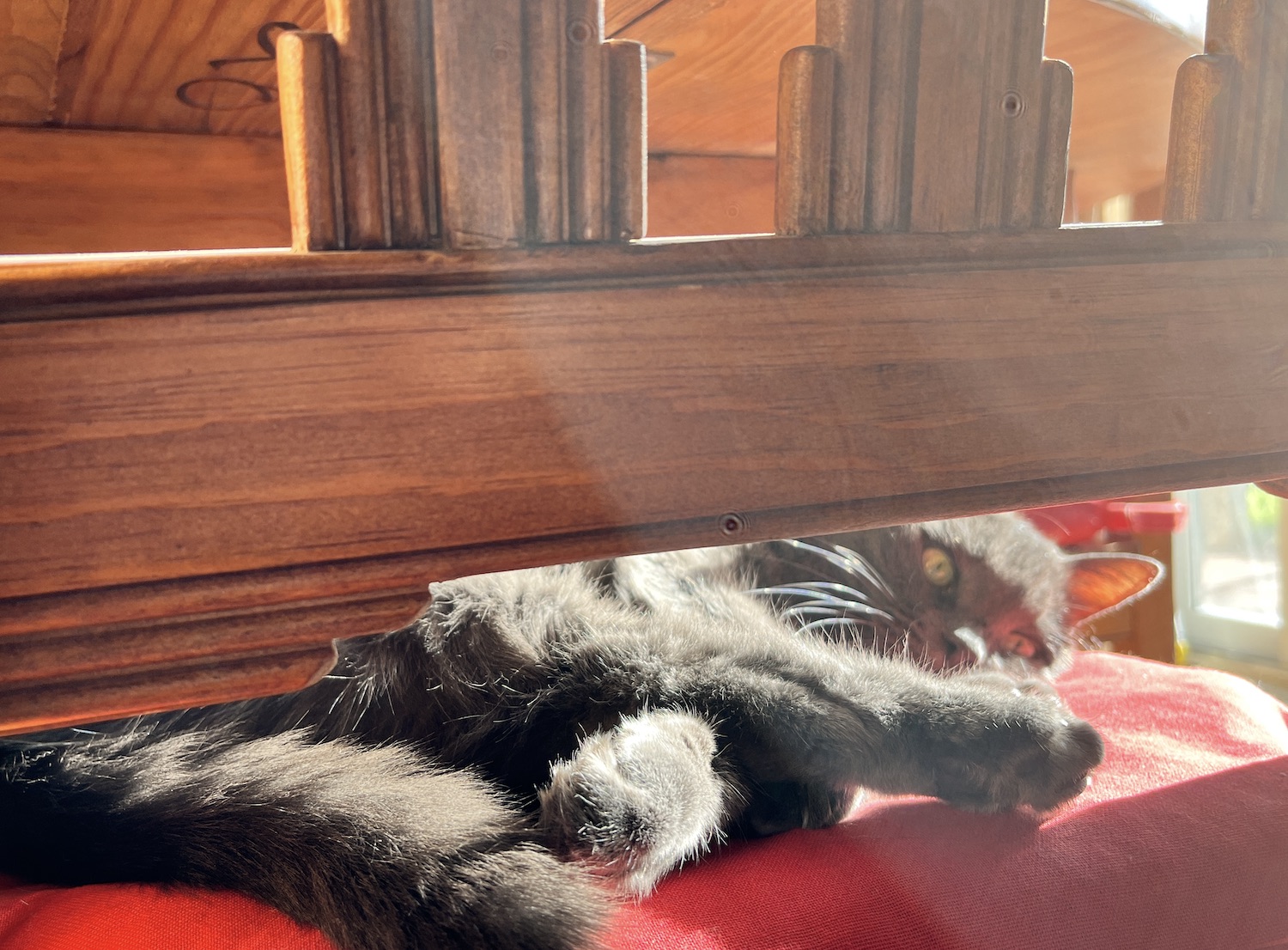
Miss Mia Sopaipilla recharges her batteries with a dash of solar power.
After a week of rain Miss Mia Sopaipilla was delighted to find some sunshine pouring through the back door this afternoon.
Me too. I got soaked during three rides last week, and not with sunshine, either. The kind of drenching that leaves you peeling off soggy kit in the garage and lubing the squeaky bits.
On the bike. The squeaky bits on the bike.
I managed to stay dry today while cycling home from Reincarnation after dropping the Subaru off for its semiannual health check. But I was not exactly toasty.
It was 40-something downtown when I rolled away from the shop, and I was wearing wool socks, tights over bibs, two long-sleeved jerseys, long-fingered gloves, and even a Sugoi skullcap under the old brain-bucket.
Happily, it was all uphill from there, so I wasn’t generating any wind chill. And the Russians weren’t rocketing my area of operation, though I found out later that Reincarnation had scored a direct hit on my wallet.
This is to be expected when your beater is old enough to vote. Also, it’s cheaper than a car payment and just might save me a long walk home at some point. I don’t always have a bike in the back and my cold-weather kit on.
• Editor’s note: It’s a gray, gloomy day here at El Rancho Pendejo, and Hal Walter’s road-trip tale has put me in mind of my own meditation from the spring of 2000, when the vile Crusty County weather had me thinking about snorting that long white line to wherever.
“I have been buggered to near death by the clock.”— Jim Harrison in “The Beige Dolorosa,” from the novella collection “Julip”
“How do I shut this alarm off?” my wife asked some years back. Her sports watch was cheeping incessantly, like a baby bird in a sack of crack.
“Like this,” I replied, snatching the watch from her, placing it on the kitchen floor and pounding it into a flattened silence with a claw hammer. We both laughed, but warily; killing time just isn’t that easy.
Still, when you see time limping along like it does in a snowbound April in the Colorado mountains, scraping the slush off its boots on the welcome mat of spring, there arises a murderous desire to put it out of its misery. So Shannon has begun hiding the hammers as I glare at the clock, as if I could will its crawling hands into picking up the pace, spinning me up some sunshine.
• • •
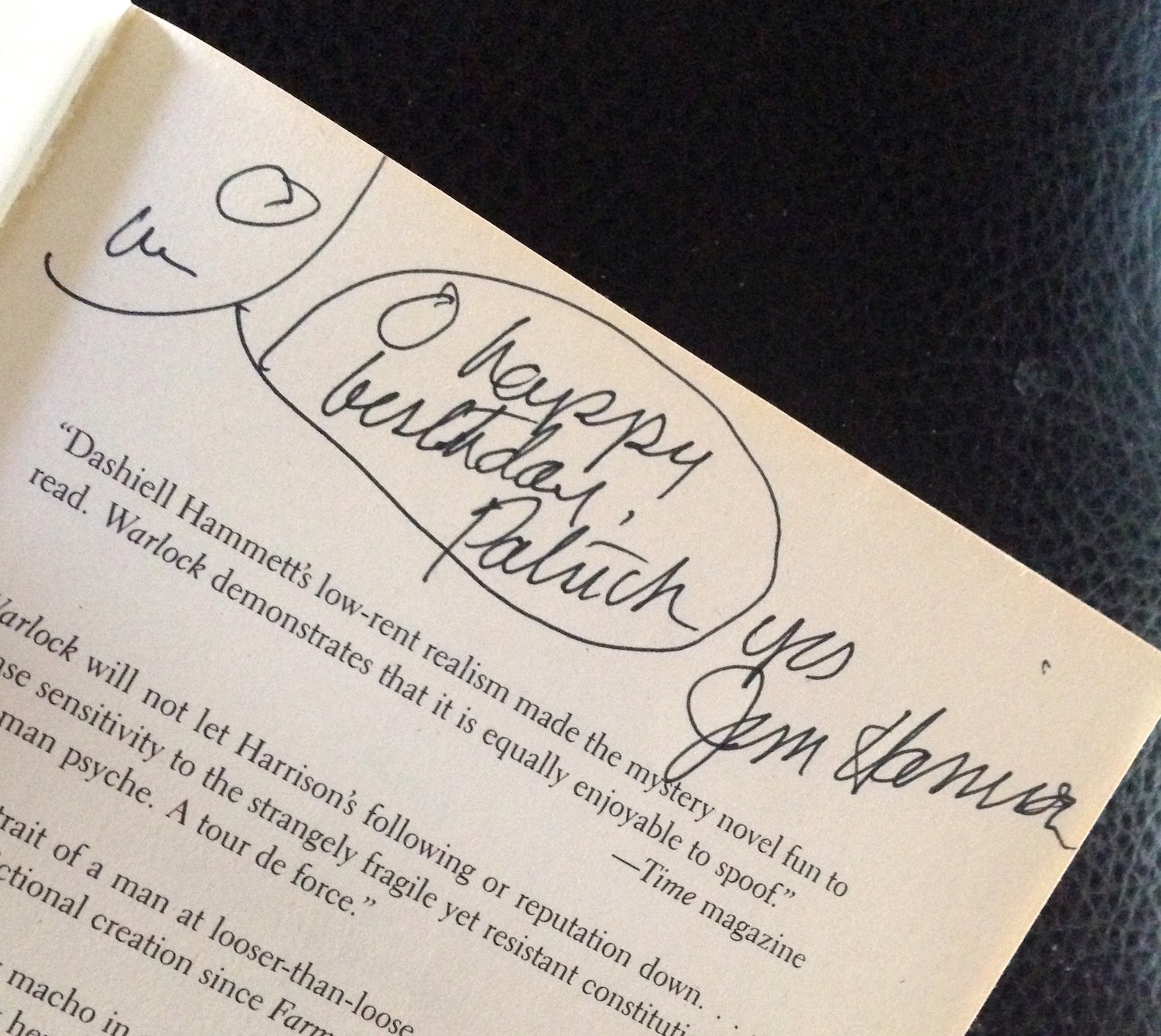
“We’re going to be late,” I warned my friends Hal and Mary as we dawdled first over stout, then over coffee, in a succession of Bibleburg bistros. It was my 46th birthday, and we were headed to Colorado College for a poetry reading by one of my favorite authors, Jim Harrison. Harrison seems the sort to bark at nitwits who interrupt his work, and I wanted his autograph, not his antipathy.
Jim Harrison laid his Jim Hancock on my copy of “Warlock,” though it was not among his favorite works.
As it turned out, we were right on time, and Harrison was late. A student of Zen Buddhism with his own temporal compulsions, Harrison announced: “I’m not a long reader. This will be exactly 52 minutes.” A koan for a birthday present.
Frankly, I’d have settled for a little less light and a little more warmth. Spring brings Colorado the heavy snows that we used to get in winter like everybody else, and the way my mental batteries were running down under the gray-flannel skies had me convinced that I was solar-powered.
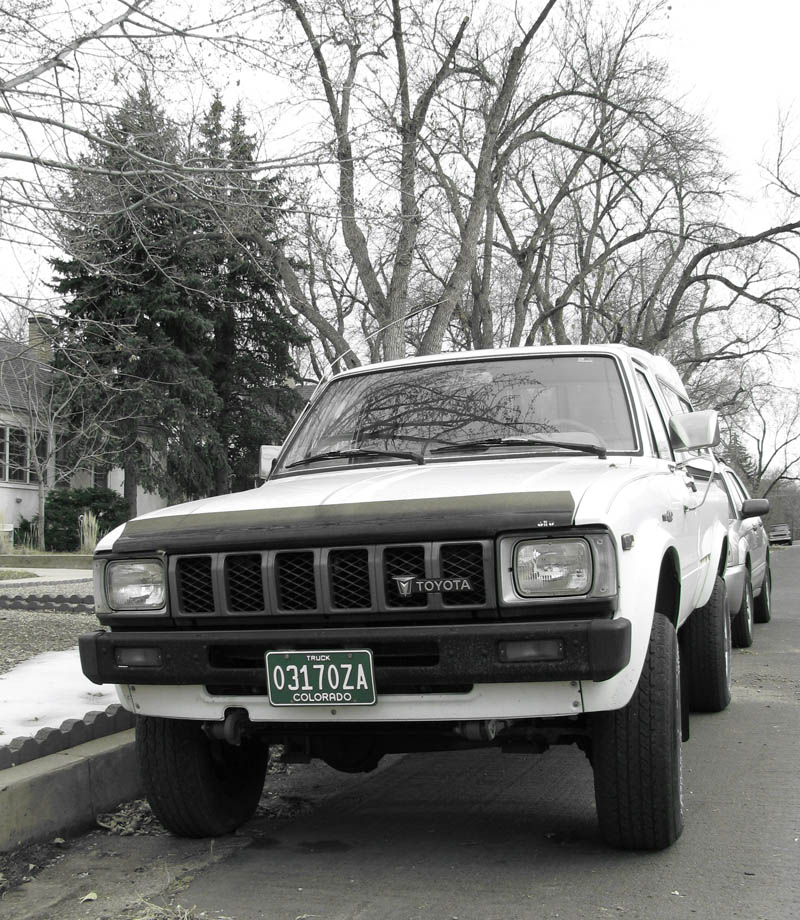
My last escape attempt, a mid-March road trip to a cycling festival in California, was too short and not nearly sweet enough. I’ve been contemplating another to someplace where the locals’ knowledge of snow is limited to what they’ve been able to glean from the Encyclopedia Britannica, but you can’t pilot a Toyota truck to the Virgin Islands, not even in four-wheel drive.
And then there’s the expense. The rising price of gasoline aside, it’s not always possible or desirable to sleep in a pickup, which lacks certain amenities — like a toilet, shower, sink, stove, furnace and elbow room, especially when the camper shell is stuffed fore to aft with a bicycle, a cooler full of beer and a day pack crammed with computer gear and drawing tools.
Even if you pack camping gear and spend your nights outside the truck, you’re doomed to an occasional Motel 666 if for no other reason than hygiene, an impulse that will cost you anywhere from $30 to $60 a pop, depending upon your ZIP code at the time.
So lately I’ve been eyeballing used RVs and wondering whether I’m old enough to own one. This is not unlike like cigar-smoking; you have to be of a certain age to pull it off without looking ridiculous.
Too, as a cyclist who has played mirror-tag with many a blue-haired land-yacht captain over the years, the notion leaves me feeling a little like a Lakota warrior applying to join Custer’s 7th Cavalry.
And the entry fee for the RV lifestyle is a high curb to hop — even an elderly, smallish Toyota RV can run from five to ten large, while free-lance cycling journalism pays on the small side.
• • •
In the essay “Going Places,” from his collection “Just Before Dark,” Harrison advises: “Do not scorn day trips. You can use them to avoid nervous collapse.” So with a light snow falling and the promise of more on the way, I jumped into my ’83 Toyota 4WD and headed north to talk to a guy who had a used, slide-in, pop-up camper for sale.
As I bounced crazily down our steep, corrugated goat path to the county road — this truck, which under a previous owner carried a camper, has springs apparently salvaged from a buckboard — I realized I’d forgotten my watch. A moment of dismay, then satori; I had more than enough time to make the noon appointment, and there was nothing of pressing urgency requiring a timepiece, so screw it.
So, after checking out the camper — affordable and nicely minimalist, with a cabover bed, a small sink and stove, a pedestal table and bench, and a furnace — I spent the afternoon idling around downtown Bibleburg, where it was not snowing, the roads were paved, and distractions were available in variety.
Drank a pint of Guinness and ate a burger in Jack Quinn’s; looked for Harrison books in the cavernous used-book store Gateways; sipped a tall Americano in a Starbucks staffed by two pleasant young women chattering away like magpies. Then I took my sweet time getting home, and not just because I was following a snowplow and an 18-wheeler up a slushy Hardscrabble Cañon.
Again, Harrison, in “The Beige Dolorosa” from “Julip”: “The clock is the weapon with which we butcher our lives.”
The character who writes this line on an index card — an academic rebelling against the tyranny of the clock as he comes to terms with a vastly altered life — then wraps his watch around the cord of his Big Ben electric clock and dangles both in the toilet, flushing and laughing.
He continues: “The damnable watch still worked. I put it on the floor, stepped up on the toilet seat and jumped, smashing the watch to bits. It occurred to me that I was getting a little excitable, so I took the remnants of the two timepieces outside and peed on them to complete the scene appropriately. I reached back in the cabin and turned off the light, the better to see the stars. They were so dense they made the sky look flossy, almost a fog of stars which had drawn infinitely closer to me than ever before, as if my destruction of time had made me a friendlier object for their indeterminate powers.”
Smash your watches. Pee on your clocks. Go look at the stars.
• Editor’s note: It’s your lucky day, folks. We have a guest post by my old pal Hal Walter, who invested a portion of his increasingly rare downtime in telling us a tale of that long and winding road.
By Hal Walter
I do a lot of driving these days. Between coaching a rural 2A cross-country team at Custer County School, and overseeing my autistic son Harrison’s transition to college life this fall, I am becoming more intimate with the Central Colorado highways than I really care to be.
Our cross-country team is traveling to nine different meets this fall, from one to three hours away, by bus. Sometimes I am the bus driver too.
My son is attending Colorado Mountain College in Leadville, where he also runs on the cross-country team — which means even more mountain driving to see his competitions. Because of issues surrounding his being on the autism spectrum I spend some nights and partial days in Leadville and also bring him home for weekends.
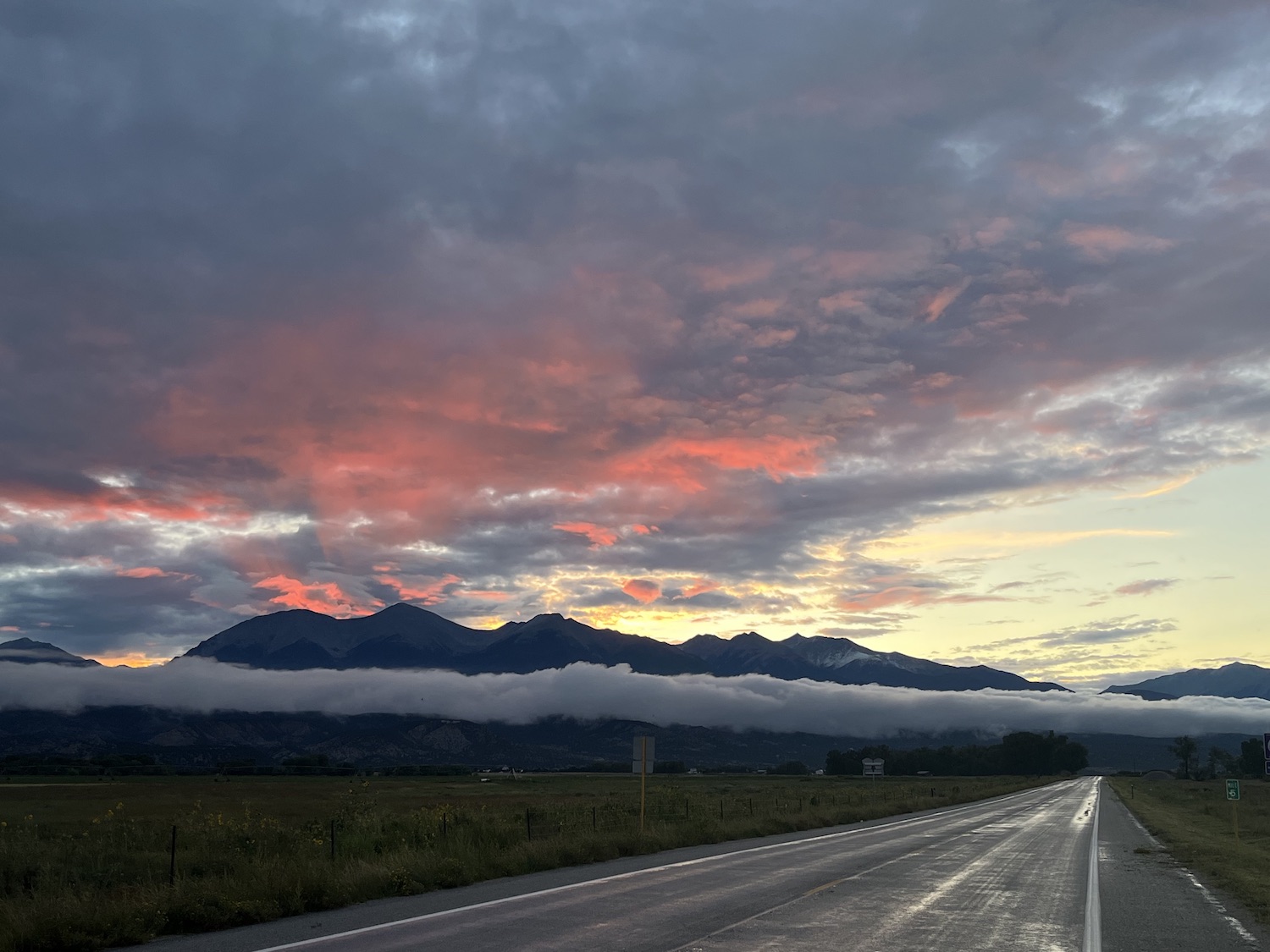
Recently on a Sunday evening, I conned my wife into joining Harrison and me for dinner on our way to Leadville. After an excellent meal at the new Thai restaurant in Westcliffe, Mary headed back to the ranch while Harrison and I pressed on to the Timberline Campus as the sun sank behind the Sangre de Cristo range.
About 12 curvy miles north, nearing the small settlement of Hillside, I saw something cross the highway in the dim light ahead. It seemed fairly tall so I immediately thought it might be an elk and slowed down. I don’t want to hit anything after some road debris tore a hole in my gas tank on an earlier trip, but I especially do not wish to hit an elk in my 10-year-old Suzuki SX4.
I also encounter a fair number of Amish travelers in this area, on horses, in carriages and more recently, riding e-bikes, which I reckon to be their version of motorcycles.
I hit my brights but they were useless in the twilight. Slower, slower. I finally rolled up to the place where I was expecting to see elk, but instead spied an odd-shaped object on the left-hand side of the highway where there is basically no shoulder. I’m thinking, “What the heck is that?”
It was initially a tallish Thing, segmented and rectangular. Then I realized it was a hand truck stacked with white boxes. It seemed at once to be moving yet standing still. That’s when I saw the smallish guy behind it, head barely above the load, pushing it along.
I coasted forward and looked to my left as I passed but could not get a good read on what sort of person this was. As I drove on I saw in the rearview mirror the hand truck crossing the highway right after I passed. Was that a homeless dude or an Amish person? It almost seemed like an apparition, yet I knew it was real.
At the next curve I slowed down again for a big Amish carriage in the oncoming lane with clomping horse, headlights and flashing taillights. A mile or so later at a ranch driveway I made out the silhouette of an Amish man astride a horse. After I passed he spurred the horse out onto the highway and in the fading red glow of my taillights disappeared south into the darkness. I drove on, still puzzled by the guy with the hand truck.
It’s about 105 miles from Westcliffe to Leadville. After a short stop at the Salida Safeway to stock up on some necessities for Harrison’s week ahead, we arrived at the CMC residence hall after 9 p.m. We schlepped the clothes, electronics, groceries, running shoes, and other items into the room. We straightened up a little, got the coffee ready for the morning, and went to sleep.
The next morning Harrison wandered off for breakfast in the cafe. I did some more organizing of his things, then headed off to the nearby trail system for a hike-jog. I then accompanied Harrison to meet one of his instructors before his first class. I spoke with the assistant dean. I talked with Harrison’s counselor. I went back to the room and did some cleaning, got a shower, packed up, and left Leadville right after noon, bound for cross-country practice back in Westcliffe.
I stopped about halfway home, in Salida, and got lunch to go and the necessary coffee. I also went to the running shop, tried on, test-ran, and bought new shoes. I ate while driving, then stopped to change into my coaching/running gear just before Hillside. I drove on. Just as I arrived at Westcliffe I saw up ahead something curious on the road.
As I drew near in the bright daylight I realized it was indeed a homeless guy still pushing his hand truck of white boxes, like something right out of “The Road.” He was moving so slowly the motion was barely discernible. In the time I had driven more than 200 miles and done countless other tasks that I viewed as necessary, this man had pushed his hand cart of boxes about 12 miles.
The testament to human endurance notwithstanding, a flood of thought coursed through my road-weary brain about the pace of our lives and the pace of others, what we view as necessary and how little others have. The spectrum of my own First World problems as compared to someone living at a snail’s pace. The craziness of our lives, and of our times.
Hal Walter hangs his hat outside Weirdcliffe, Colo., whenever he’s home long enough to take it off.
 Mad Blog Media