“I would like to tell you how genuinely proud I am to have men such as your son in my command, and how gratified I am to know that young Americans with such courage and resourcefulness are fighting our country’s battle against the aggressor nations.”
—Lt. Gen. George C. Kenney, Allied air chief in the southwest Pacific, in a 1943 letter to my grandmother, Clara Grady, noting her son’s receipt of the Distinguished Flying Cross
Kind of a gloomy November morning here in The Duck! City.
But not as gloomy as it must have been back in the Forties, when the men of the 433rd Troop Carrier Group were fighting the Japanese in and around New Guinea.
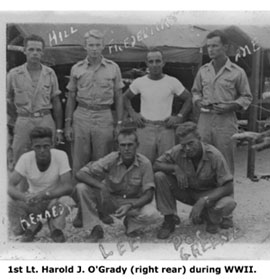
I was surfing lazily across the Innertubes when I stumbled across a Library of Congress collection of interviews with some of the men who served in the 433rd with then-1st Lt. Harold Joseph O’Grady, who was awarded the Distinguished Flying Cross in 1943 but rarely discussed his wartime service, even with family.
One of the interviewees, another Harold — Harold E. “Vick” Vickers — discussed his service from right here in Albuquerque back in 2005, and again in 2012. What a small world it is.
Vick wanted to be a pilot like my old man, but didn’t have the vision for it — “You had to have perfect eyes,” he said — and so he served in a support role, in operations, with the 433rd.
And he had to take ahold to get that job. He enlisted in what then was called the U.S. Army Air Corps (later the Army Air Forces), but instead found himself in the Signal Corps. Vick wasn’t having any of that — he fought to be Air Corps and got his wish.
“Be careful what you wish for,” they say. And they ain’t just a-woofin’.
Vick was supposed to ship out — for real, on an actual ship out of San Francisco — but wound up ordered to travel to New Guinea with the air crews in a formation of brand-new C-47s.
His plane blew an engine and missed the departure, and once the aircraft was squared away his crew had to play catchup, solo, with a brand-new navigator, island-hopping across the Pacific to Brisbane and finally to Port Moresby, New Guinea, which had yet to be pacified by the Allies.
And that’s where things got really hairy. Not a memoir for the faint of heart. It gave me some idea of why the old man might not have been eager to share his war stories with snot-nosed kids.
Here’s to Vic, Hank, and all the rest of the men and women who did their best in far-off lands, especially the ones who never came back to tell their tales.
 Mad Blog Media
My father, similarly, served in WWII, over in Europe. His unit was captured by the Germans in November of 1944 and he spent the next six or so months as a “guest” of the Germans. The low point was when word came down that the Germans wanted to separate the Jewish POWs (of which he was one) from the rest of the group (that order was later rescinded as the Germans were reminded that the POW officers were still very much in communication with the International Red Cross and would report this as a wart crime). The high point was one day in mid-Spring 1945 when they awoke to find that their German captors had all fled in the face of the on-coming allied army. My father and his group eventually managed to make it to allied troops and were sent to England to recuperate. He spent two months there, getting “fattened up” to the point where he was no longer skeletal remains and could be shipped back home. The fact that it took two months to achieve that should give you some idea of just how bad the conditions were in the camp. In retrospect, it’s little wonder that he would not talk of his time during the war whilst I was growing up and was only until he was in his 80’s that a friend (also a vet of WWII) talked him into sharing his experiences. Even then, I know that he pulled his punches when describing some of the things he experienced. He was, and always will be, a hero to me and my brother.
It really boggles the mind. Snatched away from home and hearth “for the duration” of a world war. Talk about your open-ended commitments. It’s a wonder they weren’t all driven insane.
Two of my uncles served in WW II. One, Ralph, was an aide to Gen. Raymond Wheeler in SE Asia, so he managed to avoid getting shot at and his war stories were about riding elephants in India and learning Hindi. My wife, who is Indian, visited him shortly after she and I met and he greeted her in Hindi, which made a lasting impression. Uncle Roy was in Patton’s 3rd Army as a member of a railway reconstruction battalion and did get shot at, as I found out as we both got drunk at my mom’s wake and he showed me pics of where he and his buddies had been pinned down by German 88’s. He died in a VA hospital in Buffalo.
But the guy who really had the war stories he didn’t tell was Officer Fred “Woody” Woodard of the Rochester P.D. Woody and I got to be friends when I was working my way through college at U of R security and Fred was moonlighting as a U of R security guard at night while being full time Rochester P.D. motorcycle cop. Woody had been a 101st Airborne trooper who got parachuted into Normandy and fought it out with the Germans at Bastogne. He never talked seriously about the war but always had funny stories. But one day over breakfast after a night shift I asked him about Malmedy. He got real quiet and said “we didn’t take a German alive for about six weeks after that”. I knew after that conversation to not ask Fred about the serious issues of the war. He had things he really did not want to discuss.
Woody worked traffic in Rochester until he was hit by a car while doing a traffic stop and retired with a serious disability. What a pisser.
These guys had the real thing. We sit on our asses and think about it.
Our gang around the pickle barrel here has a few members who did their bit in the jungle and the desert. Not the War to End All Wars (which clearly did not) or “The Big One,” as Archie Bunker called it. But still, when the call came, they went.
Those of us who didn’t wonder how we would have fared, I expect. I’ve read a lot about war — too much, probably, fiction and nonfiction, memoir and poetry — and somehow I don’t see myself turning out like Alvin York, Audie Murphy or Chesty Puller. Bad vision, worse discipline, too profound a respect for my own pale Irish-American hide to see it punctured by bullet or blade.
Sheeyit, I couldn’t have been Bill Mauldin or Ernie Pyle, either. I’d have probably wound up as that guy who told the shavetail to go take a flying fuck at a rolling donut and spent the duration in the stockade.
Perhaps one of the dirty baker’s dozen eh?
Commander Cruller and His Lost Pastry Airmen.
To war we are sent
Duty bound, a debt to pay
Our time is wasted
My dad’s dad was a medic on Omaha Beach — “not for the faint of heart” immediately comes to mind — which inspired my old man to do ROTC and go Medical Service Corps, which lead to a year running a MASH company in Vietnam.
Neither talked a lick about their time “over there,” until Alzheimer’s hit them, and then they started recycling History Channel stories as if they were their own.
Me, I have no trouble reciting the full extent of my combat tours for anyone wanting to listen. “Son, let me tell you … those lithium ion batteries weren’t going to bury themselves in the desert.”
Jaysis, lad. Can you imagine? Working the ER under fire. Their dreams, when they got any sleep, must’ve made Hieronymus Bosch look like Charles Schulz.
My first wife’s dad, John, landed on Omaha on D+3 and his job was to, how do I say this, clean up the beach. And Omaha was the bad one. He never talked about it until one day when his son Jack and I were serving the family fresh venison we had just shot and since Jack was a newly minted vet, we cleaned and butchered it ourselves. Unfortunately, John’s steak had a couple hairs in it. He looked down at it, apparently had a flashback, turned pale white, left the table, went to his room, and closed the door. Told me a day or two later about the flashback.
Something most of us would not comprehend. Me included.
My family had a mixed bag of military duty. My grandfather was a longshoreman during WWII, my father was initially a cargo handler in the Philippines during Korea, then changed MOS twice, first to a yeoman, and then to a Communications tech O branch in Hawaii, and the Pacific NW, then the CVA 43 off ‘Nam, then North Africa, all the time listening in on the VC and eventually cracking their cypher so we could call air strikes on the Ho Chi Minh Trail pretty much whenever they tried to move anything. This was back when most military comms were HF and shortwave so listening stations were in strange locations to catch the bounce off the ionosphere at different times of day. We were everywhere with him except on board ship, which was nice, except for all the moving around. This was before they found out that moving often had a bad effect on kids, and I had PTSD before PTSD was a diagnosis for Combat vets, we had was is now called cPTSD. I went to 14 schools before I was a Sophomore in HS and registered for 16 schools but had to move twice before getting to start school.
Chihuahua. We moved, but not that much. The old man got most of his moving in early on; he was 36 before I joined the party and pretty well settled into the desk-job portion of his career, though he kept logging flight time as long as the whitecoats cleared him for it. He did a lot of TDY, too; I don’t recall him as a regular character in our little show until Randolph AFB in 1962.
And unlike some of our friends, who got to be stationed overseas, we were strictly North America, U.S. and Canada. Maryland to Virginia to Canada to Texas to Colorado. So I only did two kindergartens, two elementary schools, two junior highs and one high school. Not bad.
Once I got away from the family I really started moving, because I found I liked it. Also, in the newspaper game, it was about the only way an asshole like me could get a raise and/or promotion. A change of venue meant a less critical jury; for a little while, anyway.
So a rough tally for me is 20 towns (some of them, like Bibleburg, twice, or more than twice); 11 states (also a few repeaters); and two countries.
Most of my moving was around Colorado — B-burg (five different houses), Alamosa, Greeley, Pueblo, and Denver.
Next up is New Mexico — Española, Santa Fe, and The Duck! City.
All the others were one and done.
No PTSD for me, I don’t think. But both sides of the family were not tight with their own kin, for the most part, so it’s not as though we were being torn away from places with long histories and lots of love. But my buddy Hal and I agree that if the diagnosis had been available in our childhoods we probably would’ve been diagnosed as “on the spectrum” and hosed down with the drugs du jour.
My own situation was made worse by starting school young and then skipping a grade in the transfer from Canada to Texas. I was younger than all my classmates by a fur piece; no driver’s license in high school and didn’t turn 18 until the end of my first year at college.
My father also served in New Guinea during WW2. Starting as a staff surgeon he rose to commanding a portable surgical hospital there. Today popularly called MASH. He left when I was an infant. I finally met him when I was 4 years old.
My MIA/KIA Uncle Bud:
https://dpaa-mil.sites.crmforce.mil/dpaaProfile?id=a0Jt0000000ccAbEAI
Man. All of these medics popping up around here this year. They didn’t get a lot of screen time in the war movies I was addicted to as a kid, outside of John Wayne hollering “MEDIC!!!” But I bet the real troops were glad to see them when the need arose.
What grim duty that must have been. Diagnosis and treatment under fire. And some days I thought trying to write in a noisy newsroom was a bridge too far.
My Father went in the Navy in late 42, boot camp at San Diego, and then to Newport News for Six days on a train to take a brand new liberty ship to the South Pacific with a shakedown cruise through the Panama Canal and on to Australia for two (2) years then got malaria. The Navy sent him to Seattle to run supplies from Seattle to Kiska for the duration. Along the way, he lost a wife through divorce and custody of my half-sister. I never knew about this till two weeks before he passed in 1987. Went home for Thanksgiving and we talked till the wee hours.. My mother’s dementia caused her to throw away his Navy journals. but he would never show them to anyone. I don’t think I am as tough or could have been at his age. I do know that for five years after WWII, he and two friends drank seriously. They never told their kids either. May Deity bless them in whatever afterlife there is.
There’s tough, and then there’s tough. In terms of sheer physical prowess, we know from the Olympic medals that today’s kids are faster, stronger, more agile.
But those are the pampered super athletes, who only perform under ideal conditions.
And we know the Ardennes, the Frozen Chosin, and the jungles of SEA were less than ideal on a good day.
I’ve tried on what passed for 1950s snivel gear in Korea. You ordered your boots two sizes too big cuz you were going to put four pair of socks on. And you never washed those four — you just rotated them, tried to keep the driest pair touching your skin. “Waterproof” meant waxed cotton, not Gore-Tex. And even when it was 20°, Squad Daddy expected you to shave in your steel pot.
(Reminds me: is “whore’s bath” A politically incorrect term these days? “Sex worker personal hygiene” doesn’t roll off the tongue.)
I think the Woke call it “pits and bits” now. What were Audie Murphy’s pronouns, d’ye think?
My father, Dr. Raymond D. Brigham, was destined for the Navy VF-12 college training program in 1944, based on academic and other criteria. It was a program to get officer candidates a college education, and turn then into naval aviators if they qualified for that duty. That was the plan, until my father was tested for color-blindness; failing that test disqualified him for the program.
Shortly thereafter, he was drafted into the army, and he did his tank destroyer training at Fort Hood, Texas. After that, he was sent to France and fed into the meat grinder that was Northern Europe in the late winter and early spring of 1945.
Some WWII popular histories give the impression that after The Bulge ended, it was a nice stroll to Berlin. Nothing could be further from the truth. U.S. military casualties in the European Theatre peaked in Feb.-April. of 1945. The movie, “Fury,” gives a depiction of the intensity of conflict in that period.
Somewhere in Belgium/Luxemburg/Germany on the combat lines, my father contracted spinal meningitis. He was evacuated first to Liege, Belgium, and then to a U.S. military hospital in Paris (Pitie-Saltpetriere, which I have subsequently visited), where he partially recovered until being sent back to the U.S. in the fall of 1945. His final recuperation and rehabilitation took place in the VA hospital in Temple, Texas.
My father spent most of his 19th year of life in hospitals, but he recovered well and had a full life of academic, scientific, community, and family accomplishments. He passed away at the age of 94.
I know this is a long read. Thank you for bearing with me. My father regretted that he did not really “do much” in the war, as illness took him off the line. I respectfully disagree. He did his duty, which is all you can ask of any soldier. His grateful son, Dale
Yes he did, with humility and honor. My father was much the same, a combat engineer and glider pilot in the Pacific building temporary runways.
Marston Mats? Think about landing on those boys in the wet after a tough day’s work with angry Japanese persons. Or laying them down whilst the aforementioned tried to see to it that you did not. Hoo-boy.
Yep, that’s the stuff. In my day they called it PSP, pierced steel planking. There were variations including some aluminum non-skid stuff. But, PSP was everywhere in theater. Now, I can see the stuff used vertically to build portions of the border wall. When we drive to Bisbee, we see a wall of it from Coronado National Monument all the way East dividing Naco, Arizona and Naco, Sonora. Ugly, it is.
“He did his duty.” Damn straight he did. And lived a good long life afterward, too. And helped raise a thoughtful son from the sound of it. I don’t know how much more the nation could ask of one person.
Thank you, PSB and POG, for your very kind words regarding my father. That means a lot to me, especially coming from the both of you. Regarding little old me, my wife would describe me more as “thoughtless,” rather than “thoughtful.” Dale in MIZZOU-ree
Do your duty: “Duty, then, is the sublimest word in the English language. You should do your duty in all things. You can never do more. You should never wish to do less.”