My man Ken Layne says in his latest episode of “Desert Oracle Radio” that he got the idea for his podcast from (wait for it) Tom Waits.
Somehow this fails to surprise me. Mr. Waits casts a wide loop. Wasn’t that long ago that people thought he was Leon Redbone. Turns out he was Ken Layne. Frank Zappa was Leon Redbone.
Not really.
Here’s Ken Layne:
One of the initial inspirations for this radio show was a Tom Waits interview I read in an alt-weekly newspaper three decades ago.
So Tom Waits has these bits that he’s doing for the press tour so the reporters aren’t too annoying. They can’t keep up because he’s just rolling out these little stories, tall tales, routines. And one of them went something like this. He says, and I’m quoting incorrectly for memory:
‘Oh, I’ve got a radio show now, out in the desert, in a little desert town, it’s called ‘Strange and Unusual Facts.’ And then he’d say some oddball factoid about lemurs or the height of Big Ben or how many legs a centipede has, which is variable, turns out. Then, Tom Waits tells the music writer for the alt-weekly, ‘It’s a small station and the signal doesn’t get far, but people are enjoying the show, and, in fact, a number of people are moving to this desert town just to hear it.’
That always sort of stuck with me. Because somewhere up ahead would be this radio show in the little desert town of Joshua Tree.
And you know what? I’ve had a number of people tell me in person, to my face, that they moved here because of this radio show.
So, Tom, if you’re out there tonight, thanks for the idea.
I’ve taken a few ideas from Tom Waits myself, not all of them good. Never went with the soul patch, though. That was Frank Zappa. Or was it Leon Redbone?
Once you start looking beyond his only No. 1 hit, “The Way It Is,” you realize the guy has been playing in your background for years. Decades.
Hornsby has worked with almost everybody worth listening to. Leon Russell. Clannad. Bonnie Raitt. Bob Dylan. The Nitty Gritty Dirt Band. The Grateful Dead.
He co-wrote “The End of the Innocence” with Don Henley and played on the track with Henley and Wayne Shorter.
That’s a tune with legs, and you can still hear them kicking ass 37 years later:
O beautiful, for spacious skies But now those skies are threatening They’re beating plowshares into swords For this tired old man that we elected king Armchair warriors often fail And we’ve been poisoned by these fairy tales The lawyers clean up all details Since daddy had to lie
Some of Hornsby’s playmates appear on the new album, “Indigo Park,” due out April 3. Raitt, who sings on “Ecstatic,” told The New York Times that she treats herself to a live recording of her friend performing “Dreamland” before taking the stage each night.
“The guy is just still diving deep and improving and playing hours a day and stretching,” she said. “He’s the one musician I would have if I could only have one on a desert island.”
The new album came, as new ideas often do, when Hornsby had been hoping to take a break. Nope. The title song arrived first and dragged the others along to keep it company.
Hornsby told The Times that “Indigo Park” is something of a glance at the rear-view mirror.
“This is the first record where I’ve really dealt with looking back,” he said. “On a lyrical level, I’ve always been kind of pushing forward. But this time I thought, ‘OK, you’re 70, [expletive]’.’”
Sounds like he’s still moving forward to me. Don’t give up the driver’s license yet, Bruce. Try to make the ecstatic last.
The artist who created “The Triplets of Belleville” is at it again.
Finally — some good news for a change.
Sylvain Chomet, the French animator behind “The Triplets of Belleville,” is back at the ol’ drawing board after 15 years.
“A Magnificent Life,” in U.S. theaters Friday, is an animated biopic concerning Marcel Pagnol, a French playwright, filmmaker and author whose works celebrated the Provence working class, according to The New York Times(gift link).
The film, says Mother Times, showcases Chomet’s fondness for narratives set in the mid-20th century and protagonists who are artists or performers.
Which is all very fine, of course. And we should all dash out to see it at once, if not sooner. But the good good news is that the maestro is hard at work on a spinoff of “Belleville,” based on a story he wrote more than two decades ago, in which the triplets visit their 100-year-old father, who does not know that they spurned traditional employment to become cabaret singers. Says Chomet:
“It has the same feeling as my previous ‘Triplets’ film. It’s completely mad, and it’s quite a baroque movie with brand-new, very cartoony characters.”
Meanwhile, Chomet’s fans will probably not be surprised by his views regarding today’s soulless, cookie-cutter animation. Asked if there were any recent animated films he’s enjoyed, he mentioned Pixar’s “WALL-E” — which was released in 2008.
The weather suddenly has a nasty case of multiple-personality disorder.
First it was breaking heat records right, left, and center. Then yesterday, it was the thundering winds and the air so thick with particulates, pollen, and various monoxides and dioxides — hence the phrase, “Beware the ’ides of March!” — that one had to chew each breath 666 times before swallowing. The AirNow.gov klaxons were going all like aaaaaaOOOOOOgahh and the local air-quality monitors were an equally loud shade of red that matched my eyes.
I didn’t even think about going out for a ride or run. Nevertheless around 10:30 last night I was blown out of bed and into the spare room by an allergy attack the likes of which I haven’t suffered since LBJ was hoisting his beagles and the Vietnamese by the ears. I didn’t think it was possible for a human body to contain that much snot, unless maybe that body belonged to Karoline Leavitt.
I did wonder whether UFC bro’-brahs Addled Hitler and Bibi the Beast going all Michael Corleone around the Bible Lands might have had some effect on the global climate. I’ve heard it said that The Pestilence can change the weather in DeeCee just by dropping trou’. In any case both should be in cages, and if they wanted to fight, well, I’d buy a ticket.
Today we awakened to temps in the 20s with a forecast high in the 60s, which would be par for the course this time of year. But the forecast also calls for highs to ascend to the upper 80s by Thursday. Perhaps Lucifer has finally found the escalator that runs upward.
“The Devil you say? Wonderful to see you again, old chap. Bit of an upgrade from the trip downward, yes? ‘Hurl’d headlong flaming’ and all that? Will you have tea? Oh, I beg your pardon, something cool for a change, certainly. …”
Speaking of failed rebellions and free beverages, I see “One Battle After Another” took the big prize last night. At times I wonder if the Oscars aren’t actually the work of some third-rate TikTok movie critic name of Domhnall O’Scar, an Irish-American knee-walker who decides who gets what depending upon who’s underwriting his bar tab at the moment.
“One Battle After Another,” y’say? (belch) Is tha’ an empty glass I see before me? Yeer a gennl’mun an’ a scholar, sir. Down the hatch and up the rebels! (urp)”
Still, this year’s “spring forward” meant we spent one less hour today stacking sandbags against the tide of bullshit flowing downstream from the Orange House.
So, winning? Maybe. We must take these little victories wherever we find them.
This morning I burned a little of my saved daylight by reading an essay in The New York Times, in which the daughter of two former American revolutionaries found the Oscar-nominated “One Battle After Another” to be “nothing more than entertainment” rather than “a battle cry for a generation.”
Huh. Hollywood veterano Paul Thomas Anderson cranks out a rapid-fire rom-com inspired by a rambling mythical history by Thomas Pynchon, and Hope Reeves — who herself is working on a comic memoir of being raised by retired Weatherpersons James H. Reeves and Susan Hagedorn — finds it regrettably unserious.
Well. Shit. Can’t have that. Can we?
Why not?
• • •
I myself have been regrettably unserious since — well, since forever — and, like the thought of suicide, it has gotten me successfully through many a bad night. And a few fairly grim days, too, whether shortened or lengthened by government fiat.
My upbringing was unremarkably middle-class — Catholic Republican father, Presbyterian Democrat mother — and yet somehow I came to cast myself in the role of atheist radical son.
A diet rich in Warner Brothers cartoons, Marx Brothers movies and Mad magazine will give a kid a taste for anarchy. Who do you root for? Not The Man, that’s for sure. It was one battle after another and Elmer Fudd lost every one of them.
So while I would eventually become interested in Weatherman, and personally sample various flavors of Marxism — Socialist Workers Party, October League, Communist Party (M-L) — these last two, like Weatherman, offspring of the Students for a Democratic Society — my first real political infatuation was with the Yippies.
• • •
Elmer wanted to cut off my lovely hair and send me to Vietnam. I wanted to Bugs Bunny his ass. And so did the Yippies, whose regrettably serious alias was the Youth International Party.
Abbie Hoffman and Jerry Rubin were probably the most famous of these Groucho Marxists, whose theater was the street. Levitating the Pentagon. Throwing money at traders at the New York Stock Exchange. Running an actual pig — Pigasus the Immortal — for president.
The Yippies invaded Disneyland, taking over Tom Sawyer’s Island, threw pies, and applied for a permit to blow up the General Motors building. When it was denied, the Yippies shrugged and said it only proved that it was impossible to work within the system to change the system.
Alas, that old system sure proved durable, resisting change from within and without.
Some Yippies became yuppies. Rubin traded his Viet Cong flag shirt for the suit and tie of a businessman. He died in 1994 after being hit by a car while crossing Wilshire Boulevard, in front of his penthouse apartment. He was 56, well past the 30th birthday after which nobody was to be trusted.
Hoffman jumped bail after a dope bust and went underground. He eventually resurfaced, did some light time, and returned to activism.
But it was the Eighties — remember those fabulous Eighties, kids? — and the old act didn’t seem to be going over so well with a new audience. Hoffman died, reportedly by his own hand, in 1989. He was 52.
• • •
By then, mockery had already begun infiltrating (or was being co-opted by) The Establishment. “Saturday Night Live,” which debuted in 1975 with guest host George Carlin, somehow remains relevant in an aw-shucks-just-kiddin’ sort of way. David Letterman, Jon Stewart and Stephen Colbert have had their innings, and Jimmy Kimmel is still in there pitching despite some booing from the luxury box at Fudd Stadium.
But there’s something about old-school, street-level mockery that really gets The Man’s dander up. The reigning Man, Elmer Befuddled, who hires out his shotgunning of critters at home and abroad because bone spurs, watches a shit-ton of TV. And if he sees yuuuuge crowds from coast to coast rocking the next No Kings rallies on March 28, giving him the old Warner Bros.’ sendoff — “Th-th-that’s all, folks!”— he might just do a John Belushi, spin right out of his chair, and hit the deck in a slobbering, shitting sayonara.
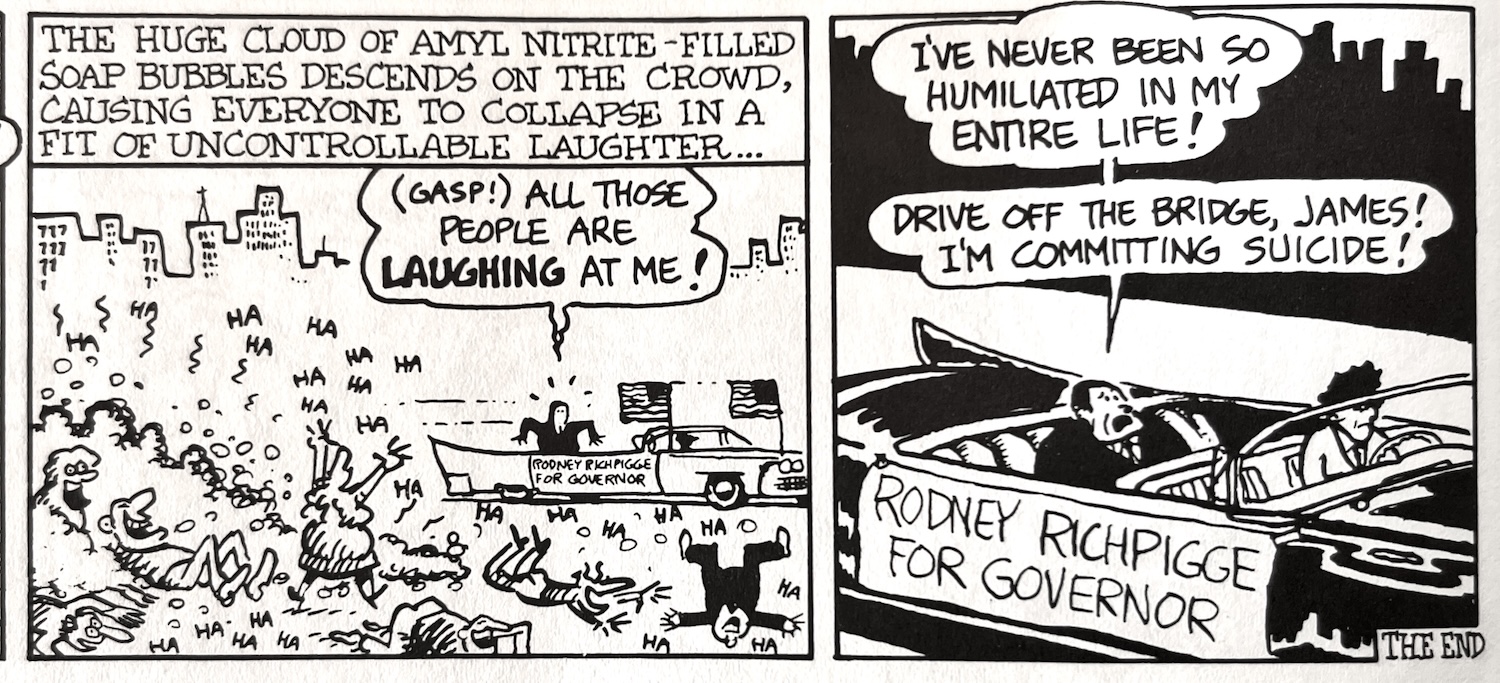
It comforts me to think back to one of Gilbert Shelton’s “Fabulous Furry Freak Brothers” cartoons, in which political candidate Rodney Richpigge commits suicide by proxy, ordering his chauffeur to drive off a bridge because he thinks people are laughing at him (a half pint of amyl nitrite getting an unexpected wash in Fat Freddy’s jeans was the actual giggle-trigger).
Hope, as they say, springs eternal. No matter what time it is.




 Mad Blog Media