A police mugshot of John Lewis from Nashville, during the Sixties.
“Do not get lost in a sea of despair. Be hopeful, be optimistic. Our struggle is not the struggle of a day, a week, a month, or a year, it is the struggle of a lifetime. Never, ever be afraid to make some noise and get in good trouble, necessary trouble.” — Rep. John Lewis (D-Ga.)
“I just happened to be wearing black on a sidewalk in downtown Portland at the time. And that apparently is grounds for detaining me.” — Mark Pettibone, a Portland protester snatched off the street by anonymous men in camo who sprang from an unmarked van.
When Mother Jonesasked the Homeland Security Department for details of what DHS agents are doing in [Portland], a spokesperson sent a press release in which acting DHS Secretary Chad Wolf described nearly 100 incidents allegedly perpetrated by “violent anarchists” — mostly vandalism of the courthouse and other federal buildings. (A typical example: “Violent anarchists graffitied the Hatfield Courthouse.”) — Dan Friedman, Mother Jones.
In the previous two decades of international public-health experience, starting with SARS and on through the rest of the acronym-heavy list, a standard procedure had emerged, and it had proved effective again and again. The U.S, with its combination of scientific and military-logistics might, would coordinate and support efforts by other countries. Subsequent stages would depend on the nature of the disease, but the fact that the U.S. would take the primary role was expected. When the new coronavirus threat suddenly materialized, American engagement was the signal all other participants were waiting for. But this time it did not come. It was as if air traffic controllers walked away from their stations and said, “The rest of you just work it out for yourselves.”
“We’re approaching our final destination. Please return your tray tables and seat backs to their fully upright positions, place your heads between your legs, and kiss your asses goodbye. And thank you for flying Trump Air.”
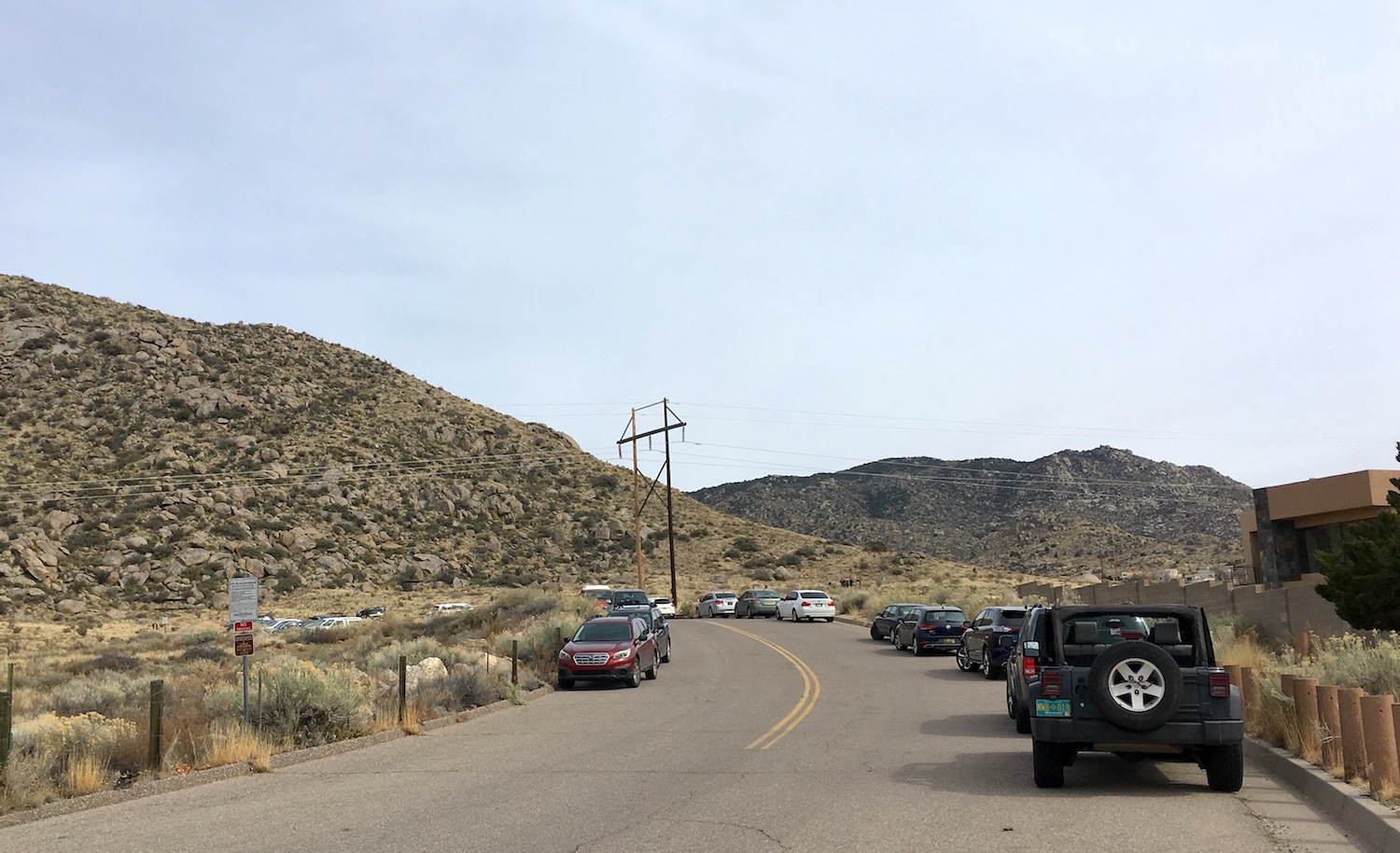
The Menaul trailhead, shot from a social distance.
Beyond hoarding beans, buttwipe and bullets, people don’t seem to be taking The Bug seriously in these parts.
Or they didn’t on Sunday, anyway.
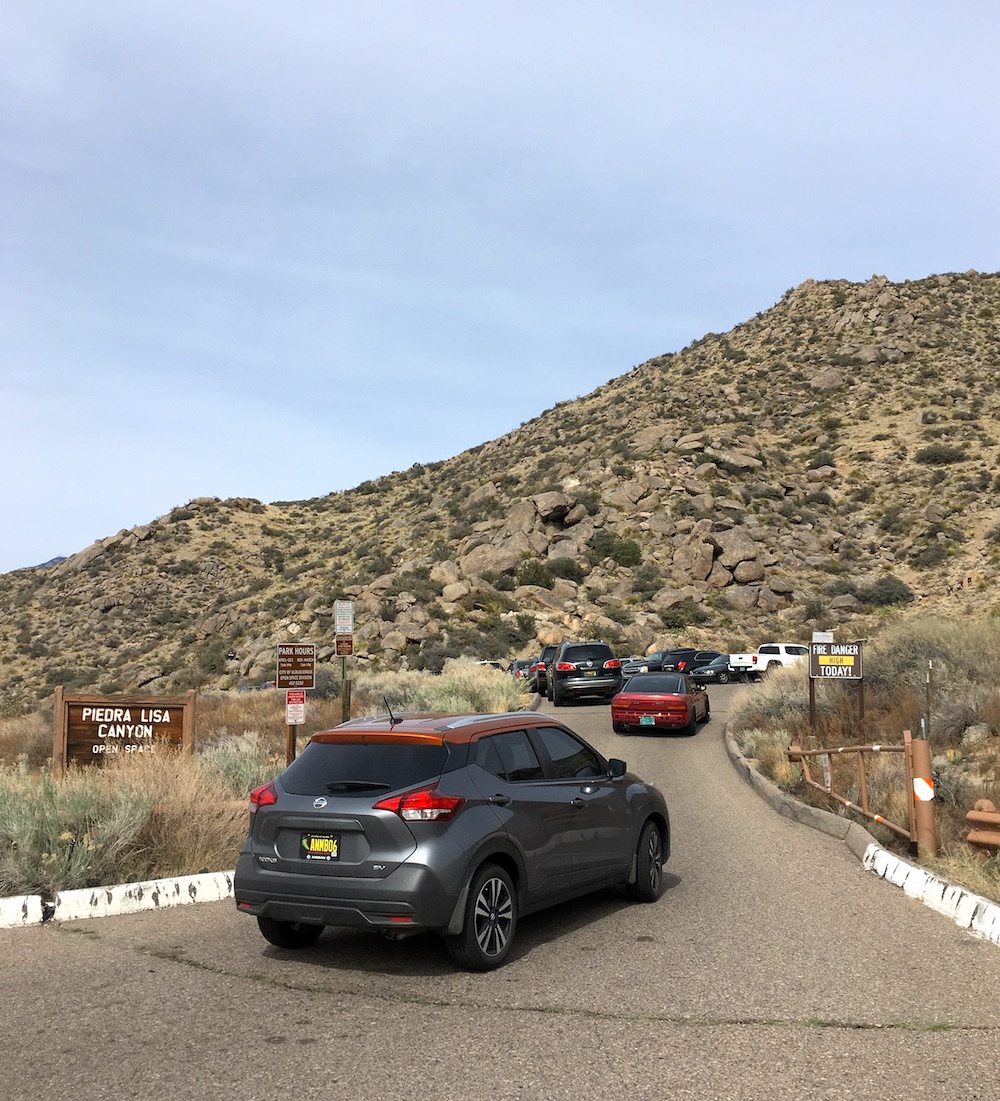
When Herself and I bicycled over to the Dark Tower to deliver some vino to Herself the Elder, we passed three trailhead parking lots that were jam-packed and overflowing onto neighboring streets.
Call me crazy, but this seemed like antisocial distancing to me, on a par with slow dancing in a burning building, the New Mexican equivalent of sunburned bro-brahs wearing bikini babes like earbuds during spring break in Florida.
Maybe the authorities were watching, too. Maybe our crowds were not out of the ordinary.
Because come Monday, Gov. Michelle Lujan Grisham went on TV to lay down the law. Or the advisory, anyway.
The nut graf? Keep your distance, preferably behind closed doors.
“There are a lot of people out and about,” she said. “This creates risk. This creates exposure.”
The Piedra Lisa trailhead, which looked like the drop-off lane at an elementary school.
I created a few exposures myself with the old iPhone camera, and here they are, all shot from a proper social distance, if only to avoid an ass-kicking (“Hey, man, whatchoo taking pictures of, huh? You work for my old lady?”).
And when I got back to El Rancho Pendejo I created another podcast.
• Technical notes: I recorded this episode with an Audio-Technica ATR2100-USB mic straight to the MacBook Pro, using Rogue Amoeba’s nifty little app Piezo. Editing was in GarageBand. The background music is “Buddy,” an iMovie jingle. The other sound effects were liberated from the GarageBand loops library. And those musical references? The musicologists among you will be familiar with “Highway to Hell” (AC/DC); “Stairway to Heaven” (Led Zeppelin); “Happy Trails” (Roy Rogers and Dale Evans); “Get It While You Can” (Janis Joplin); “The Last Waltz” (The Band); and “When the Roll Is Called Up Yonder” (Johnny Cash). These are not necessarily the folks who wrote the music, but the ones who came to mind as I was writing the podcast.
Susan Calvin was off when these two rolled off the line at U.S. Robots. From the September 2019 issue of BRAIN.
E-bikes present both opportunity and challenge for the IBD.
One more bike to sell to the base — the old white guy who already has 15 two-wheelers in the garage but may be slowing down a bit due to age or infirmity, and wants a little assist.
One more bike to lure new customers, who may have found old-fashioned cycling too difficult, or who have decided to replace a car with something greener.
One more bike to service, because the future requires more maintenance than the past.
Our heroes at BRAIN’s bike shop acquired an e-assistant to work on e-bikes, which raises another issue, one familiar to anyone who ever read Harlan Ellison’s “I Have No Mouth, and I Must Scream.”
Artificial intelligence will not come to us from U.S. Robots, complete with a full installation of Isaac Asimov’s Three Laws of Robotics and overseen by Susan Calvin, Greg Powell and Mike Donovan. It will come from Allied Mastercomputer via Ellison Wonderland, it will have ideas all its own, and it will not be our friend.
“They’re a cleaner better breed than we are,” Calvin said in an interview with The Interplanetary Press. Maybe so. in Asimov’s novels, anyway. But in real life our e-assistants will be made by us, in our image. Frightening.
You’ll want to keep them locked up at night, and not for fear of thieves.