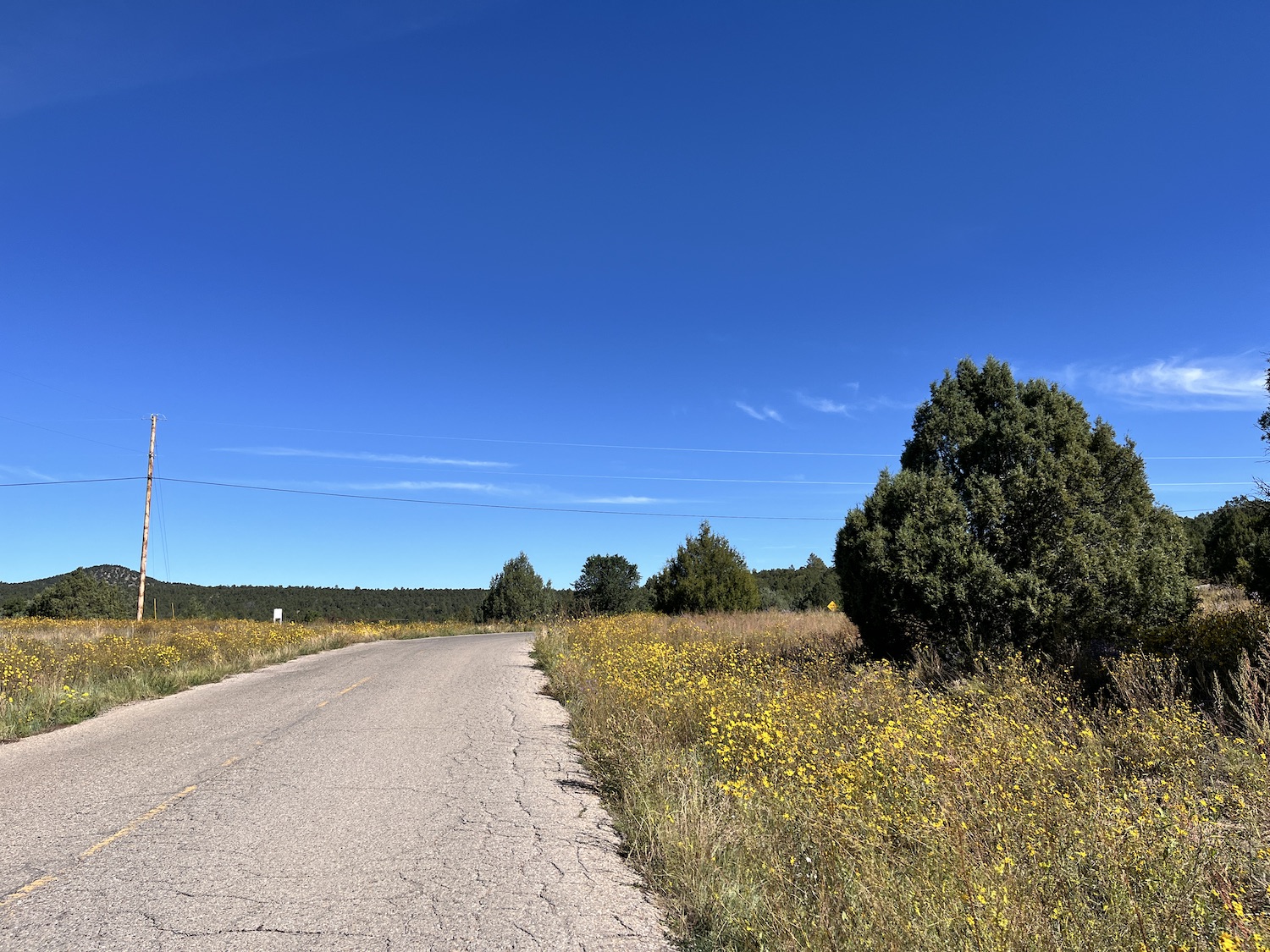
One of the rare flat spots on Tuesday’s ride through the Manzanitas.
A friend and neighbor who’s lived here longer than me and grown bored with The Duck! City menu of cycling possibilities proposed we try something a wee bit off the beaten path this week.
And so we motored up NM-337 a ways, parked at the Otero Canyon Trailhead, hopped aboard our trusty cyclocross bikes, and took a 21-mile tour of the rolling back alleys to the east and south, beginning with Juan Tomas Road and ending with Oak Flat Road.
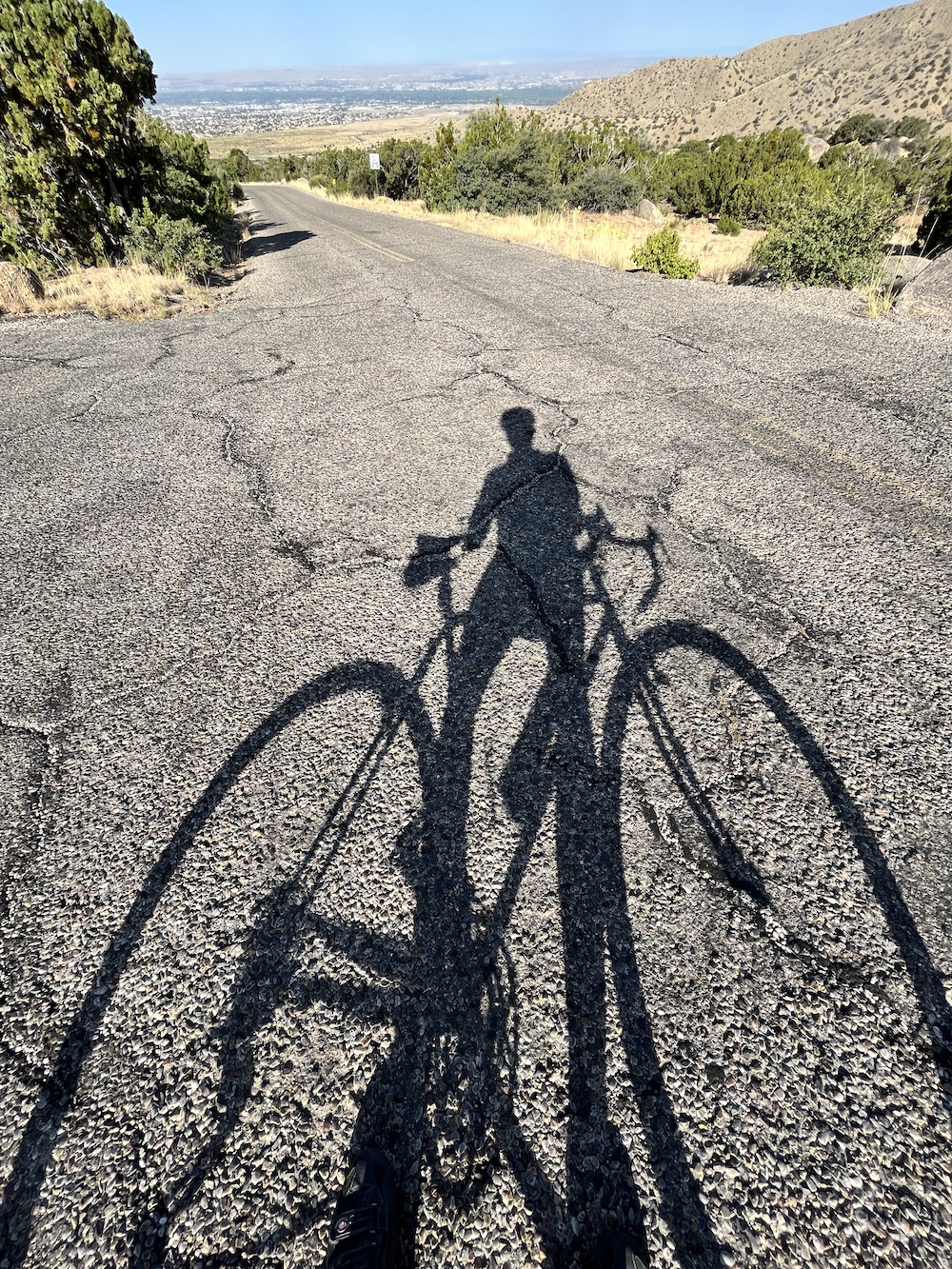
One of the smoother descents.
Phil had warned me that we were headed for some steep, gnarly bits that could only be described as “roads” because they were passable by horse or halftrack. But they weren’t any worse than some of the knee- and tire-popping Paris-Roubaix-style bighorn-sheep circuits I used to wrangle in CusterTucky County, so I got along just fine on the old Steelman Eurocross with its new 34x32T low end and 33mm Donnelly MXPs.
To be sure, long stretches were steep as medical bills, with ruts that may recently have channeled hot lava, enough bad lines for a Sylvester Stallone film festival emceed by Carrot Top, and more baby-heads than the basement of the John Wayne Gacy Memorial Montessori School in Hell, if your idea of a baby is a 45-year-old Scandinavian blacksmith who dabbles in professional wrestling, rugby, and steroids.
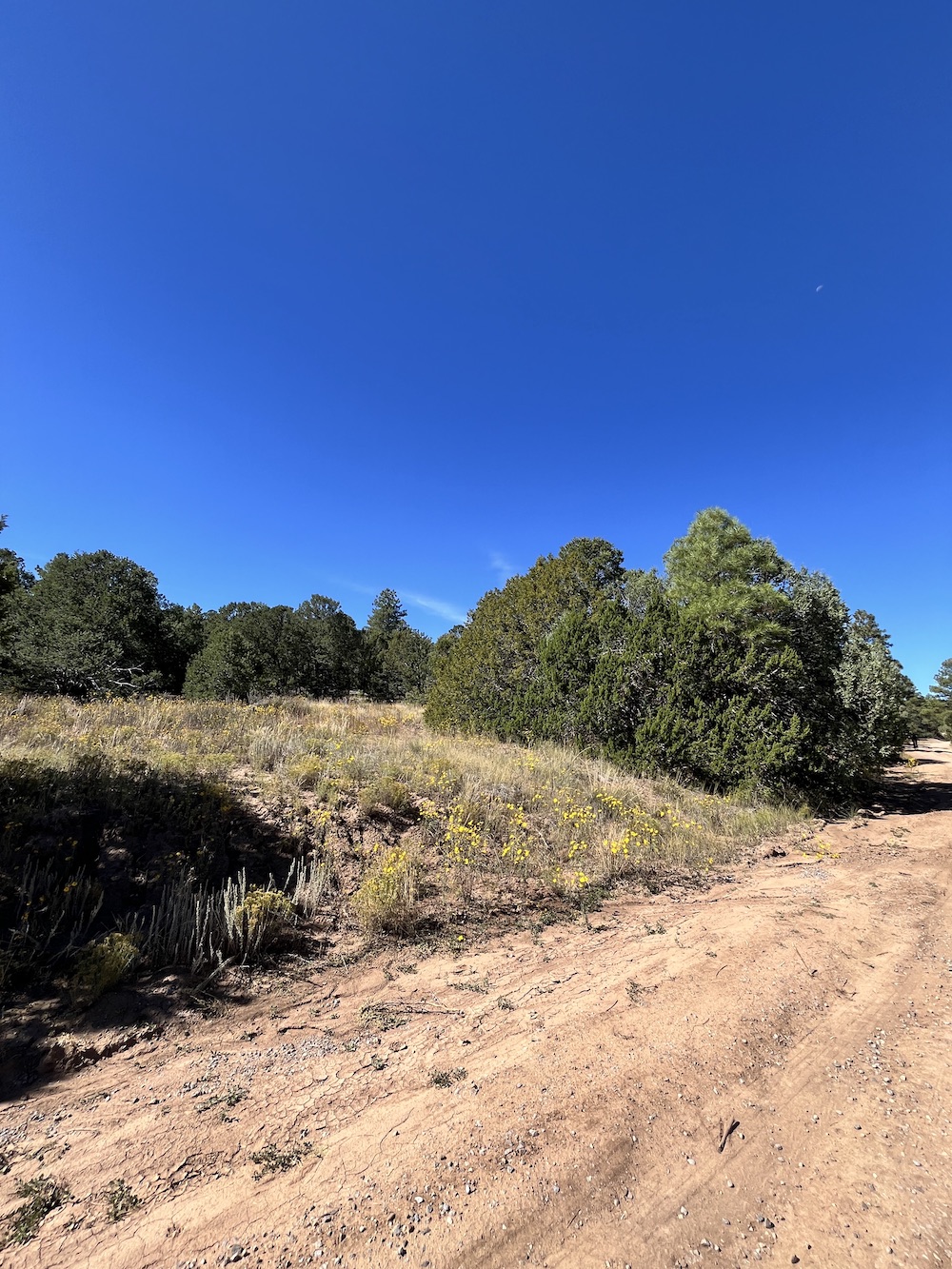
But we saw plenty of wildflowers, and the motorists were mostly parked, hunting piñon.
Oak Flat dumped us back onto NM-337, just below the Morning Star Grocery, and we had a fine, high-speed plummet to our parking spot. As roller-coaster rides go it was worth the price of admission and then some.
The North Diversion Channel Trail, just below the Osuna-Bear Arroyo connection.
Too bloody much going on lately. Trying to corral my thoughts, if any, has been like chasing jackrabbits through a funhouse with a lacrosse stick, wearing clown shoes and oven mitts. In a word: unproductive.
I won’t bore you with the details. We’re talking First World problems here:
The Soma Double Cross at Elena Gallegos.
Buffing the rough edges out of El Rancho Pendejo in preparation for a houseguest. Stalking the elusive turnip for a promised dish (Whole Foods and Sprouts, nyet; Albertsons, da). Learning that I had failed to acquire the ingredients for another anticipated dish, the promise of which I had not been made aware, and the subsequent acquiring of same. Yet another round of flat-fixing, this time in the garage.
My favorite annoyance was an appointment at the local Apple Store’s Genius Bar, where I expected to be advised in fairly short order to hand over my elderly 15-inch MacBook Pro for a vigorous wash and brushup to resolve its “Apocalypse Now/Ride of the Valkyries” fans issue. There’s either some demonic technical haint in residence or enough hair in the case to build an entirely new cat to keep Miss Mia company. Whichever it is, I ain’t going in there looking for it. That’s what we pay Geniuses for.
But no. What I got was straight out of “Nothing but Blue Skies,” by Thomas McGuane. The scene where Frank Copenhaver and his estranged wife, Gracie, visit a Deadrock restaurant for conversation and something to eat. Conversation they get (Gracie insists). But eats, not so much, as waiters glide past without a glance in their direction, the thundering lunch herd slowly thins, and Frank comes to a rolling boil.
After the place empties out Frank finally takes the bull by the horns, flags down a table-wiping waiter, says they’d like to order.
“I’m sorry, but we’re closed,” replies the waiter.
The Apple Store wasn’t closed. But apparently upon my arrival I had not been properly logged in for my 3:30 appointment, which I did not learn until 4:15, when I was ’bout yay far from knocking over chairs and chasing a Genius through his kitchen.
And now I have another appointment on Tuesday.
So, yeah. That’s the scenic route toward explaining the lack of postage around here lately.
Speaking of scenic routes, the pix are from the rides I’ve been taking lately to keep my blood pressure on simmer as I await service.
“Jungle?” you say. “Looks more like desert to me.”
Indeed it does, especially when you gain some perspective by leaving the mean streets behind and hoofing it a mile or so southeast and about 500 ankle-twisting feet up into the Sandia foothills, just below the Candelaria Bench Loop.
But it’s a jungle, too, down there. And for a cyclist, well … let’s just say we’re not the apex predators.
I was reminded of this on Friday when I got the word that one of my riding buddies had been hit by a car at Alameda and 4th.
He and another riding bud were eastbound on Alameda, preparing to turn left onto 4th. Alas, auto traffic being what it is down there, RB No. 2 made it to the left-turn lane without incident while No. 1 got boxed out. So No. 1 hung a right, planning to make a quick U-turn and head north on 4th.
But there was this car, and the laws of physics were applied, and our riding buddy got carted off to the hospital with what I’m guessing was a pretty significant elbow injury (a couple breaks and a dislocation, according to RB No. 2).
It’s particularly disheartening because he was riding so well and with such enthusiasm last Wednesday. And then this happens.
Still: It could’ve been a lot worse. A lot worse. I ride Alameda west from Guadalupe Trail now and then, to get to the bosque, and I always feel like a rabbit on a rifle range.
Let’s all us cottontails be extra careful out there as we’re hopping down the bunny trail. They’re always locked and loaded on the firing line.
OK, we all could use a good laugh these days — These days? Most days! — and I got one texted to me late last night by a couple of guitar-playing pals in California.
The cartoonist is Michigan’s own Dave Coverly, and you can catch his act at speedbump.com. Buy his book, prints, or original artwork while you’re there. He’s done a couple of these eye-chart gags and they’re all killer. Also, dogs and cats. What’s not to like?
Those of you who share my buddies’ fondness for pickin’ and grinnin’ — I’m looking at you, Pat O’B — should give this one a look-see. I haven’t tried it yet, but I did some research and Dave’s eye chart is 20/20.
• Update: I asked Dave (belatedly) for permission to reproduce his cartoon here, and he tells me that it’s a doctored version that musicians have been passing around for a while now. There’s another that uses notation from Bach’s Toccata and Fugue in D Minor. I should’ve picked up on it because the voice balloon and chart don’t match his other work. Derned Innertube pirates are everywhere, and it seems they’re all in a band.
You won’t know the name, unless you worked with him or read him at the Los Angeles Times, the Colorado Springs Sun, the Gazette Telegraph, The Denver Post, or the Jackson Hole News, or studied under him at the University of Wyoming in Laramie.
But George stands tall in my personal history. He was one of the people who showed me by word and deed that there was a place in the newspaper game even for those of us who were a bubble or two off plumb.
When I got hired as a copy boy at the Colorado Springs Sun I was at loose ends following a brief tour of the dead-end gigs available to a dropout from a third-rate college. George was the police reporter, as I recall, and came to the Sun from the L.A. paper.
Back in 1974 the newsroom was stiff with talent, the best possible haven for a wannabe cartoonist shambling out of his teens into nowhere special if he didn’t pull his hairy head out of his hippie arse.
Bill Woestendiek and his wife, Kay, ran the outfit, sister paper to the Las Vegas Sun in Sin City. Carl Miller, who would move on to helm The Denver Post, was city editor. Bill Buzenberg, who would rise to veep of news at National Public Radio, was his assistant and an investigative reporter.
Bill McBean, another reporter, would abandon his typewriter for a paper route, claiming afterward that he made more money from delivering the Sun than he ever did writing for it. That didn’t last; he eventually got back on the scribbler’s horse in Denver, at the Post.
I was an actual scribbler; a cartoonist, or so I thought. But an adviser at Adams State College had told me just how few full-time, paid editorial cartoonists there were in the country and suggested that I cast a wider loop, maybe consider taking a reporter’s job as my entrée, a foot in the door.
Well, there I was, with both feet in and my dumb ass for company. Not a reporter; just a copy boy. And I didn’t even have the chops for that. When Carl handed me a stack of press releases to rewrite I told him I didn’t know how to type.
“Better learn,” he replied. And I did, whenever I wasn’t stripping and sorting copy from the wire-service teletypes, running copy and art to and from composing and engraving, and doing other scutwork so real journalists didn’t have to.
I learned something from all these people, starting with typing, thanks to Carl, who also passed on some firm hints about how to write for newspapers. Bill Buzenberg let me tag along and watch him interview hookers for a piece on the massage parlors infesting Bibleburg. The Woestendieks let me sit in on the copy desk on slow nights, learning how to fit copy, size art, and write heds.
George and Bill McBean took me out for drinks, told me war stories, had me over to their houses for dinner, introduced me to their wives; I soaked up their experience like a bar rag and felt as though I had become part of a family.
When I left the Sun to go back to school, this time at the University of Northern Colorado, George told me he hoped I’d come back as a reporter. And I did. But not to the Sun — to the Gazette, the bigger of the two papers in town. Because George was there, this time on the city desk.
He helped me sneak in the back door as a contractor — a little glimpse of the future there, yeah? I compiled the annual industrial edition, drew a few cartoons, and even wrote a couple of stories before getting hired in early 1978 as a for-reals general-assignment reporter at $155 a week.
And that’s where the rubber met the road. As George’s obit notes, he was “a meticulous editor and dedicated teacher.” He was not above crumpling up your copy and tossing it back to you. (We were still working on typewriters in 1978, and other people in the newsroom could actually see it when an editor threw your copy back at you.)
After a few rounds of journalism badminton George would call me over and explain in detail, citing irrefutable examples, precisely why I was a toothless cog in the Gazette‘s well-oiled machinery. Sometimes he and his opposite number Joe Barber would tag-team me. This could be like getting tossed around the ring by Mad Dog and Butcher Vachon.
It was the school of hard knocks, for sure. But man, if you don’t get kayoed, you learn how to roll with the punches and throw a few of your own. As Carl had told me once at the Sun, “We can teach you more about newspapering in a year than you’ll learn in four at college.”
But Carl also insisted I go back to college. Once again, good advice at the precise moment it was needed. Because without that journalism degree I would not have been able to stay and learn at the Sun, or follow George to the Gazette, where I learned even more, in the company of comrades from other schools, other papers.
Sadly, I suspect Carl’s advice is no longer relevant. Back in the early Seventies, at the minor-metro papers that hired me, editors like Carl and George could spend some time breaking in the noobs. An assistant city editor would call you over to demand an act of contrition for some sin of commission or omission. A copy editor might have some thoughts about condensation and clarification. A typesetter could catch an error that had eluded everyone else and that observation would find its way back to you like a bad check.
If the error slipped past the typesetter, the page proofer, and the press check, and actually made it into print, the managing editor might want a word. This would be truly educational. Envision a very angry principal, swinging a larger “board of education.”
Even George made a few mistakes, and like good students we did too. (Actually, we did not require coaching in making these kinds of mistakes, but we were finally getting paid, and could afford to make bigger and better ones.)
This was why the list of phone numbers taped to a drawer at the city desk listed as many taverns, titty bars, alehouses, grog shops, gin mills, cantinas, and buckets o’ blood as it did home numbers. In extreme cases some expenditure of shoe leather was required, but by then we were seasoned reporters, kinda, sorta, and dogged in the pursuit of The Story, or whoever was supposed to write or edit it.
After a few years we all moved on to other opportunities, because in the newspaper game this is how you get a raise or a better job, or at least a different one. If you’re inclined to keep making some of the old mistakes or maybe acquire a few new ones, it’s also how you get a fresh nest to shit in.
George suggested I start keeping a journal, and Lord, have I ever kept ’em.
George eventually left the newsroom entirely and settled down in academia, where he could continue gently and relentlessly squeezing the dumbass out of young eejits afflicted with delusions of grandeur.
One of his students recalls: “I learned so much from that man that I still find myself quoting him and referring to him as someone who influenced my life in important and meaningful ways.”
Me too. And you as well. You probably never read George Gladney, or worked with him, or studied under him. But if you’re reading this, you are under his influence.
Because it was George who told me back in 1974 that I should start keeping a journal. And that’s just another word for “blog.”


 Mad Blog Media