The Adorable Care Act

Radio Free Dogpatch first "aired" in November 2005, then promptly swirled down the Loo of History. It's back now, God help us all.
Radio Free Dogpatch first “aired” in November 2005, then promptly swirled down the Loo of History. It’s back now, God help us all.

Herself and I have been enjoying a spirited round of “Spin the Pickle” with the pirates at Anthem Blue Cross-Blue Shield, a Borg-like amalgamation of drones, robots and faceless voices that has shown a distinct lack of interest in paying our dental claims, though we notice it cashes the premium checks with no lack of alacrity.

We’ve had three valid claims denied this year — one for Herself, two for me — and generally by the time we jack-hammer the last one through the series of wormholes they jovially call their “customer service” system, it’s time for the next appointment. Makes a fella really glad that his dentist isn’t the dude from “Marathon Man.”

So, since (a) it’s too cold for a ride, (2) I’m sick of harassing the fuckers via phone, email and Twitter, and (c) I would rather do just about anything other than ride the stationary trainer, it seemed a fine day for potting up the volume over at Radio Free Dogpatch.

It’s one you can really sink your teeth into.

• The Radio Free Dogpatch archives

Homicidal Psycho Jungle Cat

"Homicidal Psycho Jungle Cat" was the title of one of Bill Watterson's "Calvin and Hobbes" collections. It's also a pretty apt description of Turkish.
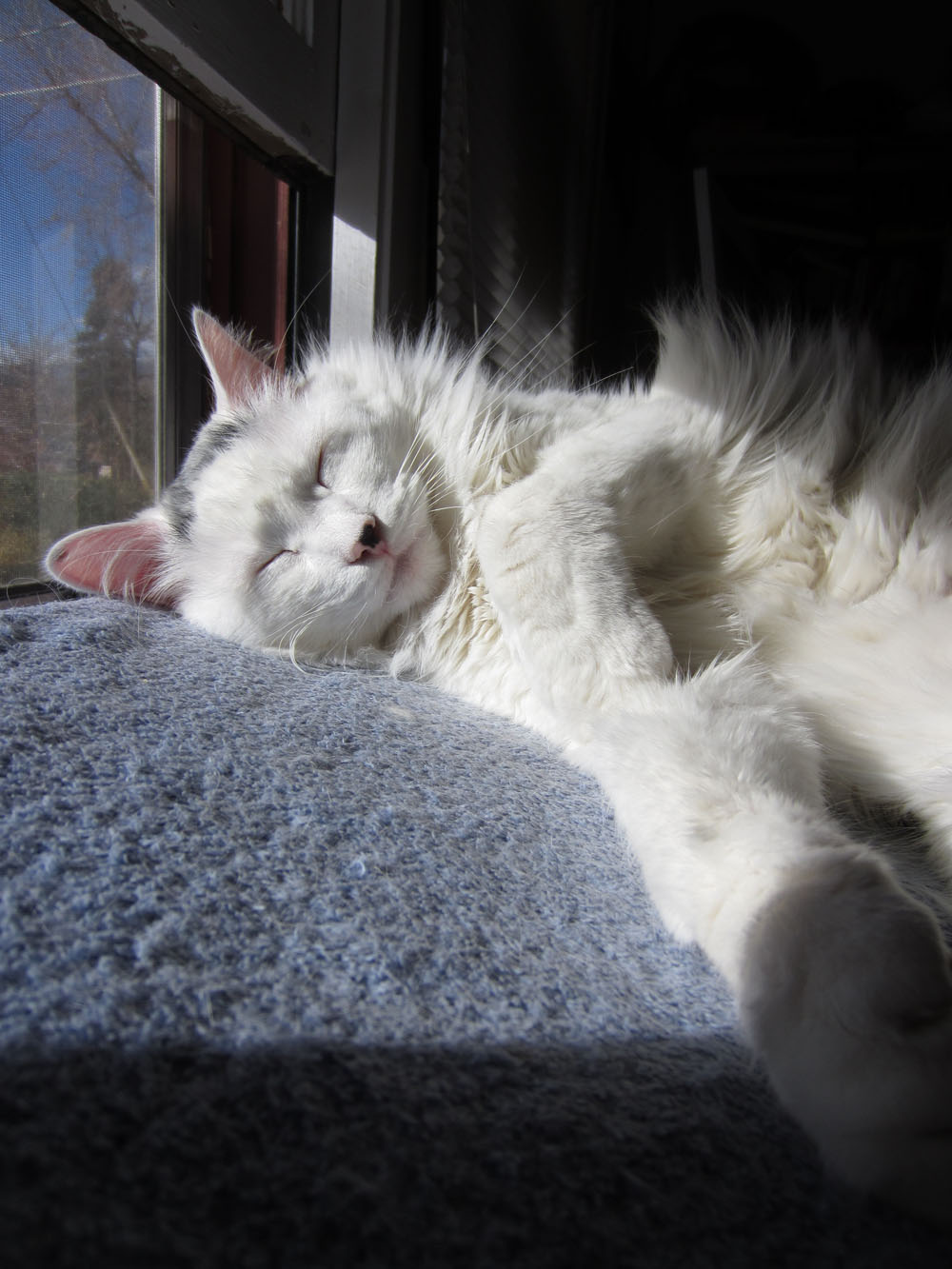
“Homicidal Psycho Jungle Cat” was the title of one of Bill Watterson’s “Calvin and Hobbes” collections. It’s also a pretty apt description of Turkish. When he’s awake, anyway.

The Hobbes to my Calvin enjoys a snooze in the sunshine.

Speaking of which, were you aware that there’s a documentary about Bill Watterson and his creations? True fact — “Dear Mr. Watterson” premiered yesterday, and NPR carried an item about it this morning.

“Calvin and Hobbes” is one of my favorite strips.  I have a dozen or so of Watterson’s books, and tried to get an interview with him back when I worked for The New Mexican (through a minion, he declined, as he does pretty much any invitation to chat with the press; smart fella).

I made the mistake of listening to the NPR piece, and now I’m going to have to thumb through a few of Watterson’s books, goddamnit. If you’d like to take a bumpy trip down memory lane on your toboggan, with your best friend for company, you can read “Calvin and Hobbes” online at GoComics.com.

This Bibleburgian Life

This American LifeHow often do you get to hear Ira Glass say “cocksucker?”

Never, that’s how often. Unless you happened to be in the audience last night as the “This American Life” host chatted amiably with a packed house at the Pikes Peak Center in Bibleburg.

Glass was recounting a back-in-the-day mishap at NPR that let the C-word through and onto the air, an oh-shit moment good for an FCC fine of a quarter-mil’ per station. Seems a board jockey who was a little slow on the trigger missed the target, instead bleeping a subsequent word, which caused an authority figure to ring up to inquire acidly what word did get bleeped, since “cocksucker” seemed to have become acceptable on-air usage.

The late, lamented George Carlin would have been proud, as Glass also deployed “fuck” (which apparently slipped into our local airwaves during a chat with someone at Radio Colorado College; “dick,” which the lawyers got all hard over while TAL was preparing to air a story in which an interviewee used it as a synonym for “jerk”; and “turd,” which actually appeared in an early David Sedaris bit, but could never make it on-air today thanks to a tightened federal leash, courtesy of Janet Jackson’s loosened bodice.

Sedaris reworked the piece as a poem, claiming that would make it art and thus inviolable, but the feds disagreed, so Glass played it for us from the stage. I ’bout shit myself laughing.

If you’ve never seen Ira Glass in person, I urge you to do so at your very next opportunity. The man has a gift for gab that any Irishman would envy.

He said his parents were “the only Jews who didn’t like public radio,” and had hoped their son would become a doctor, “because … well, we’re Jews.”

When TAL was in its larval stage, Glass said, the idea was to “take the whiff of broccoli” out of the standard NPR news model.

And all these years later, he said, the staff is still focused on those stories that hit them like a bolt of lightning, which doesn’t always happen; a lot of seemingly great ideas never make it to the air.

But that’s part of the job, because to get hit by lightning, Glass explained, “you have to spend a lot of time walking around in the rain.”