
Help!

“Won’t you please, please, help me?”

Is the pen the writer? The brush the painter? The motor the cyclist?

Grumbling over coffee about the lack of interesting reading material online — just about any old thing that wasn’t about fascists, eejits, or fascist eejits— I stumbled first across a piece about artificial intelligence worming its way into the handmade world of ’zines, and then another about bearing your own burdens from the deep, deep well that is Mike Ferrentino.

Lo’s letta.

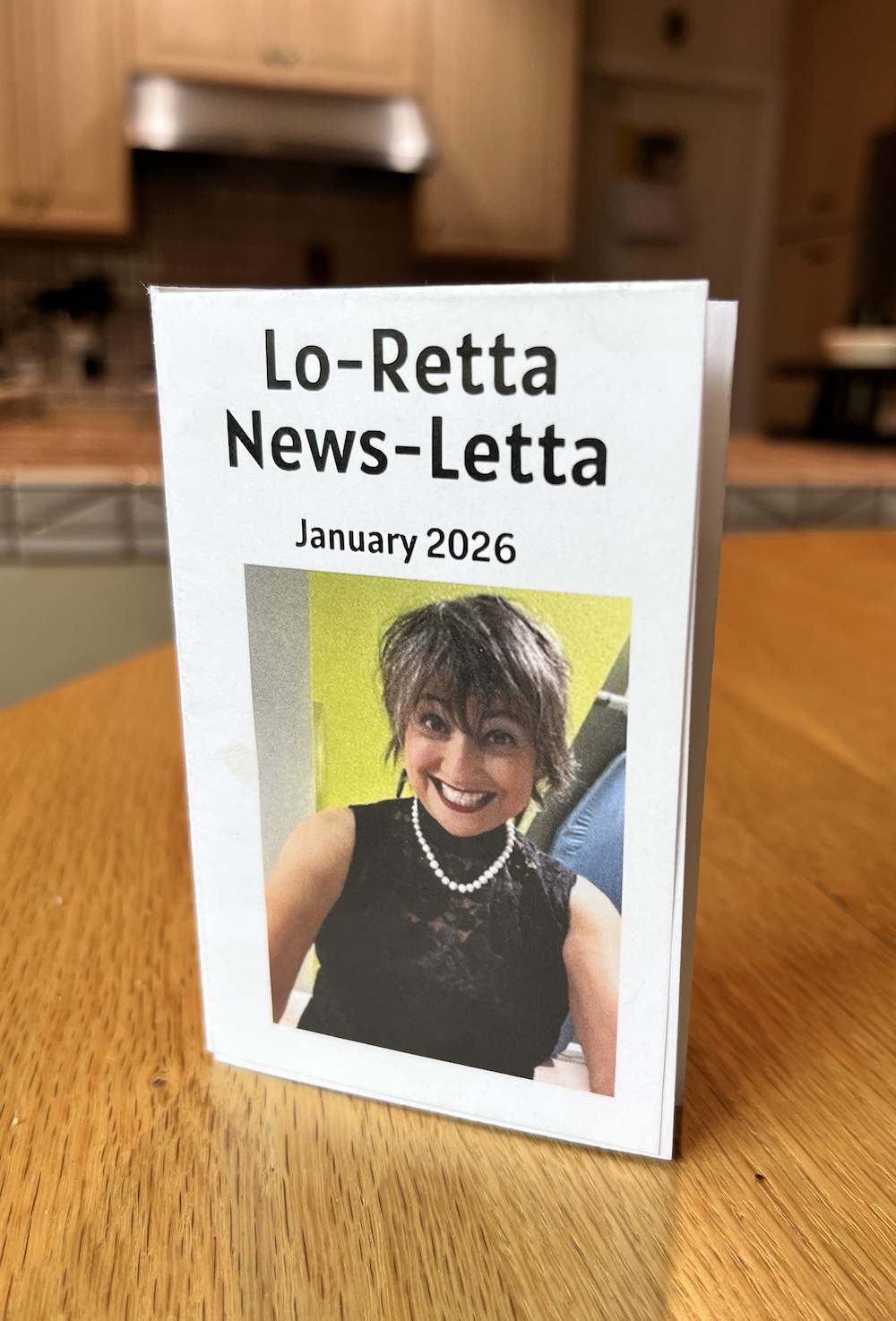
I appreciate ’zines, with their homemade artsy feel. In January our friend Lo sent us a tiny one she’d made, about the size of a hang tag, that was miles above the tired old “What we’ve been up to” family newsletter.

The niche seems to share some DNA with the underground newspapers I enjoyed Back in the Day®. I did a little cartooning for a few of those, and even helped start a short-lived one while wrapping up that B.A. in journalism from the University of Northern Colorado in Greeley.

This may have followed my ouster as cartoonist for the college newspaper following a series of mildly vile attempts to bring Bay Area Rip Off Press-style hijinks to Weld County. My derivative bullshit failed to dollar up on the hoof in cattle country.

And the new venture somehow managed in short order to crawl right up the arse of some student-government numbnuts who threatened a lawsuit over a bit of unpleasantness we’d published.

“Good luck with that,” I said, referring him to our paper’s masthead, in which my dog Jojo was listed as editor. “Not only are you a public figure for the purposes of this story, but my dog is the editor. You’re the only person I can think of who is taking us seriously.”

Still, one longs to be taken seriously. Or at least laughed at for the right reasons. Also, paid. The Revolution was not only untelevised, it was underfunded.

So I left handmade hellraising for “straight” journalism, overstayed my welcome there, and now, here I am, a half century later, comfortably underground again and still waiting on the Revolution.

• • •

Blogging the way I do it has some ’zine-like qualities, I think. But what once was called a “weblog” actually has its roots in “journaling,” another handmade, offline sort of pasatiempo that’s enjoying a comeback of sorts. Though like everything else you can take it digital if you must — your iPhone has had a “Journal” app since 2023.

George suggested I start keeping a journal, and Lord, have I ever kept ’em.

I started keeping a journal in 1974, at the urging of George Gladney, then a reporter at the Colorado Springs Sun. In the Year of Our Lard 2026 I have 15 pounds of them, a cardboard box overflowing with old-school composition books defaced with ballpoint graffiti. And what a ’zine they would make, if anyone could decipher my scribbling (cursive early on, block lettering afterward).

The cops could clear many a cold case on the evidence therein.

“Honey, you’re making a scene!” Herself would exclaim as the John Laws burst through the door.

“No, I’m making a ’zine,” I would quip as the cuffs went on and the flashbulbs popped.

Those bracelets would come off again, and quickly, too, thanks to various statutes of limitations and a general unavailability of surviving/credible witnesses.

And then I could forget about ’zines and get back to the blogging, which I’ve been beavering away at since the Nineties, shortly after I abandoned newspapers for freelancing — basically trading one boss and regular paychecks for several bosses and “It’s in the mail. …” — and thought it might be fun to be my own underground, unpaid, hands-on publisher again, if only as a sideline.

Sadly, my editor Jojo was long gone, and his daughter Fuerte had no interest in journalism.

• • •

In the Nineties scribblers didn’t have to worry about A.I., unless they’d read a lot of science fiction. Some of us were short on intelligence of any sort, artificial or innate. My comp books and Bics got demoted from deep thought to training logs as I acquired a series of Macs, modems, and text editors. I taught myself some basic HTML, paid a rural hosting outfit to house my monstrosity in one of their cages from which it could screech and throw shit at passers-by, and hey presto! A blog.

The rest, as they say, is history, and quite a bit of it. My earliest efforts are lost in cyberspace, but the Archives contain about a quarter-century’s worth of bloggery in various states of decomposition.

What I brought to my little peepshow in the virtual carnival was decades of experience in newspapers and magazines as a reporter, editor, and cartoonist. I turned pro in the journalism racket just as newspapers were stumbling through the transition from hot type — for-reals hot, lines cast in lead by a clanking Linotype machine — to cold type, which meant computers. The times they were a-changin’.

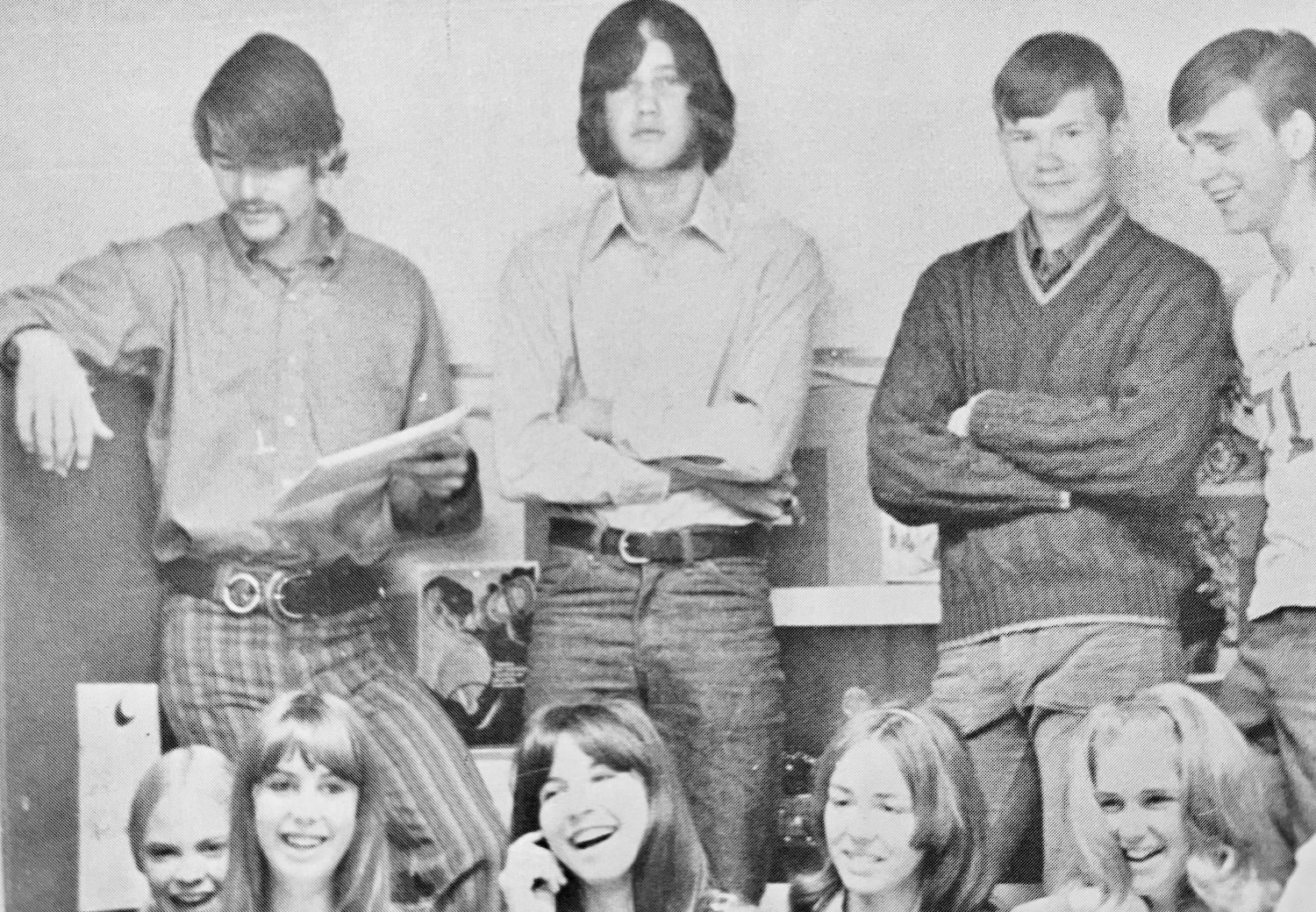
Your Humble Narrator in the Mitchell High School Echelon‘s newsroom, circa 1971.

And once the Internet became A Thing, and those computers evolved from rumbling gods behind locked doors to perky little desktop numbers that anyone could own for the price of a decent used car, they were a-changin’ again. If you wanted to keep your head above water you had to go with the flow.

Which brings us back to the process of creation, and how — for me, at least — it’s changed since I submitted that first cartoon to the Mitchell High School Echelon back in 1971.

• • •

I had only ever been a cartoonist.

Self-taught, of course. A comics junkie from jump. Superman and Batman, Mad magazine, Bill Mauldin, Herblock. I learned that you draw in pencil so you can erase your mistakes, and then try very very hard not to make more mistakes when you finally ink the penciled sketch because then you have to start over. Add ink washes or sticky halftone film to achieve shades of gray; use watercolors or colored pencils to go full Disney.

Luck of the draw.

But mostly I stuck to pencil, eraser, and black ink on paper because (a) I fucked up a ton, and (2) anything that got published was going to be in black and white anyway. Simple.

So I was I. Lord, was I ever.

And one day I found myself hired as a copy boy at the Sun, stripping wire-service copy from the teletypes, walking photos to engraving and page proofs to the copy desk, and waiting to be recognized as the next Pat Oliphant, who was then at The Denver Post.

Shortly after I’d proved competent at the basics the city editor handed me a press release to rewrite.

“But I don’t know how to type.” I said.

“Better learn,” he replied while walking away.

So I learned. My typing style remains unique, three fingers on the left hand and two on the right. Oddly fast, but a thing of beauty it is not; “touch typing” in the sense that each of those five fingers will eventually touch a key. The endless rewrites ordered by the city and/or copy desks were heavy lifting for a rookie scribe who couldn’t even fucking type, pounding away at the keys of a manual typewriter that was probably past retirement age when Damon Runyon was learning the newspaper racket down south at the Pueblo Star.

Nevertheless, I persisted. Learned. And adapted.

• • •

A few years and one B.A. in journalism later I was at the other newspaper in town — not as a cartoonist, but as a reporter — and I was delighted to see computerization finally rear its ugly head. Instead of going 10 rounds with that typewriter I could do a brain-dump into the terminal, then root through the pile and pick out a few shiny objects that might amuse an assistant city editor. If they didn’t, the rewrite would be a lot faster. And they couldn’t wad up my copy and throw it at me anymore.

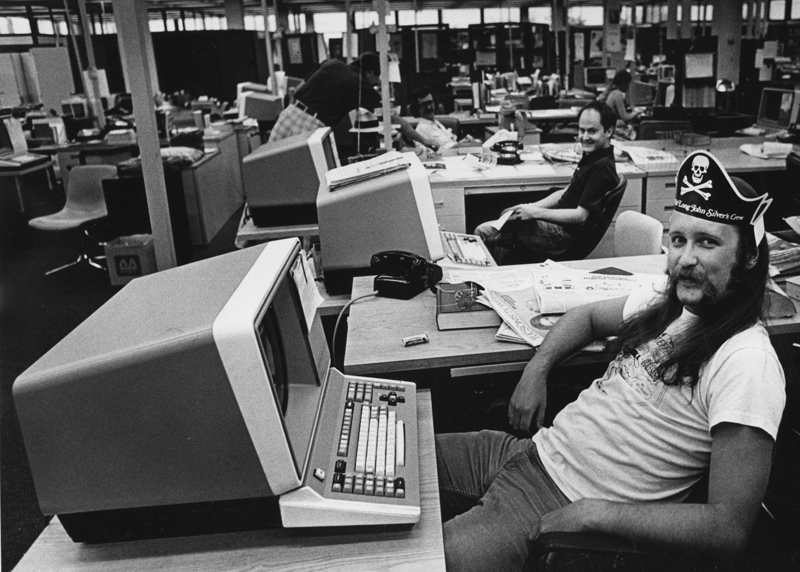
Some of the veteranos in the Gazette Telegraph newsroom were less gung-ho. They would pound out their reports as per usual, on their ancient typewriters, and then with hard copy in hand retype them into their computer terminals as smoke billowed from ears at the city desk. Eventually the typewriters were removed. Some of the typists, too.

Forty-nine years, five newspapers, and countless magazines later I have written and/or drawn on just about everything using whatever was handy: pencils, pens, crayons, and keyboards; comp books, reporter’s notepads, bar napkins, and hotel stationery; manual and electric typewriters, dumb terminals hooked to mainframes, Macs connected to the Internet, and iPhones. Even shithouse walls.

Writing is never easy, because I have read so much of it, by more talented people. But it has become easier, with the advent of computers, and especially the laptop, which liberates you from the desk. Tip over the cranium wherever you are, let its contents spill out onto that solid-state floor, then root around in the pile until you find what you need.

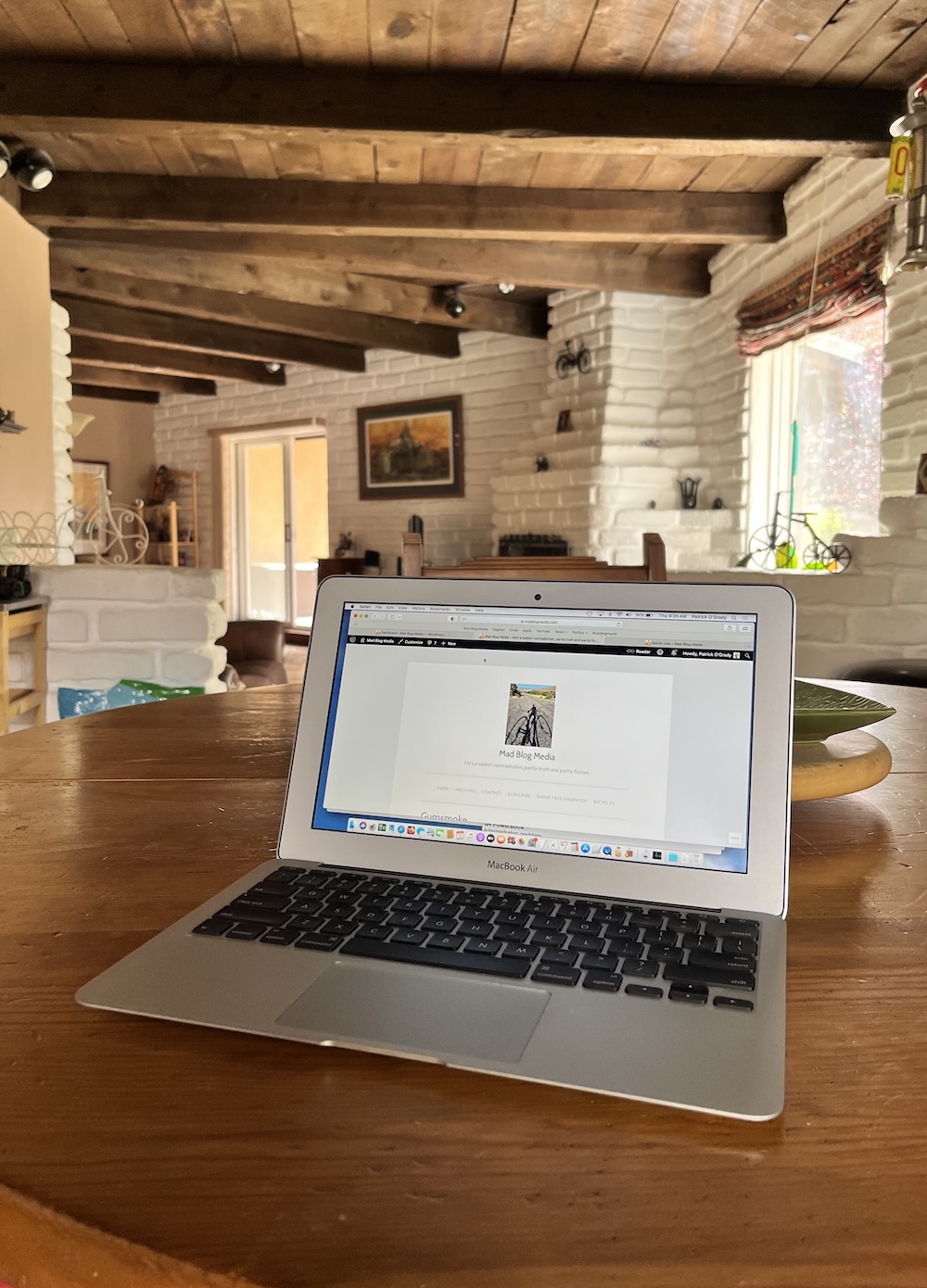
A 14-year-old hammer and chisel: My 2012 MacBook Air.

It should still feel a lot like work. Sweaty, irksome, a daylight-burning, down-the-rabbit-hole time-suck, just one goddamn thing after another. Michelangelo looked at a block of marble and saw David within. But he needed a hammer and chisel to get to him. Got his hands dirty.

I’m no Michelangelo. Just some fool with the brain farts in search of a few perverts who like the smell. Pull my finger! And I’ve tried to choose my tools wisely.

For instance, while I love me some laptop and text editor, I hate spellcheckers and grammar widgets. If I want something looking over my shoulder I’ll get a parrot. I do my own stunts, bub, and I work without a net. Now stand back and watch. Gimme room!

The cartooning got a little involved there for a while, once color became available. I needed a flatbed scanner and a lot of pig-ign’ant careening around in Adobe Photoshop to deliver 300-dpi CMYK images to the masses. But the ideas all came from the same old place (behind the increasingly powerful spectacles), and first sprang to hideous life using the same old tools (paper, pencil, pen, and ink).

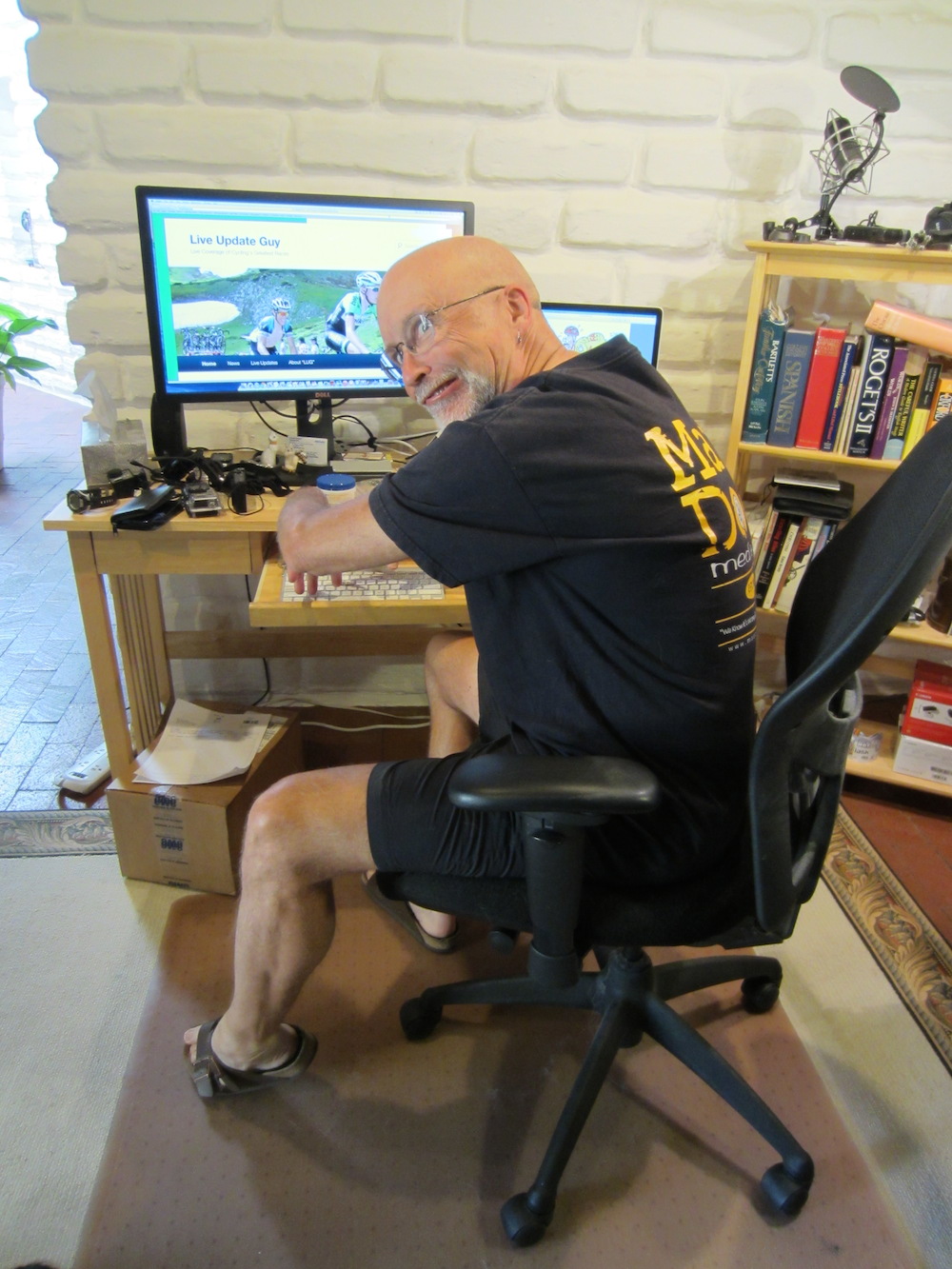
My office in Bisbee, Ariz.

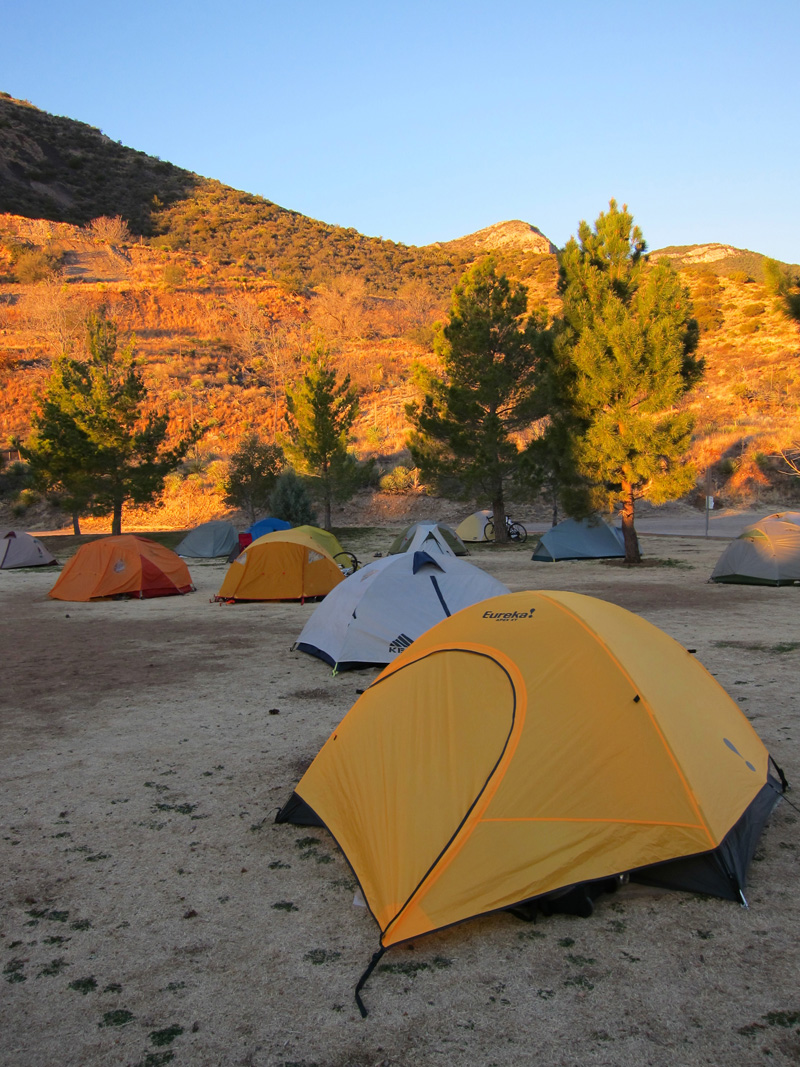
Between you and me, I think the march of progress developed a hitch in its gitalong a few years back. I work on a 14-inch 2024 M4 MacBook Pro now, but it’s no great improvement over my 11-inch MacBook Air, which dates to 2012. Better display, faster processor, yadda yadda yadda. I write a blog using a browser. I could do it with an iPhone from a tent. And I have.

So, if I ever run out of things worth saying, and interesting ways to say them, I won’t acquire some RoombaRite 9000® to hoover up all the words on the Internet and empty its bag into this blog. A.I.? N.O. It’d be like bolting a motor onto one of my Steelman Eurocrosses. Ferrentino and his father got it right: If you can’t lift it, don’t drive it.

No creative sort ever goes it completely alone, of course, unless they have a paper ranch, an ink well, a canvas farm, and a paint horse (har de har har). Find the lever and fulcrum that suit your needs and see if you can move the world. Without breaking it, if you please.

It doesn’t matter how you do the work as long as you do the work.

Fear and loathing in 2024

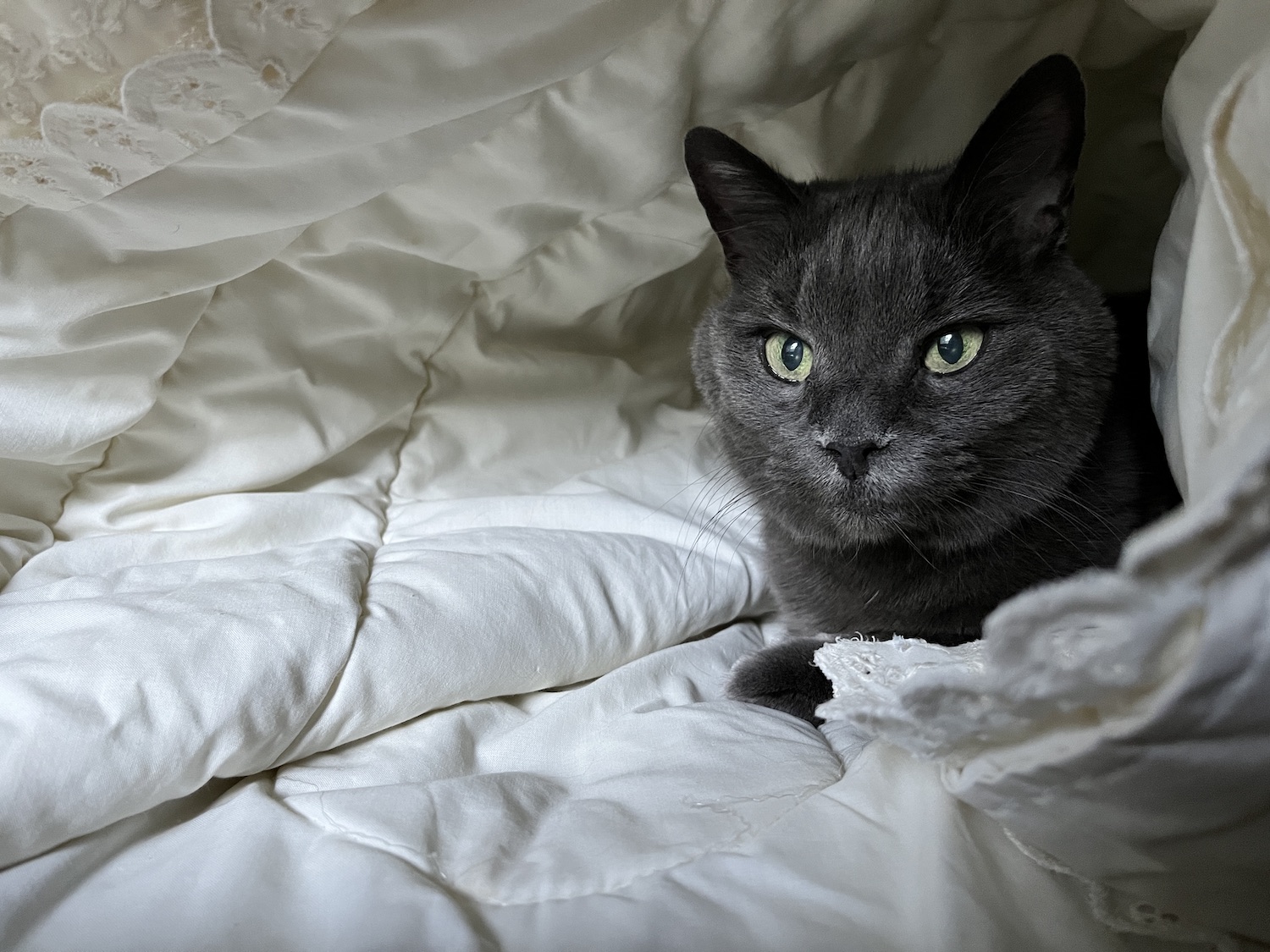
Miss Mia Sopaipilla mans (cats?) the National Affairs Desk in our bedroom.

It was not quite 4:30, and I was not quite up.

I was awake, rolled up in the blankets like a strip of bacon in a breakfast burrito. But I was in no rush to get unwrapped, gnawed on, and shat out by Election Day 2024.

My Gonzo pin, a gift from a friend during my own Gonzo period.

Like Mike’s bankruptcy in “The Sun Also Rises,” it has finally arrived: “Gradually and then suddenly.”

Don’t worry. I haven’t been reading Ernest Hemingway in the run-up to The Big Show. No, I’ve been wallowing in bits of this and that from Dr. Hunter S. Thompson.

The Good Doktor wrote madly about The Edge, until he finally stepped over it. Nineteen years later, dead by suicide, cremated, and shot from a cannon by Johnny Depp, he still has more class — albeit in a certain Hell’s Angels style — and gave more service to his country than many a president.

Writing about the Hell’s Angels in his book of the same name, HST described people like the ones Herself recently saw herding flamboyantly Trump-flagged pickups up and down Tramway, horns honking:

“They are out of the ball game and they know it, (so) they spitefully proclaim exactly where they stand … Instead of losing quietly, one by one, they have banded together with a mindless kind of loyalty and moved outside the (establishment) for good or ill. (That) gives them a power and a purpose that nothing else seems to offer.”

He may have been a bit premature with the second volume of his “Gonzo Papers,” titled “Generation of Swine: Tales of Shame and Degradation in the ’80s.” If he had kicked his dope-soaked alter ego Raoul Duke to the curb and survived to see this generation of swine — HST would be 87 today — he might have looked back on the ’80s with a certain fondness, even longing.

Describing the difference between the ’60s and the ’80s, between the Watergate and Iran-Contra scandals, he wrote:

The criminals in Watergate knew they were guilty and so did everybody else; and when the dust cleared the crooked president was gone and so were all the others. They were criminals and they had the same contempt for the whole concept of democracy that these cheap punks have been strutting every day. …”

Don’t you wonder what he’d have had to say about the 45th president — impeached twice, beaten in his bid for re-election, tried to reverse the defeat with violence and chicanery, obviously insane, declining hourly — and still within a whisker of winning a second term, going two for three? I know I do.

HST mentioned that guy only in passing, as far as I can recall. But he took note of Joe Biden’s first major presidential-election meltdown over a plagiarism scandal at law school in the ’60s. The candidate who hopes to succeed Biden, Vice President Kamala Harris, had won her first election — as San Francisco district attorney — just three years before HST died in 2005.

So, yeah. HST left the party too early for a change, and more’s the pity. He wasn’t always right, and sometimes wasn’t even readable. But when he was on his game the Good Doktor could walk with the King. Or savage him. I can’t think of anyone I’d rather be reading right now as we all tiptoe toward The Edge once again.

Here he is again, quoting John Keats instead of his personal fave, the Book of Revelation:

“Beauty is truth, truth beauty,”—that is all
        Ye know on earth, and all ye need to know.”

Selah.

• Late update: Seems Charlie Pierce had HST on the brain today too.

Labor Day in the rear view

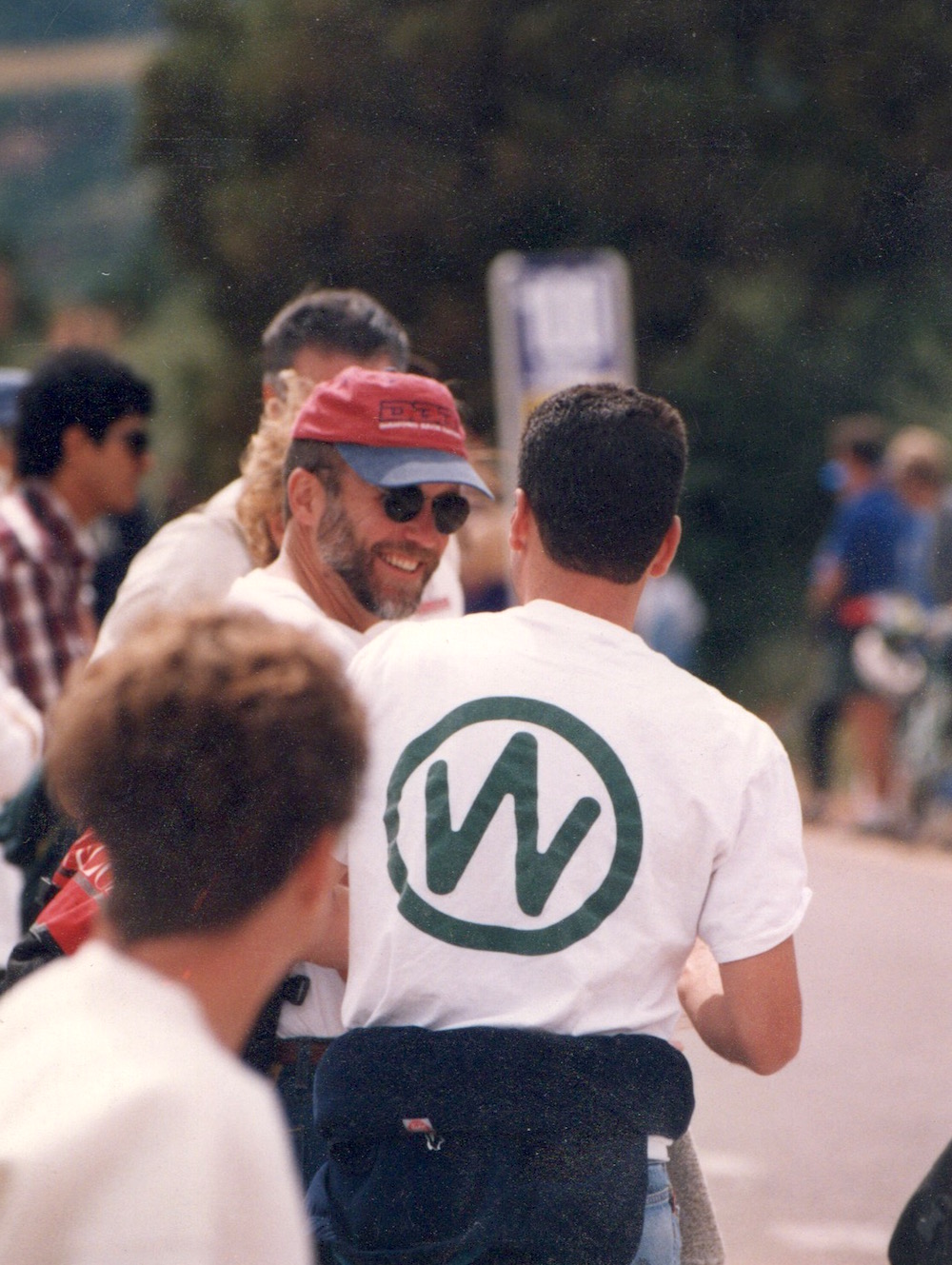
Your Humble Narrator in the salad days, covering a race in Bibleburg.

“Man is so made that he can only find relaxation from one kind of labor by taking up another.” — Anatole France, “The Crime of Sylvestre Bonnard.”

Whenever I think of myself as a “worker” I have to smile.

Oh, sure, I have worked, for short stretches, whenever there was no suitable alternative available. Drug dealer. Janitor. Installer of storm windows and patio covers. Appliance deliveryman. Dishwasher. Schlepper of pizzas and sandwiches.

But I spent the bulk of my worklife scribbling silly-ass pictures and/or arranging words in some particular order with malicious intent, to wit, attempting to convey an idea to an invisible audience.

This is right up there with tagging freeway overpasses and howling at the moon. But it pays slightly better, and mostly you can do it in the shade, sitting down.

There is a game-show quality to journalism. Your team has to collect, confirm, compose, and condense a mind-boggling overabundance of information, then stuff as much of it as possible into a sack that keeps changing size until the buzzer sounds, heralding the start of that night’s press run.

If you beat the clock, you “win” and get to come back tomorrow to play another round.

The word “play” is used deliberately. There were some long hours spent shoveling, to be sure, but they were easy on the lower back and the calluses formed mostly on the mind.

If journalism truly was a game, for me it was the only one in whichever town I was inhabiting at the moment. Composing the first draft of history day in and out in the company of (mostly) like-minded maniacs.

On my third daily and already thinking about jumping ship, arr.

The U.S. Navy used to sell itself by crooning, “It’s not just a job, it’s an adventure.” Journalism’s pitch was that it wasn’t just a job, or even a game, but a Calling — to preach the Gospel daily in the Church of What’s Happening Now (tip of the stingy-brim to Flip Wilson and the Rev. Leroy).

Now, if you think you are Called to preach, you are easy to exploit. And the gods could be  unimpressed and indifferent.

“Fine sermon, Reverend. But that was yesterday. What have you done for Me lately?”

So, yeah. Long hours, and you frequently took the Work home with you. Sometimes it dragged you in early, or on a day off. Often it took you someplace you didn’t want to go, not even for money. Especially when you considered the paucity of coins in your collection plate.

But the Work found me when I was teetering along one of those ragged edges that beckon to oddballs like me. And it kept me in bacon, beans, and beer for nearly 15 years, though I backslid to the edge from time to time.

Living on the edge.

Finally I decided I liked the edge and set up shop nearby. A small chapel, nothing serious. My sermons were unorthodox, but so was the congregation. Same old gods, but hey, whaddaya gonna do? I dodged their lightning and kept that shtick up for 30 years.

Fortune eluded me, but I got all the low-rent fame I could handle, more than I deserved. God’s honest truth? I got lucky. In the right place at the right time, with friends in high places, and more than once, too.

Could a 20-year-old stoner with zero skills wander into the smaller of two daily papers in a medium-size city today and set his wandering feet upon a path that kept him out of jail for nearly a half-century?

Never fucking happen, to coin a phrase. There are no more two-newspaper towns, and damn few newspapers, period. Most are the journalistic equivalent of dollar stores, all owned by the same two or three outfits, all selling the same two-bit expired horseshit. And magazines are following them down the Highway to Hell, which is no longer paved with good intentions.

In 2023 the 20-year-old me couldn’t even go back to selling weed, because that’s just another job now. And you know how I feel about jobs.

I once was lost, but I was found. Can I get a hallelujah?

R.I.P., Barbara Ehrenreich

She took what they were giving ’cause she was working for a living.

Barbara Ehrenreich, the journalist, activist, and author who never lost touch with her working-class roots, has clocked out. She was 81.

Her New York Times obit draws from the introduction to “Nickel and Dimed: On (Not) Getting By in America,” in which she recounts wondering with a magazine editor how the unskilled survive on the wages paid them and then blurting out something that she “had many opportunities to regret: ‘Someone ought to do the old-fashioned kind of journalism — you know, go out there and try it for themselves.'”

Which is exactly what Ehrenreich did, of course, working and living as a waitress, hotel maid, nursing-home aide, and Walmart “associate,” among other things. Then she came back and told us all about it.

And though she would be writing it up, she wasn’t phoning it in:

People knew me as a waitress, a cleaning person, a nursing home aide, or a retail clerk not because I acted like one but because that’s what I was, at least for the time I was with them. In every job, in every place I lived, the work absorbed all my energy and much of my intellect. I wasn’t kidding around. Even though I suspected from the start that the mathematics of wages and rents were working against me, I made a mighty effort to succeed.

She was not, and is not, alone. And in her Evaluation at the end of the book, Ehrenreich proposed that those of us who live in comfort while others barely scrape by should feel not just guilt, but shame.

When someone works for less pay than she can live on — when, for example, she goes hungry so that you can eat more cheaply and conveniently — then she has made a great sacrifice for you, she has made you a gift of some part of her abilities, her health, and her life.

What a gift was Ehrenreich’s life. Peace unto her, her family, friends, and readers.

Green Hills of Albuquerque

Descending Tramway Road to Tramway Boulevard.

Down, down, to Goblin-town, you go, my lad!

Well, not exactly. There’s some gobblin’ at the corner of Tramway Road and Tramway Boulevard, all right, but it involves barbecue at The County Line.

The place smells wonderful when your snotlocker works, which mine mostly does not, thanks to seasonal allergies (oak, cottonwood, juniper, mulberry, grass, etc.).

Between being all boogered up and tweaking my lower back the other day I have been in something of a mood. Maybe watching part one of the Hemingway documentary on PBS last night helped a bit. Wasn’t anyone pulling a couple hundred bits of shrapnel out of my legs in an Italian hospital, and I’ve managed to hang on to my first wife, too. So, yeah, winning, an’ shit.

True, global literary fame has proven elusive, but that’s not exactly a surprise. My agent warned me against titling my debut novel “A Farewell to Arfs.”