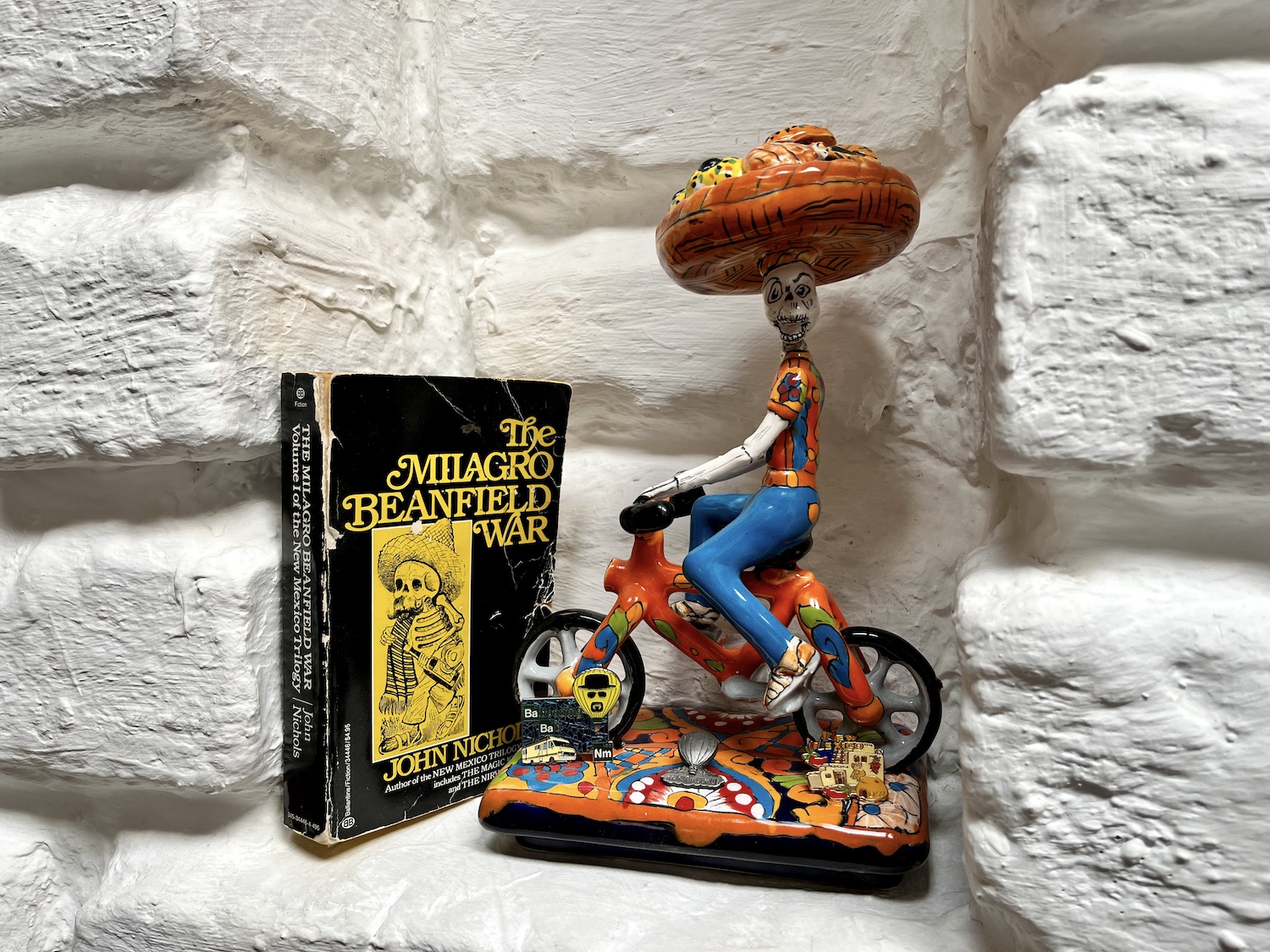
When I bought my first copy of “The Milagro Beanfield War” by John Nichols — I have bought several over the years, replacing copies rumpled, thumbed and dog-eared half to death — the clerk at the Alamosa bookstore confided, “You know, this is about us.”
I bet a lot of people thought that, from Saguache to Socorro. “This is about us.”
The New York Times was not impressed. Reviewer Frederick Busch, himself a writer of novels and short stories, observed: “Nichols’s attempt to make his love for an area and his social concern coincide with his often celebrated sense of humor is doomed by his own always visible hand.”
Well, I never read any of Fred’s work. But I read a shitload of John Nichols. And I always came back to “Milagro.”
It wasn’t a great novel. As an editor I wanted to run through it with a cleaver, dispatching various digressions, superfluous characters, and a general flowery wordiness that must have caused a thesaurus or three to burst into flames from overuse. And the movie was pretty awful.
But “Milagro” gave me my first hint that water was not just something that came out of a faucet whenever and wherever you wanted it. And I met some of its characters — Joe Mondragon, Horsethief Shorty, Amarante Cordova, Charley Bloom — in places like Alamosa, Greeley, Española, Santa Fe, and Albuquerque.
Most of all, I enjoyed their wandering, collective story, in which The Little Guys go toe to toe with The Man. Damn the torpedoes, full speed ahead. ¡Vamanos! They won a battle, but the war continues.
Alas, John Nichols does not. He has gone west after a long illness, according to his family. He was 83.
 Mad Blog Media
As a fabulous writer myself, I believe that many of the best books are those that we think how well we could edit and improve upon them. Perhaps though that is the intent of the writer and the story. To allow us to reflect upon ourselves and better relate with the characters in the stories. To view them as less than perfect needing refinement. I felt that was certainly true with The Milagro Beanfield War. Who was the NYT reviewer again? I already forgot.
Good reading in nirvana Mr. Nichols !
I liked that he wrote about places I knew a little bit; New Mexico and Colorado. So much American literature is focused on what Jim Harrison called “our dream coasts.” It wasn’t always easy to find an engaging writer who liked Flyover Country, and lived there. The NYT hasn’t even figured out that Nichols is gone, so maybe he’s not.
Phill Casaus, editor of The New Mexican, favored “The Magic Journey,” another of the works in Nichols’s “New Mexico trilogy,” the third being “Nirvana Blues.” I enjoyed “Magic Journey” too, though my copy has vanished and not yet been replaced. “Nirvana Blues” was the weakest of the three, I thought.
My buddy Hal likes his nonfiction, and I’ve read some of it. When you think of an outdoorsman and novelist who can also do essays it’s hard to beat Harrison and Thomas McGuane, but Nichols certainly has his spot in that pantheon.
I remember watching the movie in ’88 and just wondering…
I never read the book so there’s future-hope!
The book is much, much better, Hoss. I want to be the immortal pistolero Amarante Córdova when I grow up. Or maybe Onofre Martínez, who lost an arm to butterflies and ever after tipped his hat with an invisible hand. Except to cops. Onofre hated chotas.
Books are like movies, music, paintings, or other works from a creative mind; you never know what will grab and hold you, sometimes for years or a lifetime. Genre doesn’t seem to matter much at first. An example would be “Friday Foaming Rants” in Velonews. Or, another one for me would be “Walking Blues” by Robert Johnson. So, excuse me while I go ride the blinds trying to find a woman with an Elgin movement.
Whah, thankee, pard’. To get a shoutout in the same paragraph with Robert Johnson is an honor indeed. Especially since a flair for casual snark was all I got out of my deal with the Devil at the crossroads.
Well written snark and satire are hard to find these days. So is good music that hasn’t been autotuned, digitally enhanced, and studio engineered to death. How about an encore?
Sad news to start the holiday season.
https://www.bbc.com/news/entertainment-arts-67546785#