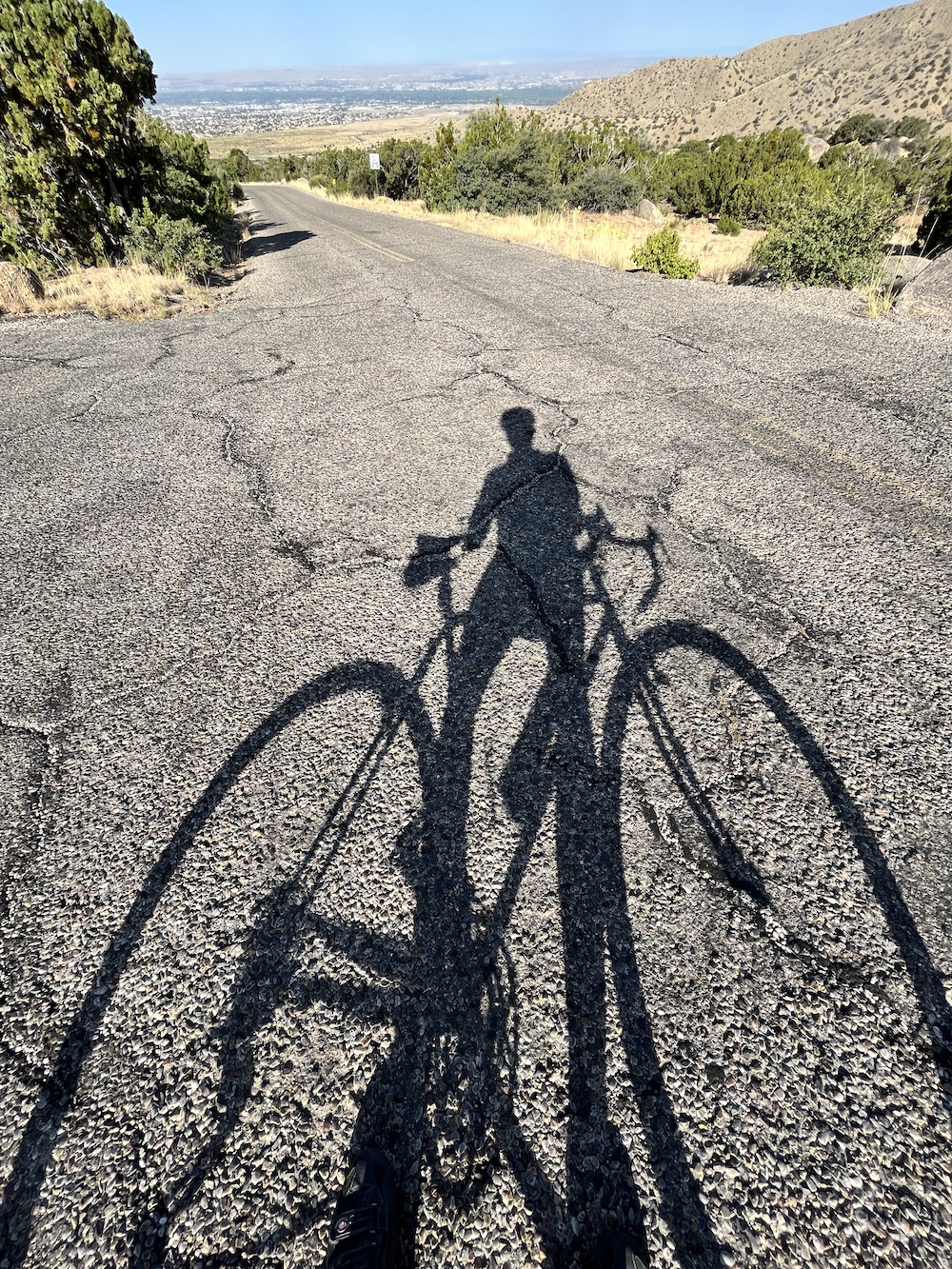
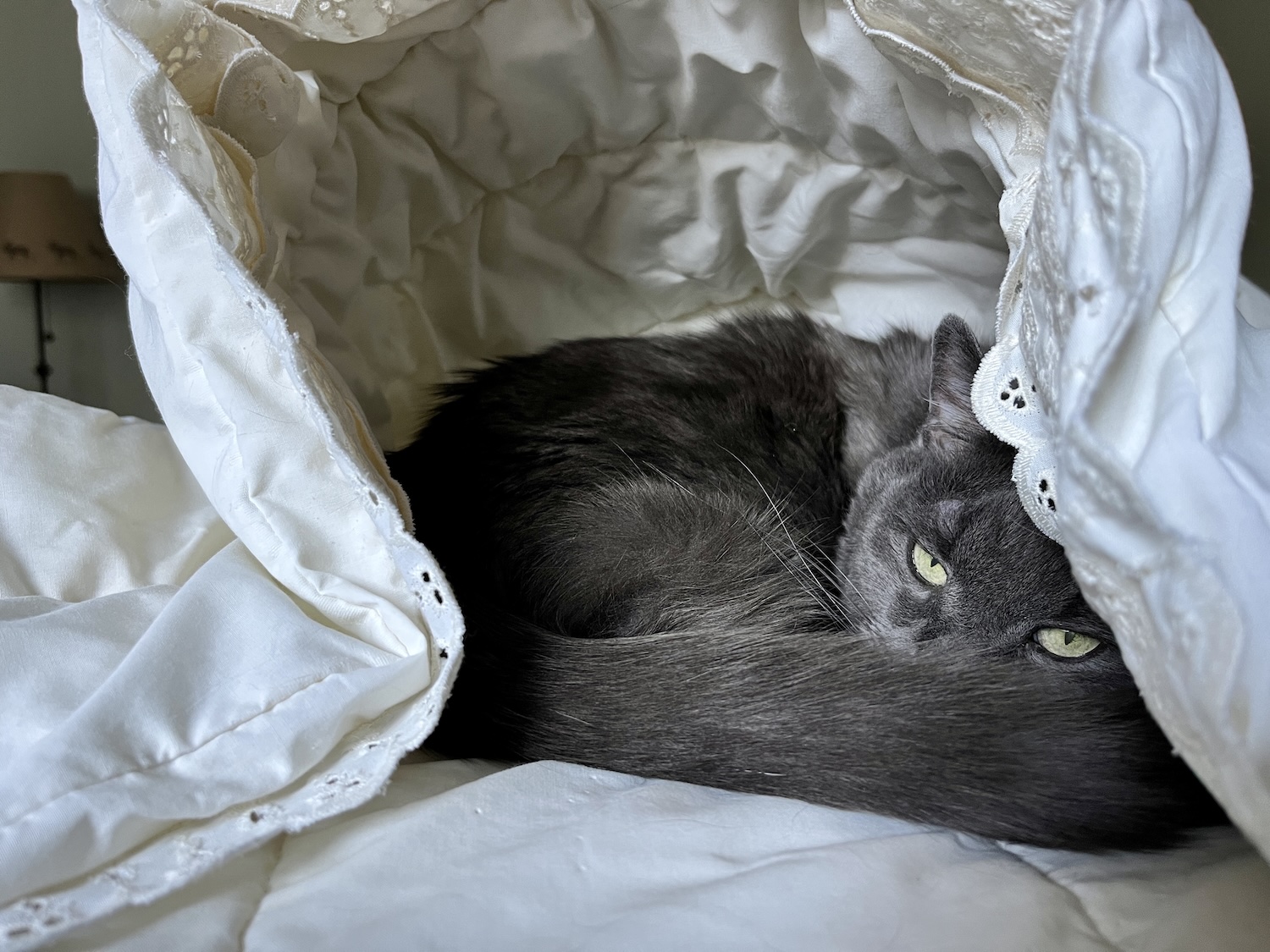
We are not on fire here. Far from it, in fact. Twenty-five degrees and windy at the moment, which is why Her Majesty Miss Mia Sopaipilla is curled up in the Winter Palace.
There was an alarming degree of peachy cloud cover to our west this morning, which in my ignorance I will attribute to secondhand smoke from the Los Angeles fires. Holy hell. The pix look like Dresden after (or maybe during) the Allied bombing.
My fellow velo-scribe Zapata Espinoza is among those whose homes went poof (h/t to the lads at my old shop, Bicycle Retailer and Industry News). A GoFundMe has been set up to help Zap and Xakota in their hour of need.
In all our years together Herself and I have never been in the shit. In the vicinity a time or two, but never to the point of grabbing go-bags and critter kennels and beating feet. We know things will never be the same, but we hope they get better.
 Mad Blog Media
Well said.
And, an appearance by Mia is always a good thing.
Miss Mia’s been enjoying the chilly weather. We get at least one gallivant a day out of her. For no reason at all she just takes it upon herself to rocket around the house, acting the fool like a kitten.
Then she requires an extended nap in her bedcave, of course.
She looks at you sideways with those green eyes like you have owed her money for a long time. Boy, go away; you bother me.
We had to evacuate twice during the Monument fire. We were ready to go, but traffic stopped us the first time for over an hour. We anticipated the command the next time and left the day before the get set call came.
The real question is what they are going to do to prepare for the next time. There will be a next time, just like hurricanes in the gulf. Climate change is accelerating.
Miss Mia gives great stinkeye. She was never intimidated by The Turk, though he was twice her size. She’d lock her ears back in attack position, narrow those green headlights, and jump on his big white ass.
As regards the next time, and there will be a next time, I don’t know what anyone can do. Too many people living in too many indefensible locations and how do you stop them from doing that?
Former Mother Jones blogger Kevin Drum lives in SoCal and has been burning a lot of daylight taking the piss out of armchair firefighters this week. One of his arguments is that nobody ever prepares for the worst disaster ever because (a) it’s a rarity, and (2) getting ready for it costs a metric shit-ton.
Here’s one example:
As far as “grabbing go-bags and critter kennels and beating feet”, been there and done that, as small pieces of burnt tree and ash settled onto the North Mesa house and deck like Ma Nature’s nuclear fallout. Was freakish. I ran around inside and outside the house with the Canon DSLR taking pictures of everything, assuming I might need them for insurance purposes if the place torched. We had 3 big, really old pinons in the back yard, the neighbors had a huge one next door, and we had a big ponderosa in the front yard. Would lash myself to them rather than cut them down.
https://labikes.blogspot.com/2011/06/las-conchas-fire-this-ones-upwind-again.html
Lucky for Bombtowne, the fire people managed to hold a fireline on the last ridge before Los Alamos Canyon, which would have led right into town. But the surrounding mountains still have that crew cut look.
My reading lately is a lot of the damage is in areas where people built into the Wildland-Urban Interface. Couple that with long term drought, human stupidity, and powerful Santa Ana Winds, and Bob’s your uncle.
Sad.
Ma Nature bats last. And the ol’ gal swings a big stick.
Indeed.
I believe with that large of a disaster akin to Paradise, CA, Lahaina, Maui, Jasper, AB, and Fort McMurray, SK to name the most similar ones, there really is no proper disaster preparation against extensive property loss. All of us need to think in turns of emergency evacuation as those of you sages above indicate. High winds and dry conditions in more populated areas is not something that scores of normally capable fire departments can handle. Although very tragic, the information indicated thus far out of Southern California regarding lives lost is hopeful. But that may alter as days go by and more proper resident reporting can be made. Both fires in Paradise and Lahaina resulted in many lives lost.
A cruel economic comment regarding the rebuilding in So Cal is if the next criminal in chief begins his immigration roundup, who will fill the building labor shortage? And I wonder how many of his investment dollars have already been shifted into Home Depot stock.
Dear Leader is already being helpful as per usual, calling the governor “Newscum” and deriding anyone who isn’t His Humble Self as “incompetent.” The old “Only I Can Fix It” song and dance.
The original was bad enough. I could do without the sequel.
Charles Pierce’s newsletter this week was about the 1871 fire that incinerated the town of Peshtigo in Wisconsin, killing at least 1,200 and torching 1.5 million acres. It was overshadowed by the famous Chicago fire, but was a hideous marvel in its own right. He cites the NWS account of the fire:
Even those of us living in Water Wonderland (former license plate slogan) need to consider what even one summer and fall of drought can do to forested areas. Or even those properties previously thought to be nicely landscaped. It can all go up in seconds given the right temperature, winds and lack of rains. I have two huge white pines steps from the house that have enough resin in them to explode into shrapnel. Can’t bring myself to cut em down since they provide kickass shade and habitat for feathered friends.
For reals. I have five gooey pines here at El Rancho Pendejo. They ever get lit up, they’ll look like a squadron of Musk’s Starships taking off.
Read the “Big Burn by Timothy Egan. I live near there and 107 years later there are still scars on the land. The fire burned over 100,,000 acres in less than 24 hours. Thinking we as a society can handle events such as the L.A. conflagration is hubris belonging to the Mutt of Mira Lago. The rest of us just pack for the worst-case scenario and hope whatever Ghost, Goblin, Spirit, or Divine Being hears our pleas, prayers, or lamentations and shows mercy on us. I put stuff in Rubbermaid Roughnecks and my Thule box and look for the way out.
Proper prep for the next one? Good lord, you mean spend money? The Berkeley CA city government has a new fire safety code governing landscaping, and you’d think the world was coming to an end to judge by the reactions of the old hippies. Good governance and civic responsibility goes flying out the window when it’s your ox getting gored.
And the thing that strikes me about all that destruction is that one of big contributors was the wood-frame, asphalt-shingle construction of all the homes. Just one big pile of dry firewood after another. Years ago in another life I worked for a company that manufactures indoor air quality residential equipment. There was a wave of fires that hit the hills above Berkeley, and the aftermath photos were what you’d expect. Streets winding among piles of ash. Except for one, and we got a letter from that homeowner. Seems he figured it was going to happen, so the house construction was fire-resistant siding and roofing, with earthquake-resistant design as well. He evacuated with everyone else, but when he came back the house was intact, and there wasn’t even any smell of smoke in the house (testimonial to the effectiveness of our product). The photo was pretty striking: a perfectly intact house amid widespread black. As soon as they re-ran the power lines his life was back to normal. He had to replant the yard, but he’d been careful there too, so meh.
So will those insurance companies pay extra on the rebuilding for fire-resistant homes? Will those cities enact building codes requiring that for new or re builds? As Patrick would say (and I hope I get this right), “Ho and Hee, and also the Hah”.
I recall seeing a photo many years ago of a long standing home in a fire ravaged area in Calif. I thought the home was constructed of concrete. Perhaps it was a similar circumstance where the homeowner thought into the future when the next big fire will come through.
I agree about the idea of rebuilding with the same fire-ready materials. Maybe what will happen will be a large investment in 3D printed concrete homes.
Does anybody have knowledge of how well stucco coated hay bale homes fare in fires?
Well, I dunno what it means, exactly, but according to The New York Times the governor has issued an executive order intended to make rebuilding easier by directing state agencies “to coordinate with local governments to remove or expedite permitting and approval processes during rebuilding.”
Adds the NYT: “The order is likely to be the first of several permit-streamlining measures issued by state, county and city agencies in the wake of the devastating fires across greater Los Angeles.”
When I think of “streamlining” I hear people yelling “Fuck the deets, Sparky, we got enough people living under bridges as it is. I don’t care if he’s building with cardboard and Kleenex. Stamp it ‘APPROVED’ and drive on.”
Patrick, Well, we’ll see. I read the article, and it kind of makes sense. California is more of a stickler than most states about building construction not making environmental issues worse. Good example is that you can’t just pave your new parking lot without devoting a part of the property to a catchbasin, so the heavy rainstorm doesn’t immediately just dump into the nearby river and contribute to flash flooding. California is reeeaaall picky. So in that sense the Guv’s move looks totally helpful. Not sure that it will help residential reconstruction, but it can’t hurt, and may clear busybody local agencies out of the way. I don’t see it doing much to fireproof the next round of buildings.
You’d think that insurance companies would lead the way on this. Do they really want to keep paying out massive claims periodically? They’ve led before. Look at your table lamp and you’ll see the UL sticker on it somewhere. That came about because the insurance companies put their foot down and said they wouldn’t pay claims resulting from faulty home thingies catching a house on fire, and UL came into existence to certify that the thingy wasn’t faulty. Result? Fewer houses catching on fire. More profits for insurance companies without screwing the consumer (hear that UnitedHealth?).
Where is the next Usonian home designed for dry fire-prone areas? Maybe it’s there already. Maybe UL should certify home designs.
It would be interesting to hear from my man Chris Coursey, who’s been a journo/elected official in Santa Rosa/Sonoma County since forever. He’s dealt with this natural-disaster shit up close and personal.
You’d think the insurance companies and construction industry would’ve put their pointy little heads together on this a long time ago. Maybe the hard hats like building new houses for everyone every few years, but I’ll bet the suits hate paying for it.
One thing we learned, and I’m sure many who tried to evacuate the LA fires
also learned, is that the roads and traffic signals are not designed to handle an immediate and large number of cars evacuating a fire. Especially, as in our case, where the fire has closed some evacuation routes. We had only one way out; the other exit road was closed by the fire. It took us 45 minutes to go 1/2 mile. The second time they said prepare for evacuation, we were gone 10 minutes after the notice.
Right. I’ve visited the areas affected by the L.A. fires and couldn’t understand how people managed to get from point A to B when the place wasn’t on fire. And I’ve read that Pacific Palisades was particularly ill-equipped for a quick getaway.
I’ve written before about our shack on the slope outside Weirdcliffe in CrustyTucky, Colo. One way in and out, a private road, 430-some vertical feet in a twisting, turning mile of dirt lined with trees and shrubs. Jaysis H., etc. I slid backwards and into the ditch on that thing in 4WD one lovely winter evening. The tow truck driver thought it was amusing until he was in the ditch too.
The 43-acre property came equipped with a nice natural “chimney” that could have channeled a fire from the county road across our meadow and straight up the hill to our propane tank. Good thinking there. Maybe not.
After watching the Iron Mountain fire from a safe distance in 2002, I scouted a back way out to the Operation Uplift road, and it probably would’ve worked, if we were lucky and I didn’t roll the truck in low-range 4WD. But it would’ve taken forever and only put us a couple miles up the county road. Fire doesn’t care that you can’t drive fast, especially when there are lots of trees to eat.
The Waldo Canyon fire in Bibleburg back in 2012 was a real eye-opener. Not a lot of escape routes from that one, either, for the folks in Manitou Springs, Mountain Shadows, and the Air Force Academy.
Here in Duck!burg we are a little less heavily treed, and fairly close to Interstates 40 and 25. But man, Tramway would be an experience in red-alert conditions. On a good day it’s basically Death Race 2000 out there.
A rather dystopian view from one of my friends about the future. “Those still around in 20 years will be living in bunkers anyway. Who care what the building codes are now? If the Trumpers don’t shoot ya, or Hurricane Fuckall doesn’t get ya, the next tornado, typhoon or nuke attack will.” He also thinks we should stop calling them wildfires and go by his acronym “WUDA” as in “wake up dumb ass”. Sigh…leave it to an ex military man to rewrite the dictionary….he’s gotta a million of em. Damn, now where did I put those bunker building plans I saw in that prepper newsletter? Summer will be here before you know it along with WUDA’s galore.
Could, WUDA, shoulda … shit, I think we got a T-shirt here. Some people won’t get the joke but some people never do.