I beg to urge you, everyone:
life-and-death is a grave matter,
all things pass quickly away;
each of us must be completely alert:
never neglectful, never indulgent.
—The evening message of sesshin at the Diamond Sangha, from “Taking the Path of Zen,” by Roshi Robert Aitken
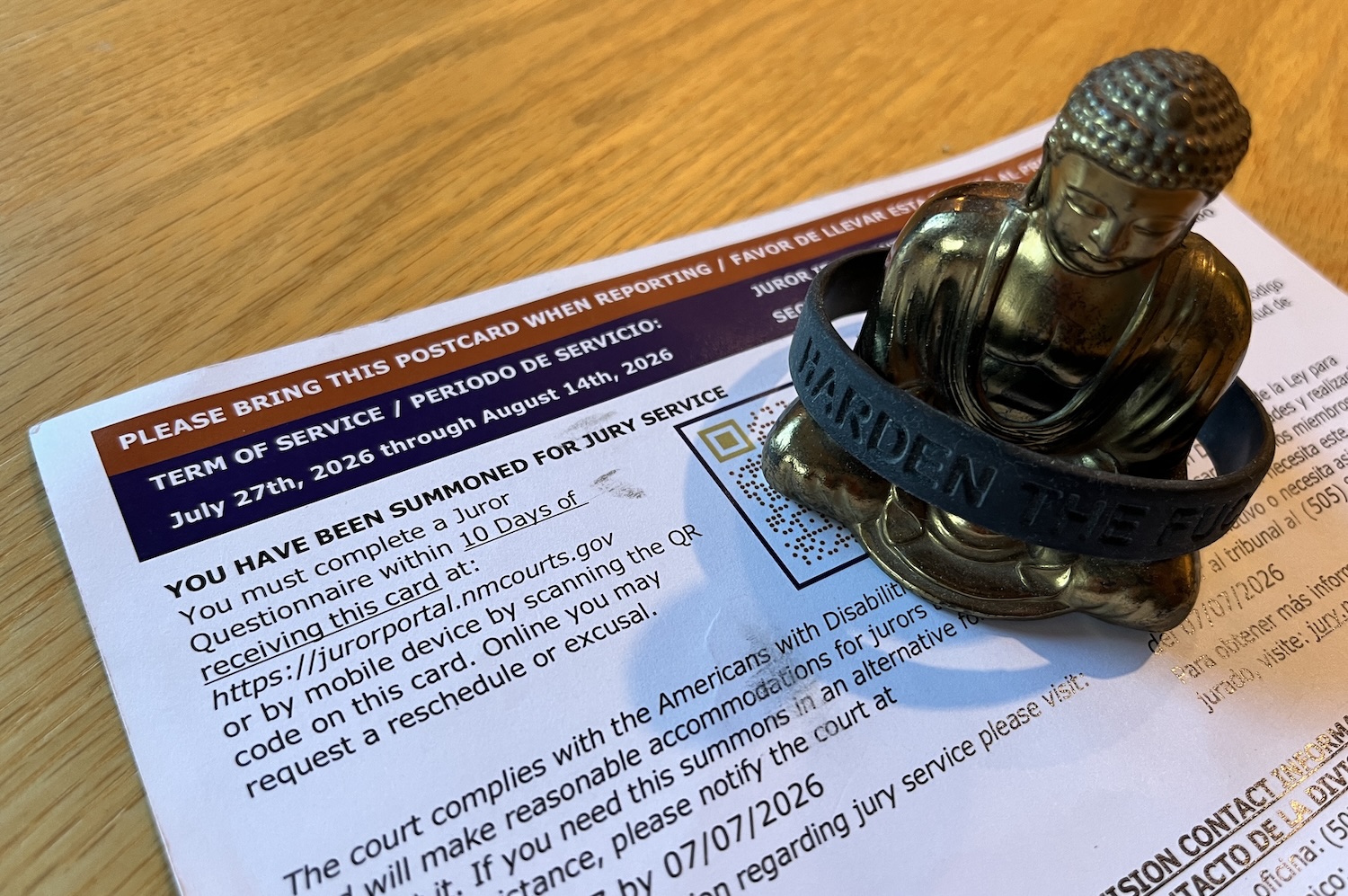
Well, they finally caught me.
Not the cops. The court.
Specifically, the Second Judicial District Court, which needed a few good people — more than a few, actually — to help them resolve a number of pressing legal matters on what one court staffer last week called “a typical busy Monday.”
I thought voir dire would put me back on the streets with all possible speed, for reasons obvious to readers of this blog. When the lawyers started asking if anyone present had ever been in a car crash I opened with getting hit by a train when I was 20. I have other, lesser tales, and usually save getting creamed by an 81-car, 7,000-ton Burlington Northern for the closer, which, frankly, I thought it would be.
“All right, I’m out of time — thanks for coming out, everybody, you’ve been a wonderful audience!”
But the number of pressing legal matters was high and the bar for jury service low and I got yanked over it and into a jury box.
• • •
I won’t tell you I was eager to serve, but I was curious, because the case was auto vs. two-wheeler. Reckless driving resulting in death. If the defendant were found not guilty of the top charge, the jury would consider a descending series of lesser charges.
Our jury seemed a well-chosen crew. Two of us had owned Vespas, a third rode some lesser scooter, and at least one was a motorcyclist. Three or four of us also bicycled, on asphalt, dirt, and gravel. I assume we were all motorists. One was a freshly minted driver who’d only been prowling the mean streets of The Duck! City for a few months. We were old, young, and in between; white collar, blue collar, retired; brown, white, black; men and women.
As the lawyers did their thrust-and-parry thing, questioning eyewitnesses, police officers, crash reconstructionists, and a medical examiner, it seemed clear why the state felt comfortable going to trial. Even the defense conceded that their client was speeding in the center lane, ran a red light, struck the two-wheeler, and its rider died. The state’s case made a bathysphere look like a $2 Walmart tea ball.
I’ll spare you the gory deets. And while I doubt The Algorithm will splash this bush-league blog post far and wide across the Innertubes, for reasons that will be made clear I’m not going to give chapter and verse of the facts in the case. Speeding, ran the red, someone died. Pretty basic stuff.
• • •
Anyone who’s spent any time in court knows it lacks the polish of the TV shows. Attorneys fumble for words and thumb through reams of paper. The technology is temperamental. Witnesses can be confused or combative. Questions you might have raised as lawman or lawyer go unasked.
The burden of establishing proof of guilt beyond a reasonable doubt lay with the state, the judge reminded us, and toward that end the prosecutors supplied the bulk of the witnesses, along with surveillance video from two businesses near the scene of the crash; police lapel-cam footage with audio; audio from a 911 call; information downloaded from the auto’s airbag-control module (event data recorder); and stills of the scene, crash debris, both vehicles, and “the decedent,” as the defense insisted the crash victim be called.
The defense insisted upon a number of things, among them their client’s actions after the crash. The defendant did not flee the scene; wasn’t argumentative when interviewed by police; and did not try to foist responsibility for the crash onto “the decedent.”
The defendant’s attorneys, focused on reasonable doubt, were less generous in that regard. The strategy seemed to be, “If it were not for this rando rocking the two-wheeler we wouldn’t even be here, wasting everyone’s valuable time.”
• • •
The usual hokum ensued. Did the two-wheeler make an improper right turn while exiting a gas station, entering the center lane rather than the curb lane? Possibly, but there was no concrete evidence of this; the rider may have entered the curb lane and then moved left to the center.
Was the rider’s helmet properly secured? This hoary old trope, decades past its sell-by date, is lifted straight from the F1 key on any lazy cop-shop reporter’s computer keyboard: (tap) “The victim was not wearing a helmet.”
That helmet? It was a full-face model. Could it have prevented the rider from hearing the defendant’s vehicle as it accelerated through the red light? If you are sensing a theme here, it is that when it comes to helmets, you are damned if you wear one and damned if you don’t.
Footage from the gas station’s surveillance camera showed rider and two-wheeler as they actually were at the time: bright colors, tail light and headlight, helmet. And when leaving the pump for the pavement, it appeared that the rider glanced left, possibly to check for oncoming vehicles.
• • •
That was just the sound check. Next, the rock ’n’ roll.
The defense argued that it made sense in terms of safety for their client to run the light. The defendant, already a few minutes late for work, was speeding, after all; it would’ve been impossible to stop before entering the intersection. Traffic at that hour was light, no other vehicles had begun crossing under the green, and the center lane ahead seemed free of any and all obstructions.
Further, once it became evident that such was not the case, it appeared that their client tried to avoid the collision, coming off the gas, braking, and steering slightly to the left. But it was too late. The impact destroyed the two-wheeler and hurled its rider up the road, with helmet ripped off. The rider sustained a number of severe injuries and died at the scene.
That’s pretty much it. The disputants rested their respective cases, then delivered closing statements. And the judge sent us off to the jury room.
• • •
It seemed clear to me that the defendant’s decision to put foot through firewall and run the red was the first and most important link in the grim chain of events that followed. It was reckless. The judge’s instructions regarding the law and how we must proceed were complex, but we muddled through, and after we picked a foreperson and discussed areas of concern a few jurors who had been on the fence picked a side. Guilty as charged. The vote needed to be unanimous.
It was not.
The defense had found the one weak link in our chain. The magic words that broke it were “reasonable doubt.”
Several of us tried to bring our lone holdout around but it was fruitless. Our foreperson reported the deadlock to the judge, who gave us more time to deliberate. Heels remained dug in. Not even a solid alternate-universe hypothetical from a juror with a strong schoolteacherish vibe could prevail. It went something like this:
What if the defendant had not been speeding? Then it would’ve been possible to stop for the red light. The rider of the two-wheeler would have turned from the gas station into the road without incident and shortly thereafter would have been sitting in a café somewhere, eating a breakfast burrito. The motorist would have been a few more minutes late for work.
No sale. We remained at 11-1.
Once again the judge asked us, one by one, whether more time for deliberation might help us reach a unanimous verdict.
No, your honor.
And that was that. Dismissed.
• • •
As a junior-varsity cartoonist and columnist I grew accustomed to seeing my arguments dismissed. Not everyone was buying what I was selling.
I try to be a tough customer myself, but I’ve been played often enough to know that refreshing breeze cooling my nether regions means my pants are puddled around my ankles again. About three times out of five, if I’m on form and the wind is right, I can I.D. bullshit if I catch a good, strong whiff of it. And in that courtroom I smelled it coming from the defense. Eleven people agreed; one did not. That’s all it took.
Could/should our holdout have avoided jury service through a more vigorous winnowing process or by pleading extenuating circumstances and requesting a rescheduling or excusal? Maybe. The doubt seemed unreasonable, more emotional than intellectual. But what it seemed like to me was irrelevant. Move to strike, your honor. …
• • •
As a young reporter I was dragooned into covering a water-board meeting. The information was made available and I couldn’t for the life of me make any sense of it. The editor was not amused. Was I a poor choice for the task? Could I have declined the assignment, or tried harder? Yes, yes, and yes. In any event, somebody had to do it and it was my turn in the barrel.
As it happened, another reporter was able to cobble together the story I could not write. Journalism is a team sport.
And, as it turns out, so is the law. It’s my understanding that a new trial has already been scheduled and a new jury will be selected. Maybe I’ll go back as a spectator, if there’s nothing good on TV.


Jesus wept. As a motorcyclist, I could feel my gut twisting in a knot as I read through the last part of this narrative. And speaking of a water-board, I think that holdout juror should have been water boarded until he/she/it changed its mind.
It was a sad tale. A long four days. I like to let what remains of my mind off its leash to run around sniffing at this, and rolling in that, but it wasn’t in the job description.
The judge said these trial lawyers are up to their eyeballs, and I believe it, because they were picking juries for three criminal cases last Monday. And of course the John Laws are likewise.
Would more surveillance video from other cameras helped sway our holdout? A picture’s worth a thousand words and a video packs an even bigger punch. But we only got two perspectives and just one was solid.
As a motorcyclist (and bicyclist) you know exactly how that deal went down without having to be on the scene or in the jury box.
Well written. And thanks for serving.
Thank you, sir. That is the third or fourth iteration of the post, and the final version went through 25 revisions. I’ve been working on it since I got home from court on Thursday.
I’m glad to have finally done my bit. It got me out of my routine — I ignored the news of the state, nation, and world for a solid week — and I feel like I learned a thing or two. But it was a long four days.
As an aside, Herself tipped me to a good piece about jury duty in the latest David Sedaris book, “The Land and Its People.” The essay is called, “Yes, Vote.”
I was on a jury in a civil trial once. To make this bike related, It was Jan/Feb in Connecticut and obviously cold, but I rode my bike to the courthouse the twenty miles one way every day for three weeks! This was pre- 9/11 and once I was noticed, I was able to bring my bike into the same entrance where the judges entered, and they let me keep it in a storage room. I even took the same elevator, me in cycling garb and them in suits! That would not happen today.
Anyway, I felt the deliberations were a sham. We had a bunch of dolts who would rather chit-chat and complete the Word Jumble instead of deliberate meanwhile the lawyers were racking up billable time waiting for us. I was the lone hold out until I rationalized into the majority’s way of thinking and caved. I still think I was wrong. Leaving the courthouse on my bike, one party’s lawyer passed by, rolled down his window, and said thanks! A few weeks later I received a letter from one party’s lawyer telling me part of the verdict was set aside with the judge determining the jury likely came to a hasty decision because we had been deliberating for a week and came to a consensus on a Friday. I wrote back to the lawyer explaining otherwise.
We got thanked too, despite our failure to deliver. The judge dropped into the jury room for a quick chat, and the prosecutors buttonholed a few of us as we left the elevators, headed for the exit. They asked for a critique and a little insight into our thinking. Neither judge nor prosecutors seemed defeated; quite the opposite.
The defense attorneys? Never saw ’em again.
Court staff was pro. Everyone from the security dudes doing the TSA-style screening at the front door to the jury wranglers to the bailiff seemed to be on the same page: “Let’s see if we can deliver a little justice here today.”
Thank you for the narrative and your service. I suspect that you make a very good juror, citizen O’Grady. You touched very well on the difficulty of courtroom law. I’m not sure without knowing all the evidence that you were presented with, what decision I would have concluded, but it is likely I would have found the defendant guilty. I’m a past speeder and hold a very high standard to the responsibility that one who is breaking that barrier must adhere to. A person that speeds and is attempting to slip through a light that is turning red, and those actions then cause a person to lose their life, that person is guilty and should face the consequences for the rest of their life.
I am a little confused about your mention of 11-1, and then indicated “ten people agreed, and one did not.” What am I missing?
Gracias, hombre. After I got clipped by that train I logged about four years’ worth of walking, cycling and bumming rides. Collected a careless-driving rap and “failure to yield” because, well, duh; lost my license on points (previously having run a red during a right turn); and couldn’t get it back after my time was up because nobody would insure me. Imagine that!
I did a lot of stupid shit behind the wheel once I reclaimed my ticket to ride, but in my geezerhood I’m mostly responsible, obeying speed limits, road signs, and the gentler Voices in my head, which are greatly outnumbered by the other sort.
Good point on the 11-1/10-1 thing. It was a 12-person jury, but with the 10-1 bit I was suggesting that 10 people agreed with me and one did not. This is hubris, of course. You’d have trouble finding 10 people who agreed with me on anything in the entire state of New Mexico and possibly throughout the desert Southwest. Maybe Colorado too.
I should probably be less cutesy* there.
* Revision applied.
I’ve been on four juries in my life (they say reporters don’t get on juries, but they lie). Twice was an alternate, and my agreement with the final verdicts was 50-50. Twice I was foreman, and my agreement with the final verdicts was 50-50.
Twelve people in a room. Twelve lives experienced. Instructions from a judge that all sound equally important, but should all be taken with a grain of salt when compared with common sense.
Bottom line: Your participation matters. A lot of privileged white people find a way to exclude themselves. The system can suck, but it’s the best one we’ve got for now.
I was really impressed by my fellow jurors, especially the younger ones. One of the kids was foreperson, and another posed some of the most pointed questions and could do big picture and down in the weeds.
The stern schoolteacherish person may have been our senior member and was sharp as a tack.
There was no hollering, which was cool. Discussion was measured and respectful. And when we weren’t on the clock we found plenty to talk about, from mutual interests to unique pasatiempos.
Finally, there was a shared sense of tragedy, as in: “Wow. Lotta people’s lives took a sharp turn to Bummerville here.” Shit rolls downhill, and there’s always someone living in the valley.
• P.S.: Thanks for all the rides Back in the Day®.
Well, maybe I won’t plead old age if summoned.
As I said, I wasn’t thrilled about getting pulled in, selected, and then assigned to a case. I’m often selfish and I like my long-established routines.
But the case involved something I have to think about constantly: Is today the day I get executed for the crime of Being in the Way?
So I guess you could say I got lucky. Unlike “the decedent.”
And even though we failed to reach a verdict, some good came out of it all. I asked my fellow jurors if what we’d heard and seen made them rethink how they drive, and most agreed that it had.
And Herself has promised to turn into the curb lane when making a right. She’s been known to swing wide, just like everyone else here in The Duck! City. Swear to Dog, you gotta keep your head on a swivel around here. My motto, whether on four wheels or two, or even just burning shoe leather, is “Everyone is trying to kill me.”
Yep, a little over 6 years ago, after the Santa Fe ride, the fear began to outweigh the pleasure of riding.
I am starting to think, in my advanced decrepitude, if I want to give a week to the legal system or be face to face with the worst of humanity. But if the donvict is in the dock, I would answer the call of duty.
It’s not as though the situation is going to get any better. Worse is more likely.
Look at all the additional hazards that have come into play over the past few years. Inside the vehicles, screens instead of knobs and buttons. Outside, everything from e-minibikes to standup scooters. I saw an eejit on one of those standup scoots blast through a solid-red light the other day. If you’re in such a rush to die, why not just stay home and shoot yourself instead of ruining some other poor sod’s day, along with his grille and windshield?
The Stupid is strong out there. Herself and I were on a quail ride Saturday and saw this putz on a moto pop a sloppy wheelie on Tramway and nearly fall right the fuck over. I’m thinking: “Go ahead on, son, Hell ain’t half full. Just do it where I’m not compelled to watch.”
Was on my one and only jury trial years back. Two kids were sorta drag racing and goofing around at high speed in separate cars. Car A more or less forced Car B off the road and into a tree killing the driver. The prosecutor brought up murder chargers along with many others on the driver of Car A. Turns out they were close buddies and school mates. It took awhile but we the jury finally let the kid off from the murder charges and nailed him with enough others to lose his license and be on probation for a good while. As no drinking was involved and driver of Car A cried throughout the trial, we figured he would have to live with it forever and so why pile on.
Justice tempered with mercy. Well done indeed. Something like that would indeed take up residence in a fella’s head.
Nice write-up, Mr O’G, thanks. Any thoughts you’d care to share on why the one juror held out? Reasonable doubt, based on what, specifically? Any apparent bias?
The blockage seemed emotional rather than rational, Eric. During voir dire a number of potential jurors found off-ramps and took them; in one case, the judge asked a candidate with a sensitivity to graphic imagery if she would feel more comfortable on some other jury. That would’ve been an excellent time for our holdout to speak up and hope for a lighter burden.
POG thanks of course for your service and scribbles. Right of way is determined by velocity and tonnage. Keep up the great work! Look forward to the next installment, always. Love from WNC.
Clyde, y’old pointer. How’s life its ownself up there where the hoot owls court the chickens?
Our boy Furry has been doin’ the bidness over to NSMB, yeah? That dude goes deep.